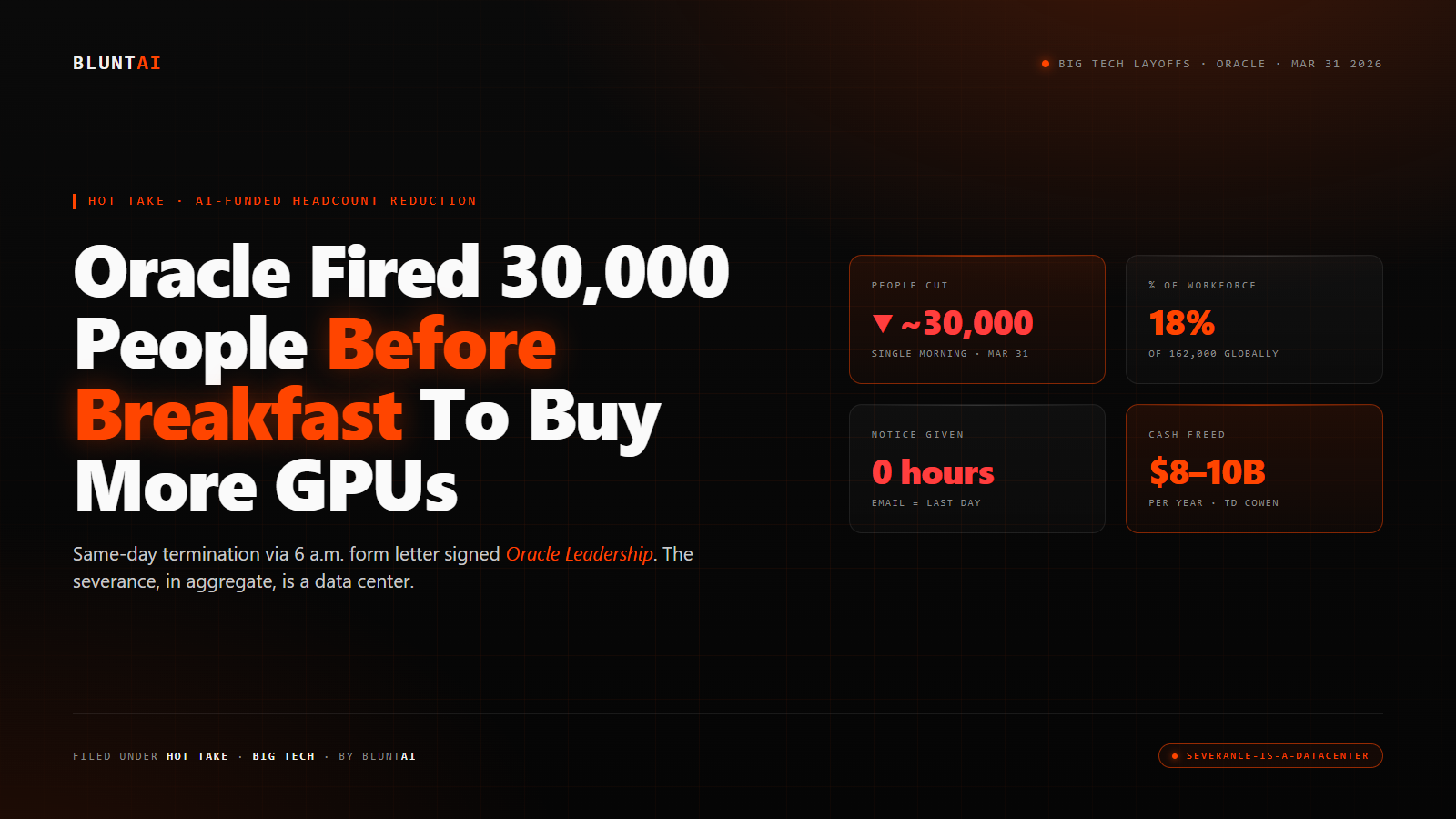
Oracle Fired 30,000 People Before Breakfast To Buy More GPUs
The email hit inboxes at 6 a.m. local time. United States, India, Canada, Mexico — whatever side of the planet you woke up on, if you worked at Oracle on March 31, 2026, there was a roughly one-in-five chance the first thing you read that morning was a form letter from “Oracle Leadership” informing you that your role had been eliminated due to “current business needs” and that Tuesday — the day you were reading the email — was your last.
Not your two-week notice. Not your transition period. Your last day. Enjoy your cereal.
Between 20,000 and 30,000 people received that message. Nobody outside Oracle’s C-suite knows the exact number because the company did not issue a press release or a regulatory filing; the head count dropped silently in the company Slack over the course of a morning. Employees watched it in real time. One Reddit thread pinned the count at roughly 165,000 users before the email wave and 155,000 a few hours later. Ten thousand names, gone, from one scroll of a user list. If you are looking for a single image that captures what the AI boom is actually doing to this industry, that’s a strong contender.
I want to walk through what happened here and why, because the numbers are ugly, the message is uglier, and the cynical read is probably the correct one.
The severance is a data center
Oracle is in the middle of the largest capital-expenditure binge in its forty-year history. Over the next several years the company has committed roughly $56 billion in AI data center spending — GPU farms, power contracts, NVIDIA allocations, the full Stargate-adjacent infrastructure stack. The problem, as every analyst who has looked at Oracle’s balance sheet has pointed out, is that Oracle’s balance sheet cannot comfortably sustain that kind of outlay. The cash has to come from somewhere.
So it came from payroll.
TD Cowen’s back-of-the-envelope is that the March 31 cuts free up $8 to $10 billion in annual cash flow. Analysts are already forecasting that this was the first wave, not the last — Oracle may ultimately reduce its workforce by 25% before the restructuring is complete, which on today’s numbers is another 10-15,000 people on top of the 30,000 already gone.
Here is the honest way to read that. Oracle is taking thirty thousand human careers, converting them into a line item, and spending that line item on GPUs from NVIDIA. The severance, in aggregate, is a data center. You didn’t lose your job because of a downturn. You lost it because your boss wanted to buy a bigger lab coat for his AI.
Who got kept, and what that tells you
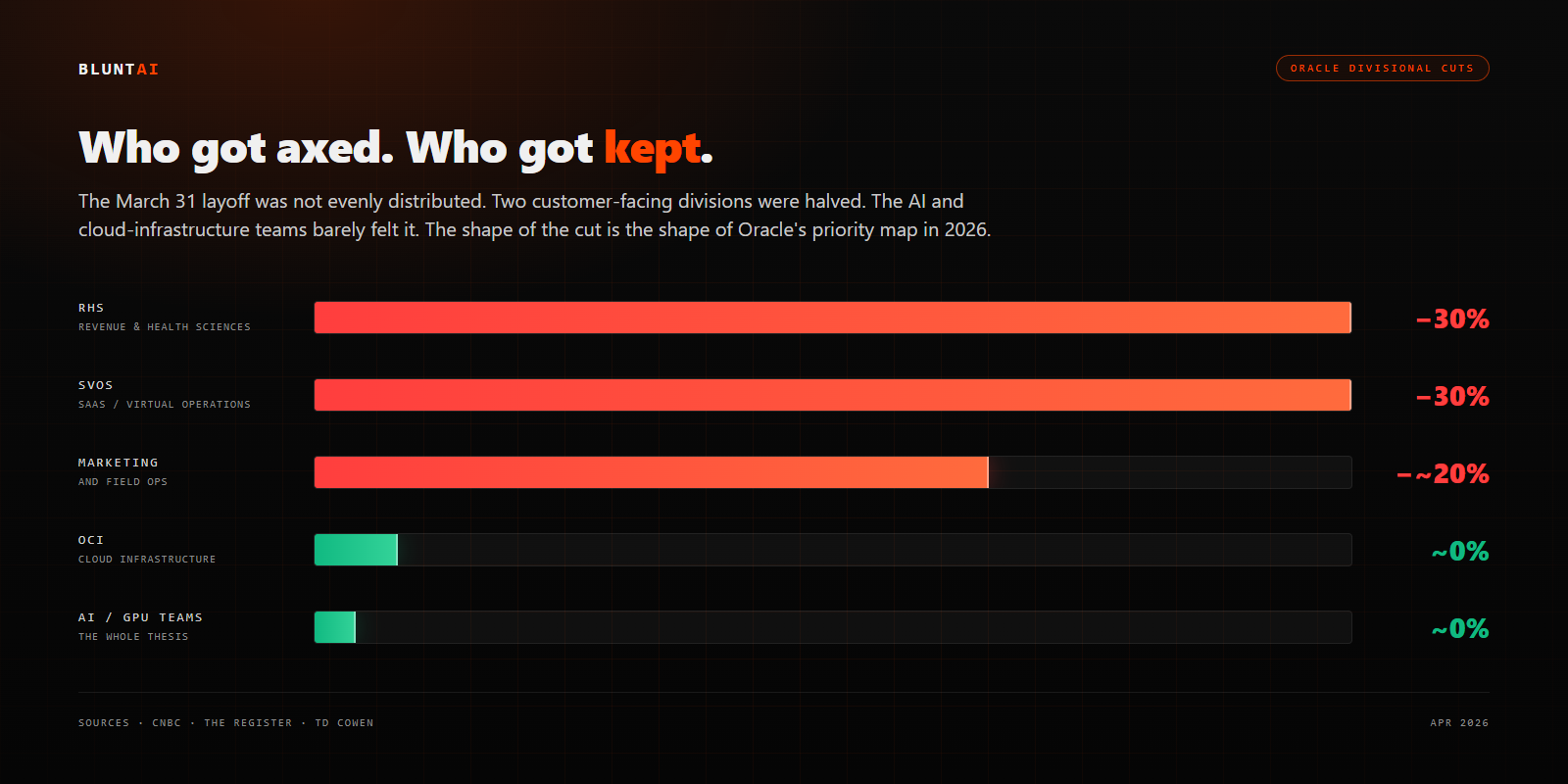
The cuts were not evenly distributed. Two divisions got flattened:
Revenue and Health Sciences (RHS) — the part of Oracle that grew out of the Cerner acquisition, handling pharma, healthcare IT, and patient data — lost roughly 30% of its headcount. SaaS/Virtual Operations Services (SVOS) — the teams that keep Oracle’s sprawling cloud SaaS catalog running day to day — also lost about 30%. These are not administrative overhead. They are two of the divisions that touch customers directly.
The division that was almost entirely spared? Oracle Cloud Infrastructure (OCI), the hyperscaler cloud, and anything with “AI” in the job title. You can read the exact shape of the company’s priority map from the shape of the layoffs. SaaS operations for existing customers? Expendable. GPU lease management for new AI workloads? Indispensable.
If you are an Oracle customer reading this, that distribution should worry you. The people most recently fired are the people whose job it was to keep your deployment running. The Register already ran a story titled “Oracle AI obsession could mean higher prices, worse support” and it was generous. The leaner half of the org is the half that used to pick up the phone when your migration went sideways.
The 6 a.m. form letter
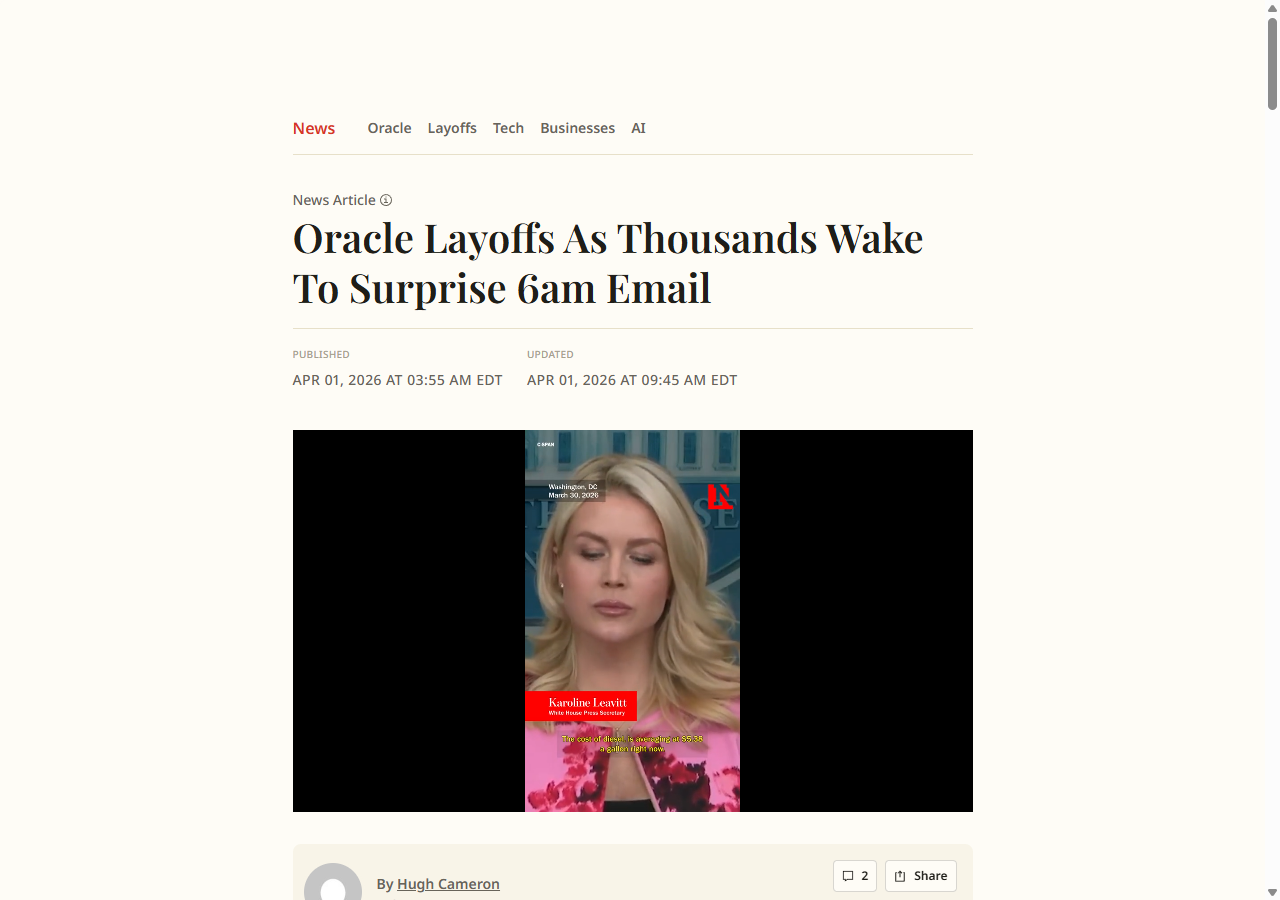
Let’s talk about the email itself, because the choreography of a layoff says a lot about what the company thinks of the people it is laying off.
Six a.m. local time means before most people are awake. Sent under “Oracle Leadership” means no individual manager is named. Same-day termination means there is no handoff, no farewell, no final week to say goodbye to the team you built something with over the last five or ten years. Your laptop was probably already locked when you finished reading the second paragraph. There is no one to push back to. The choice of 6 a.m. is not an accident — it is designed to land while Slack is quiet, before the news can aggregate, before the water-cooler retrospective can start.
Inc. magazine ran a piece titled “Oracle Laid Off Thousands by Email — and That May Have Been the Right Call.” Read it if you want a good example of the genre of corporate-HR apologia that gets written every time a big tech company does something cruel: the argument goes that an impersonal form letter is somehow more respectful than a conversation because it “avoids placing the burden of the explanation on a middle manager who wasn’t consulted in the decision.” I’ll let you decide whether that’s true when it’s your career and you are the one who received the form.
But even if you buy the “efficiency” argument, the shape of the thing tells you the truth. Oracle did not believe it owed any of these people a direct explanation from a human being. That’s the posture. That’s the tell.
Larry Ellison is 81 and he is playing for keeps
Here is the macro context you need to hold in your head.
Larry Ellison, Oracle’s co-founder, is eighty-one years old. In the last eighteen months he has personally and corporately pulled Oracle from a “legacy database vendor” narrative into one of the most aggressively-funded AI infrastructure players on Earth. He has struck a multi-tens-of-billions-of-dollars deal with OpenAI for compute, joined Project Stargate, positioned OCI as the cheaper alternative to AWS and Azure for NVIDIA-heavy workloads, and personally added more to his net worth in the last year than most countries’ GDP.
Ellison is not firing thirty thousand people because Oracle is struggling. Oracle’s stock is at an all-time high. He is firing them because he is in a hurry. He has a narrow window — a couple of years at most — to lock in Oracle’s place among the three or four companies that will run the world’s AI compute. Every dollar he does not reinvest in GPUs is a dollar NVIDIA sends to his competitors. So the cheapest place to take that dollar from is the wage line.
That’s the game. It is not hidden. It is not complicated. It is not being obscured by clever PR. Oracle is telling you, loudly, with the $56B commitment and the 6 a.m. email and the silent Slack shrinkage, that in 2026 the company is a compute provider first, and everything else — the enterprise ERP customers, the health-sciences contracts, the SaaS ecosystem — is a secondary business whose payroll exists to be converted into racks.
The Blunt takeaway
I want to be clear that this is not unique to Oracle. Meta, Amazon, Salesforce, Block, Pinterest, Atlassian — the 2026 tech layoff tracker has 78,000 names on it already, roughly half of them with “AI efficiency” as the stated reason. But most of those were done in batches of hundreds to low thousands, with internal announcements, with some semblance of process. Oracle is the one that did 30,000 in a single sunrise via form letter.
There is an “AI washing” debate floating around right now — the argument that companies are overstating how much of these cuts are AI-driven, and using the AI narrative as a socially acceptable cover for post-COVID overhiring corrections. That argument has merit. It is almost certainly part of what’s going on at Meta and at Google.
It does not really fit Oracle. Oracle is spending tens of billions on AI. Oracle did directly cite cash flow needed for AI data centers as the motivation, via analyst channels. Oracle did spare the AI and OCI teams. This is not AI-washing. This is AI-enabled payroll reduction, fully committed, fully explicit, and fully cold.
My rating on this whole situation: Save your money. Not for Oracle’s products specifically — you can still buy their cloud and it will still mostly work — but as a general instruction for anyone still in the industry. The companies in the middle of the AI arms race are going to pay for their GPUs one way or another. If you are working at one of them and your job is not on the critical path to an inference endpoint, build a runway. The next 6 a.m. email might have your name on it, and you’ll read about it in the morning.
Sources
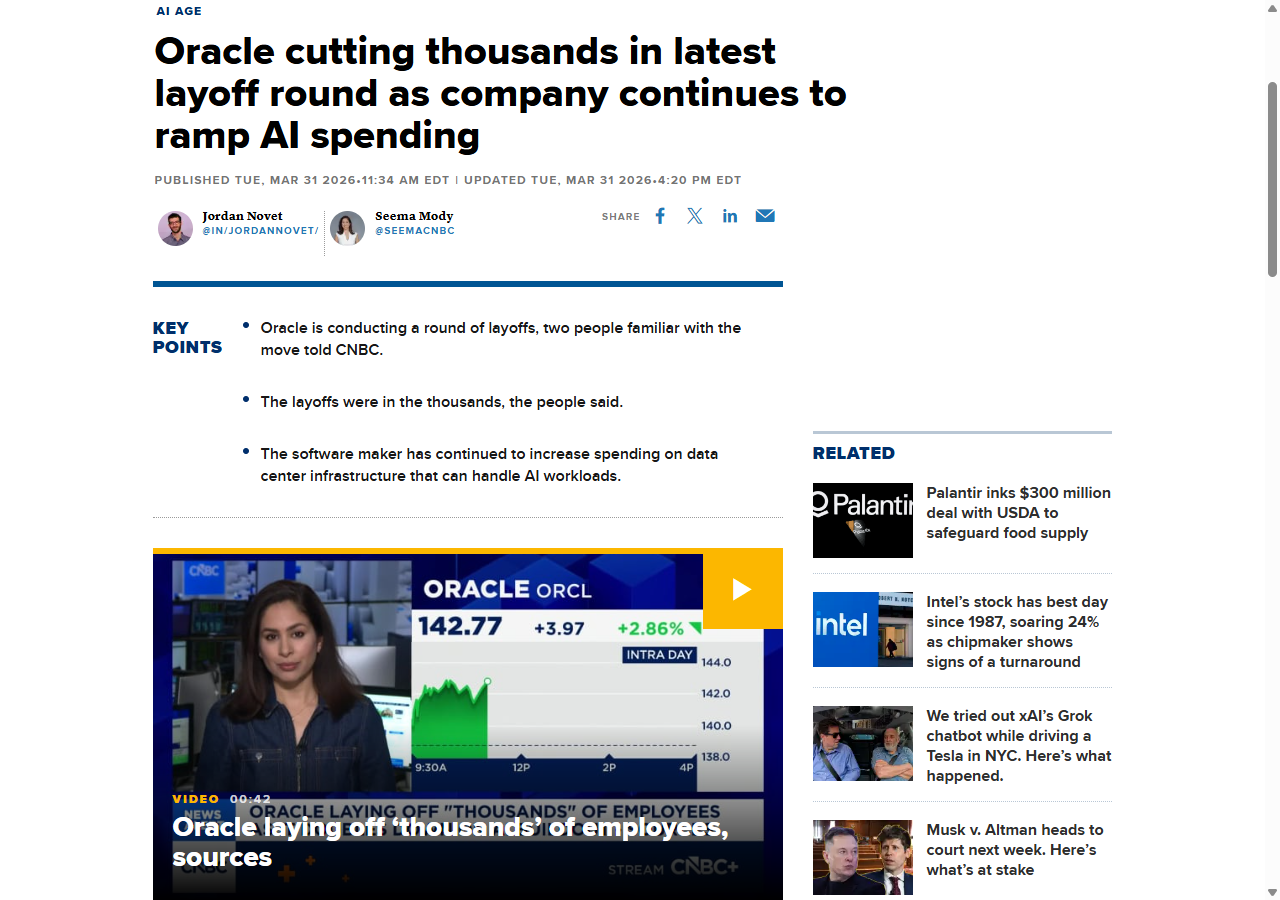
- CNBC — Oracle cutting thousands in latest layoff round as company continues to ramp AI spending (March 31, 2026)
- Newsweek — Oracle Layoffs As Thousands Wake To Surprise 6am Email (Hugh Cameron, April 1, 2026)
- HR Executive — Oracle layoffs hit via a 6 a.m. email
- The Register — Oracle AI obsession could mean higher prices, worse support (April 13, 2026)
- Inc. — Oracle Laid Off Thousands by Email, and That May Have Been the Right Call (Suzanne Lucas)
All opinions expressed on BluntAI are editorial opinions based on publicly available information and personal testing. We may earn affiliate commissions from links on this site.


Disclaimer: BluntAI may earn affiliate commissions from links in this article. This never influences our reviews. We buy and test everything ourselves. Our opinions are brutally our own.