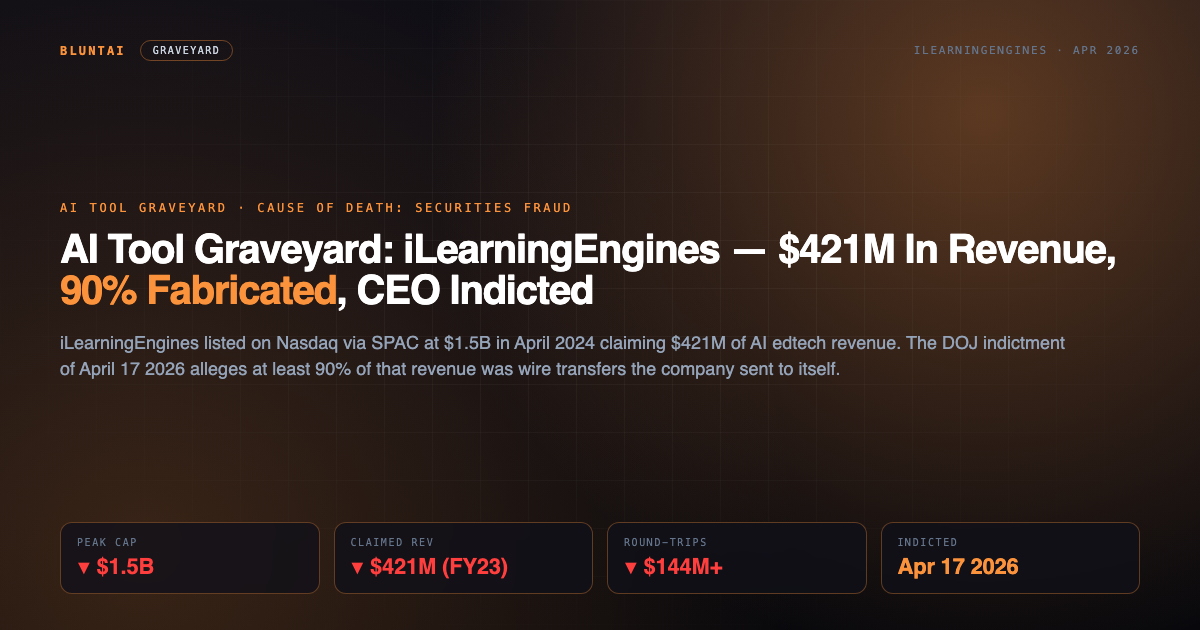
AI Tool Graveyard: iLearningEngines — $421M In Revenue, 90% Fabricated, CEO Indicted
iLearningEngines was, on paper, exactly the kind of AI company that should have existed in 2023-2024.
It claimed to do AI for enterprise learning: workforce training, compliance content delivery, automated quiz generation, the whole “we use ML to help your employees learn faster” pitch deck that any HR director with budget signed up for in 2023. It claimed customers across insurance, healthcare, and education in the US, India, and the UAE. It claimed to be growing 50%+ year over year. It claimed $421 million of 2023 revenue.
It went public on Nasdaq via SPAC merger in April 2024, peaked at a market cap of $1.5 billion in the days that followed, and got the standard victory lap of “AI edtech unicorn validates the sector” headlines from the trade press.
At least 90% of the $421 million in claimed revenue was a wire transfer iLearningEngines sent to itself.
That is the cleanest sentence I can write to summarize what the U.S. Department of Justice unsealed in an indictment on April 17, 2026, charging the company’s ex-CEO Harish Chidambaran and ex-CFO Farhan Naqvi with multiple counts of securities fraud, wire fraud, and money laundering. The company filed for bankruptcy in late 2025 after Hindenburg Research published its short report. The trial is pending. The investors are not getting their money back.
This is the first AI-tool tombstone of 2026 that involves federal indictments, which feels worth marking. So let’s mark it.
What iLearningEngines Said It Did
The product, marketed to enterprise customers, was an “AI-powered learning automation platform.” That phrase was deployed in approximately every press release and investor deck for three years running. The actual functionality, as described on the product website (still live as of writing, in the way that ghosts of dead products often are):
- AI-generated training content from corporate documents
- Automated assessment / quiz generation
- A chatbot that answered employee compliance questions
- “Predictive learning” — the system would supposedly recommend training modules based on an employee’s role, performance, and skill gaps
If you squinted, this was a thinner version of products from Cornerstone OnDemand, Docebo, or 360Learning. If you didn’t squint, it looked like a fairly normal (if uninspired) enterprise edtech wrapper around some commodity LLM API. The pitch was that the company served large customers in regulated industries — banks, hospitals, insurance brokers — where ROI was easy to claim and harder to audit.
The pitch was also entirely fictional, in the parts that mattered.
What iLearningEngines Actually Did
The DOJ indictment alleges, and the Hindenburg short report from August 2024 demonstrated through bank records and corporate filings, that iLearningEngines built a roughly four-year-old machine for manufacturing revenue out of its own balance sheet.
The mechanism was straightforward enough that the most upvoted Hacker News comment on the indictment summarized it in one sentence:
They opened bank accounts in fake names and bought their own product to boost revenue.
Slightly more detail, from the indictment’s own description of the round-tripping scheme:
An associate of Chidambaran, who previously worked as an iLearning vice president, incorporated and opened bank accounts in the names of several purported iLearning customers. Over the course of several years, the defendants transmitted millions of dollars from iLearning to an account controlled by this individual. This individual then sent those funds to other accounts he controlled in the names of other entities.
Translation: iLearningEngines wired its own cash to bank accounts that an ex-VP had opened in the names of fake corporate “customers.” Those fake customers then “paid” iLearningEngines back, often through additional intermediary entities to obscure the source. iLearningEngines counted the inbound transfers as enterprise software revenue. Investors counted the revenue as growth. The market counted the growth as a unicorn.
Round-trip transactions documented in the indictment: at least $144 million. Total revenue claimed in 2023: $421 million. The DOJ’s allegation: at least 90% of that 2023 revenue was fabricated through this loop or substantially similar fake-customer mechanisms.
The Hindenburg Receipt
The fraud got caught the way these always get caught: a short seller did the work that the auditors didn’t.
In August 2024, four months after iLearningEngines listed on Nasdaq, Hindenburg Research published a short report alleging massive revenue fabrication. The Hindenburg findings were the kind of item-by-item destruction that took the iLearningEngines investor relations narrative apart in public:
- Several of the named largest customers had no public record of being iLearning customers at all — no case studies, no LinkedIn employees referencing the integration, no procurement filings.
- Bank account ownership for the alleged customers traced back to the same Indian and UAE addresses as iLearning’s executive team.
- Reported revenue per employee was an order of magnitude higher than realistic for a company at that size in enterprise edtech — a giveaway that revenue was decoupled from actual operations.
- The reported list of “Fortune 500” customers, on closer inspection, included multiple entities that had publicly denied being iLearning customers when contacted directly by Hindenburg.
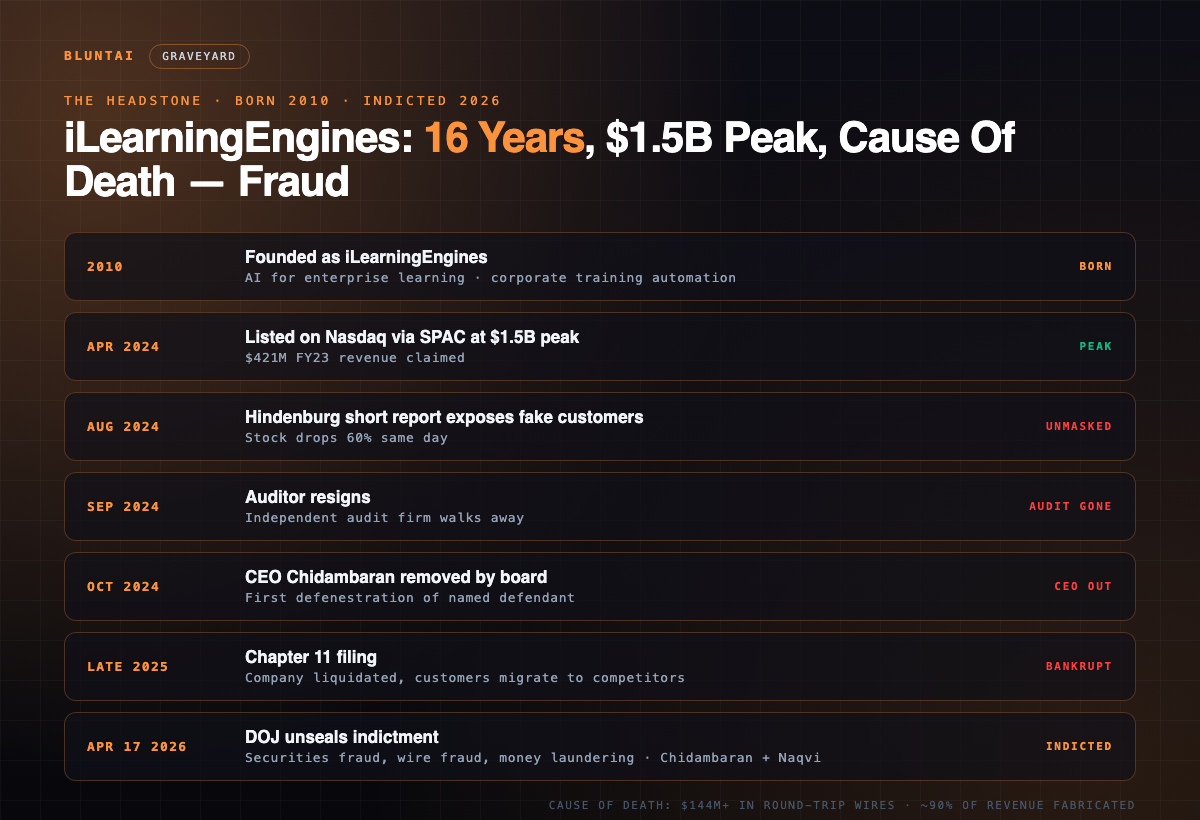
The stock dropped 60% the day the report dropped. Auditors resigned. The board removed Chidambaran in October 2024. The company filed for Chapter 11 in late 2025. Twelve months after that, the DOJ unsealed the indictment.
What Killed iLearningEngines
This wasn’t an AI company that died because the AI didn’t work, or because the market shifted, or because a bigger competitor showed up.
This was a company that died because the market gravity of “investors will pay any multiple for an AI company in 2023” was strong enough that someone built an entire fake company to ride it, and the eventual collision with reality involved bank accounts, indictments, and a $1.5 billion market cap evaporating into a settlement column on a litigation tracker.
The post-mortem failure list:
| # | What failed | What it should have been |
|---|---|---|
| 1 | SPAC due diligence — The merger sponsor did not sample-audit a single one of the alleged customer relationships before greenlighting the listing. | Direct customer reference calls, not just attestation letters from the company. |
| 2 | Auditor credibility — A small firm signed off on financials with revenue inconsistencies that a Big 4 firm would have flagged. | Listed companies of this size need real audit firms with skin in the game. |
| 3 | Investor pattern recognition — A company claiming 50%+ YoY growth in enterprise edtech in 2023 should have triggered “show me the customers” reflexively. The AI hype made this filter dormant. | Reference checks that include the customer side, not just the seller’s deck. |
| 4 | Public market vetting — Two days of “AI edtech unicorn lists on Nasdaq” coverage. Zero days of “wait, who are their customers and why isn’t anyone tweeting about using this.” | Trade press should not write product-validation pieces on Day 1 of a SPAC listing. |
| 5 | Internal whistleblowers — The company had hundreds of employees on paper. Apparently zero of them flagged that the customer list was fictional. | This one is the hardest. Cultures that allow obvious fraud to persist for four years are not normal. |
If iLearningEngines had been a private company, the fraud would still have been fraud, but the harm would have been contained to a smaller set of accredited investors who, in theory, could afford the loss. The SPAC route turned this into a public-market fraud that wiped out retail money — pension funds, 401(k) target-date allocations, retail traders who saw “AI edtech listed on Nasdaq with growing revenue” and bought.
That is the part of the story that makes me angry, and the part that the indictment is correctly aimed at.
Lessons For You, The Person Who Buys AI Tools
1. AI label inflation is now a fraud surface, not just a marketing surface. Three years ago, “we use AI” was a label that companies stuck on basic if-statements to capture VC money. In 2026, “we use AI” is a label that companies stick on literally fabricated revenue to capture public market money. The difference between marketing slop and securities fraud is a thin line and iLearningEngines crossed it.
2. Customer references are everything. If you are evaluating an AI vendor for your business — large or small, public or private — and they cannot produce three customer references who will hop on a call with you within five business days, that is the diligence answer. iLearningEngines could not produce them when Hindenburg asked. Their entire customer list collapsed under a single afternoon of phone calls.
3. Revenue per employee is a tell. Enterprise edtech at iLearningEngines’s scale should support roughly $300-500K of revenue per employee in a healthy business. Their reported numbers were 4-5× higher. That ratio is, in any honest enterprise software company, a giveaway that something is wrong: either the business is so good it should be five times the size it claims to be, or the revenue is fake. It was the second one.
4. Short sellers do the work nobody else does. Hindenburg, Muddy Waters, Citron, and the small ecosystem of forensic short-sell research firms remain the single most reliable source of fraud detection in public markets in 2026. Auditors won’t catch it. Banks won’t catch it. The trade press won’t catch it. Read the short reports. Treat them as primary sources, not adversarial marketing.
5. The AI hype cycle is producing a generation of fake AI companies. iLearningEngines is the first one to get prosecuted in 2026. It will not be the last. Several private companies currently raising rounds at AI valuations are running variations of the same playbook. The DOJ has a long backlog. Stay tuned for the rest.
What’s Left
iLearningEngines’s product is non-functional. The website redirects to a Chapter 11 administrator page. The LinkedIn page lists “Closed” as the status. Of the ~700 employees on the books at the peak, most never worked in product or engineering — they were sales and customer success at fictional accounts, or admin at the round-trip entity layer.
Real customers — there were some — got migrated to Cornerstone, Docebo, or simpler in-house solutions. The product, such as it was, leaves no obvious successor and no community asking for one.
The indictment names two defendants by name: Harish Chidambaran (ex-CEO) and Farhan Naqvi (ex-CFO). Both have entered not-guilty pleas. The criminal trial is expected in late 2026. Civil suits from defrauded investors are stacking up in the meantime.
Most of the $1.5 billion that retail investors put into iLearningEngines stock at the SPAC listing is permanently gone. Some fraction may be recovered through clawback litigation. The realistic recovery rate for retail investors in cases like this is in the 5-15% range.
The Headstone
Born: 2010 (founded as iLearningEngines) Listed: April 2024 on Nasdaq via SPAC merger Peak valuation: $1.5 billion (April 2024) Hindenburg short report: August 2024 Auditor resigned: September 2024 CEO removed: October 2024 Chapter 11 filing: late 2025 DOJ indictment unsealed: April 17, 2026
Cause of death: at least 90% of revenue was the company wiring money to itself through accounts in fake names.
Not “AI didn’t work as advertised.” Not “ran out of runway.” Not “couldn’t compete with the frontier models.” This one was just plain old securities fraud, dressed in an AI hat for the 2023-2024 hype cycle, caught by a short seller doing the auditor’s job.
You will see this exact pattern again. Probably more than once this year. Read the indictments. They are the best litmus test the AI industry currently has.
Rating: Hindenburg called it. The DOJ confirmed it. The market loved it for a year.
Sources:
- Reuters: Ex-CEO, ex-CFO of bankrupt AI company charged with fraud (April 17, 2026)
- Hacker News thread (158 points, 68 comments): news.ycombinator.com/item?id=47828225
- Hindenburg Research short report (August 2024) — original receipts that exposed the fraud
- DOJ Eastern District of New York indictment (April 17, 2026, Defendants: Harish Chidambaran and Farhan Naqvi)
Disclaimer: BluntAI may earn affiliate commissions from links in this article. This never influences our reviews. We buy and test everything ourselves. Our opinions are brutally our own.