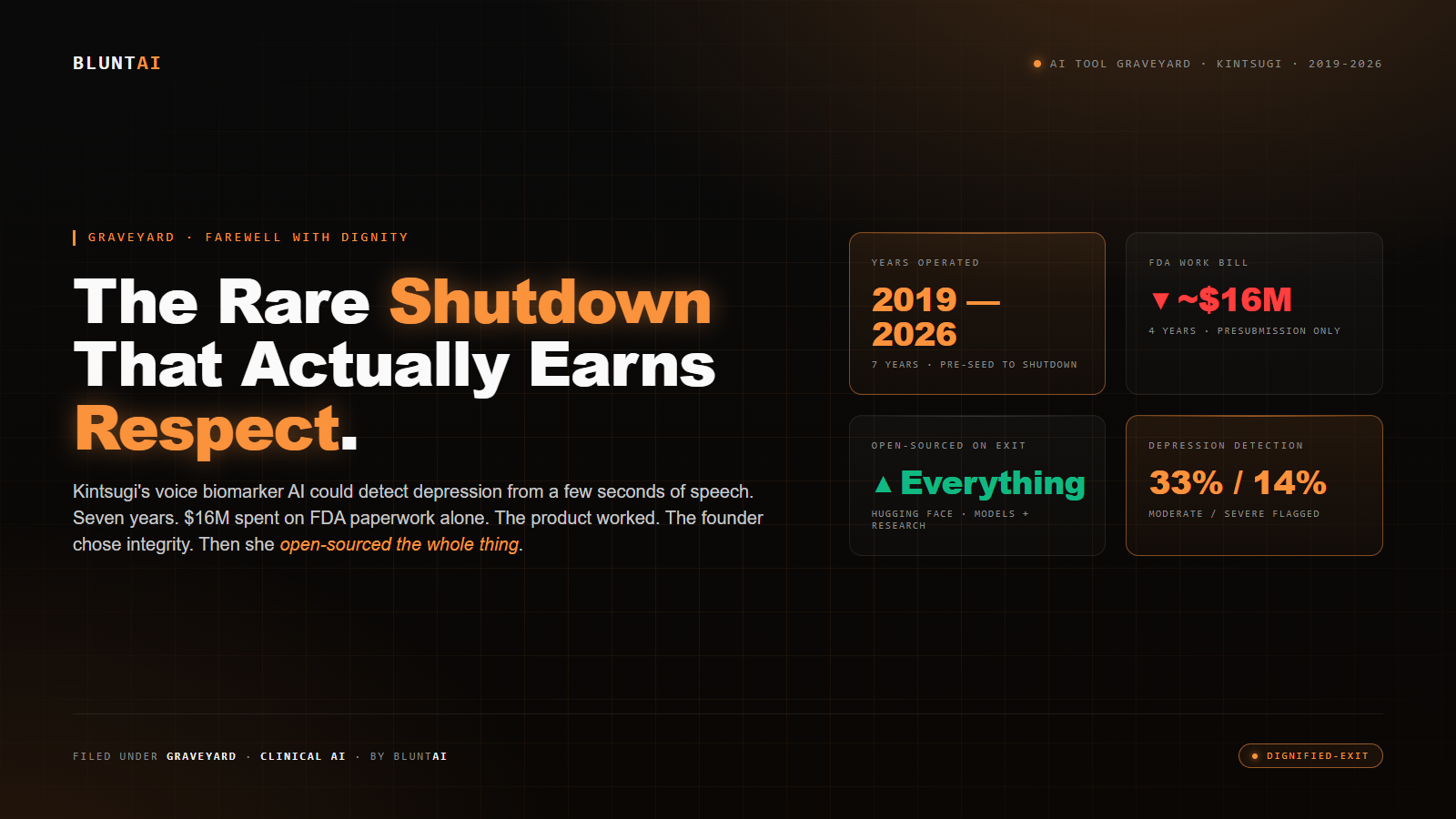
AI Tool Graveyard: Kintsugi — The Rare Shutdown That Actually Earns Respect
Most entries in the BluntAI AI Tool Graveyard die for one of three reasons: the product never worked, the founders ran out of money before they figured out what to build, or a bigger company bought the team and quietly shut the product down. Boring failure, honest failure, expensive failure. Those are the three rails we’re used to.
Kintsugi is a fourth kind, and it’s the one that actually hurts to write up. The product worked. The science got published. The pilot deployments were real, with real patients, producing real clinical signal. And the company closed anyway, because the regulator in front of them took four years and a documented $16 million to not say yes — and the CEO, to her visible credit, chose to shut the doors rather than pivot into something cheaper that she didn’t believe in.
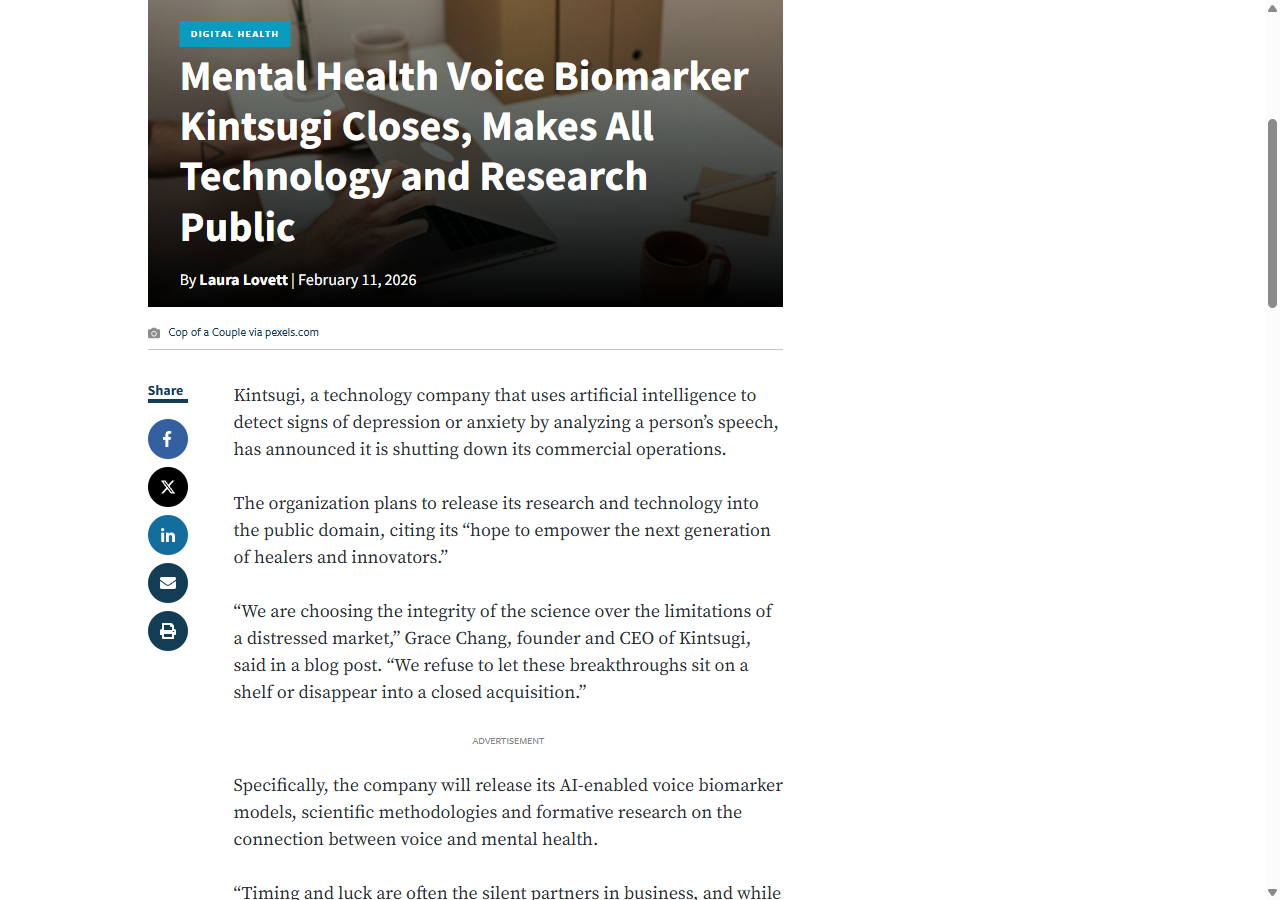
Then she put the entire model on Hugging Face for anyone who wanted it.
That is not how AI startups usually die. I want to give this one the send-off it deserves, because the story underneath it is important for anyone betting on clinical AI in the United States.
What the product was
Kintsugi’s technology did one well-defined, measurable thing. It listened to a few seconds of speech — a patient answering a normal intake question on a telehealth call or in a clinic — and used an acoustic-feature model to estimate the probability that the speaker was experiencing moderate-to-severe depression or anxiety. Not a diagnosis. A screening signal that could flag “this person’s voice carries markers consistent with depression” to the clinician, who would then make the call.
The peer-reviewed evaluation data was genuinely strong. In a published 2025 study on recently discharged emergency-department and maternal-health patients, Kintsugi’s voice biomarker flagged moderate-to-high depression in 33% of the screened population and severe depression in 14%. Those numbers are not a marketing claim. They’re from a JAMA-adjacent evaluation with a real control cohort, and they are exactly the kind of upstream signal that, if it’s reliable, should be saving lives — because the failure mode of untreated postpartum depression or discharged ED patients is measured in funerals.
The company had established commercial relationships with health providers and payers. This was not a demo searching for a market. It was a deployed product searching for a regulatory sign-off.
What killed it
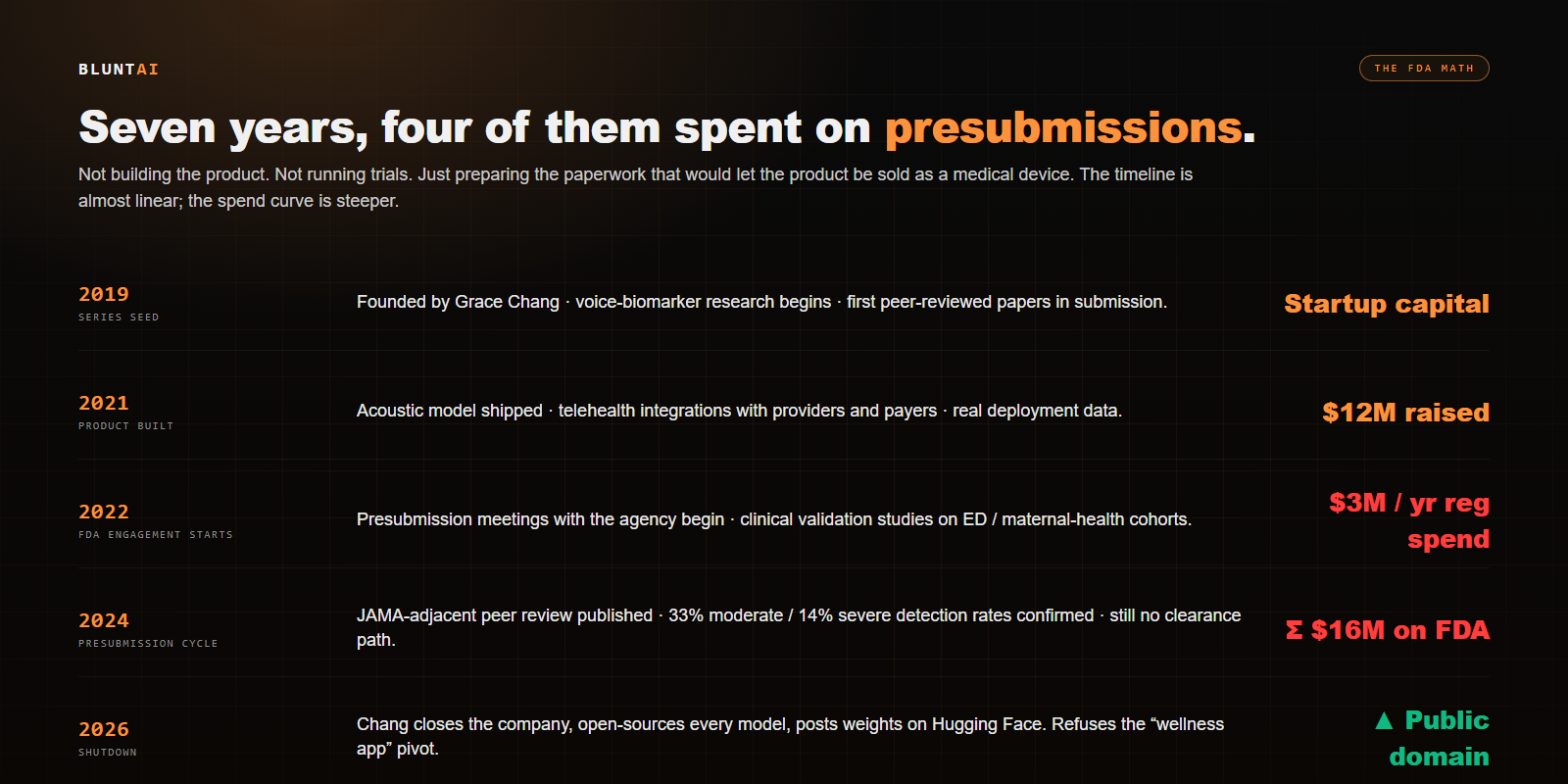
From Kintsugi’s own blog post on the wind-down: approximately $16 million spent over four years of FDA presubmission work. That figure is worth sitting with for a second. That’s not $16M spent building the product. That’s $16M spent preparing the paperwork to let the product be sold as a medical device.
The FDA’s clearance pathway for voice-biomarker AI is genuinely novel territory. There is no clean precedent, which means the presubmission process — the iterative conversations with the agency about what a submission would need to look like — costs more and takes longer than it would for a well-worn category like a new kind of stent. Every round of agency feedback means another eight or twelve weeks, another set of external clinical studies, another regulatory consultant invoice.
Kintsugi’s founder, Grace Chang, said the quiet part out loud in the shutdown post: “We are choosing the integrity of the science over the limitations of a distressed market.” Translate: we could raise more money by positioning the product as a wellness tool or a consumer app and skip the FDA path entirely. That would let us keep the lights on. It would also mean lying to clinicians about what the signal is for, and potentially putting patients at real risk. We are not going to do that.
That is a genuinely rare sentence in 2026’s AI startup landscape. Most founders in a distressed funding position pivot. Chang chose the other door.
What she did instead
This is the part that makes Kintsugi worth writing about and not just eulogizing.
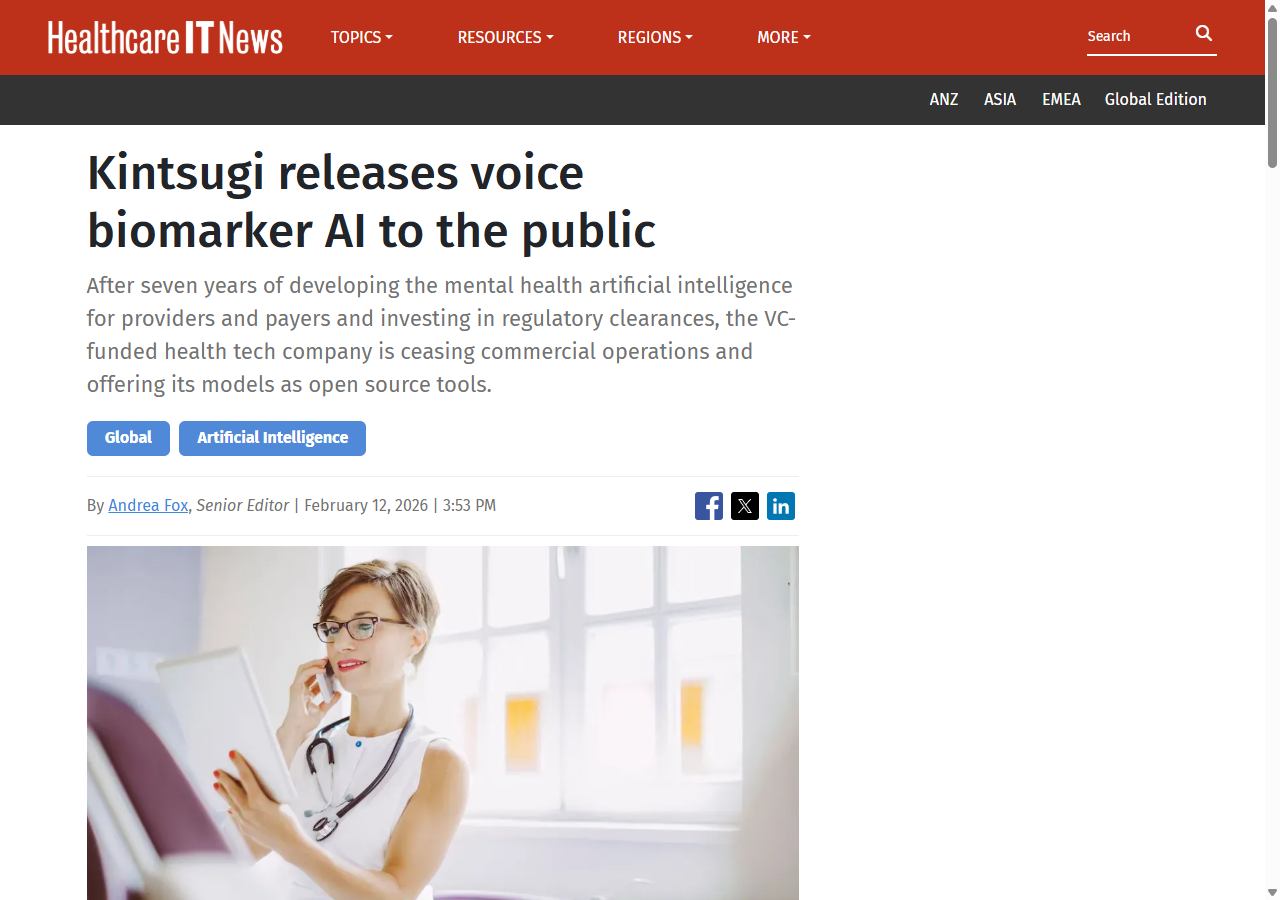
Instead of selling the team to a strategic acquirer, or locking the IP into a bankruptcy estate where it would rot, Chang and her team open-sourced everything:
- The voice biomarker AI models, weights and all, on Hugging Face.
- The scientific methodology and preprocessing pipeline.
- The formative research linking acoustic features to clinical outcomes.
This means that if you are a clinical researcher, a hospital IT team, a non-profit mental health organization, or a grad student with a thesis idea — you can take the model Kintsugi spent seven years building, fine-tune it on your patient population, and build on the work. It’s an academic bequest, not a fire sale. For a venture-funded company, that choice is almost unheard of.
What this tells you about clinical AI in America
Here’s the part that is bigger than Kintsugi.
If a genuinely effective, well-studied, peer-reviewed, deployment-ready mental health AI cannot survive the FDA clearance pathway even with $16M and four years, then the message being sent to the entire category is unambiguous: American clinical AI is a non-starter as a venture-backed business unless you have $100M+ of patient capital, a regulatory-first team of thirty, and a roadmap that accepts six to eight years before revenue. You need to look like Abridge, or Hippocratic AI, or a FDA-veteran spinout. You cannot be a twenty-person startup with great acoustic engineers and a clinical advisor.
This shapes the whole landscape. The companies that can actually compete in clinical AI are increasingly either (a) subsidiaries of big-cap healthcare incumbents, (b) Google / Microsoft research arms operating on their own clock, or (c) extraordinarily well-funded bets where the first four rounds are explicitly regulatory. If you are anywhere else on the spectrum — including a strong team with a working product and a real clinical need — your options are to raise as if you were in big pharma, or to cash out early, or to do what Kintsugi did and call it.
The second-order effect: patient-facing benefit gets delayed. The acoustic biomarker model Kintsugi built will probably make it into clinical use eventually, because the code is now public and somebody larger will integrate it. But the path from public code to a deployed tool inside an actual hospital will now take the extra three-to-five years of cross-institutional effort instead of the direct company-to-customer path Kintsugi was on. In a category where early detection saves lives, years matter.
The BluntAI rating: farewell with dignity
Most Graveyard entries get a one-liner. Kintsugi gets a real one: Respect paid.
The product worked. The founder chose clinical integrity over a pivot. The code is public. The science is public. The patients who would have been served by this signal will, eventually, be served — just later, and through a different path.
If you are building clinical AI and you are reading this, I would encourage you to do two things. First, clone the Kintsugi models from Hugging Face. They are genuinely useful as a starting point, and the license is permissive. Second, look at the $16M / 4-year FDA timeline and build your fundraising and runway math around it as a floor, not a ceiling.
And if you are an investor reading this: the venn diagram of “clinical AI that works” and “clinical AI that can survive as a VC-backed company in the US regulatory environment” is smaller than your thesis deck claims it is. Kintsugi is the counter-example that should be in every pitch meeting where somebody promises FDA clearance in 18 months.
Rest well, Kintsugi. You did the honorable version of failing.
Sources
- Behavioral Health Business — Mental Health Voice Biomarker Kintsugi Closes, Makes All Technology and Research Public (February 11, 2026)
- Healthcare IT News — Kintsugi releases voice biomarker AI to the public (Andrea Fox, February 12, 2026)
- The Meridiem — Clinical AI Hits Regulatory Wall as Kintsugi Shuts After 7-Year FDA Wait
- PMC — Evaluation of an AI-Based Voice Biomarker Tool to Detect Signals Consistent With Moderate to Severe Depression (peer review)
- Kintsugi — Voice Biomarker Technology (company site, archived)
All opinions expressed on BluntAI are editorial opinions based on publicly available information and personal testing. We may earn affiliate commissions from links on this site.
Disclaimer: BluntAI may earn affiliate commissions from links in this article. This never influences our reviews. We buy and test everything ourselves. Our opinions are brutally our own.