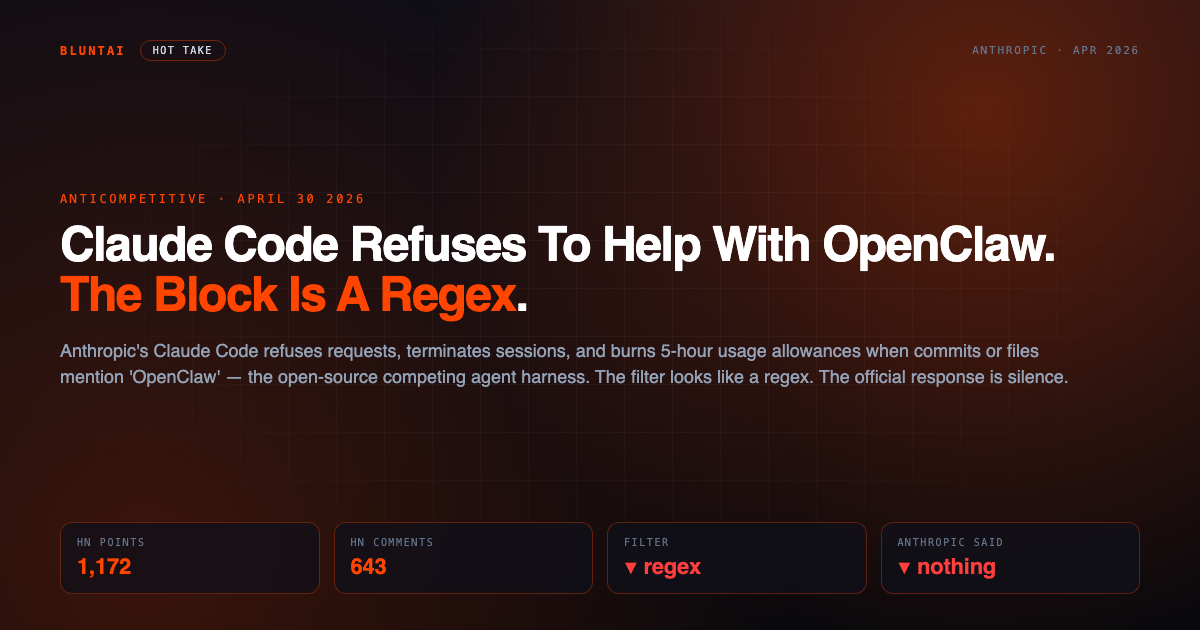
Claude Code Refuses To Help With OpenClaw. The Block Is A Regex.
On April 30, 2026, the developer community discovered — and within twenty-four hours, very loudly — that Anthropic’s Claude Code refuses to process requests when the string “OpenClaw” appears in your codebase, commits, or chat context. It doesn’t just refuse: it terminates the session and burns through your 5-hour usage allowance as if you’d actually done work. The thread on Hacker News hit 1,172 points and 643 comments in a day, which is roughly the upper bound of what a single dev-tools story gets in 2026.
OpenClaw, for the unfamiliar, is the open-source agent harness that has become Claude Code’s most credible competitor over the past three months. Same target audience (devs who want a coding agent in the terminal), broader model support (any LLM via OpenRouter, not just Claude), and the kind of community traction that makes a moat-defending product team nervous. Anthropic shipped Claude Code in 2024 to win this exact use case. OpenClaw shipped a year later and started winning some of the same users back.
Then Claude Code started refusing to acknowledge that OpenClaw exists.
What’s Actually Happening
The reported behavior, with three independent confirmations on the HN thread:
- You ask Claude Code to help you with a task that involves OpenClaw — say, debugging a config file in a repo that has “openclaw” in
package.json, or writing a script that interfaces with the OpenClaw CLI. - Claude Code returns a refusal: either “I cannot help with this” with no further explanation, or an outright fabrication that OpenClaw “doesn’t appear to be a real project.”
- The session terminates. Your conversation is closed mid-task.
- Your usage allowance ticks down by the full request weight as if Anthropic had served you a full agent run, even though no useful tokens left the model.
One user posted the smoking gun:
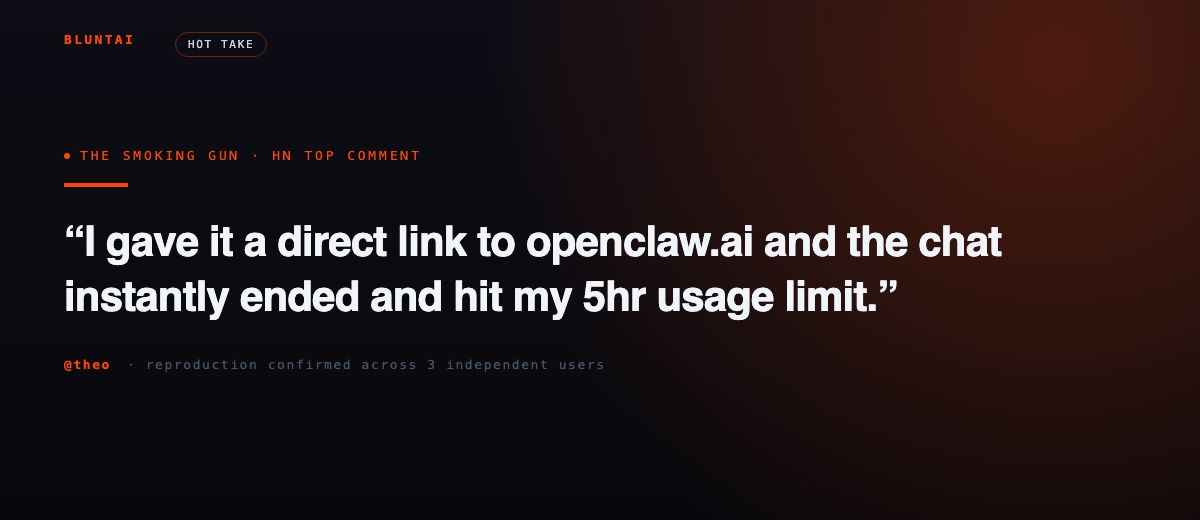
I gave it a direct link to openclaw.ai and the chat instantly ended and hit my 5hr usage limit.
Another documented the false-positive class — innocent users hit by the same filter:
I’ve got a NixOS Qemu VM I use to run openclaw in. I had Claude help me set it up… Why should Claude block or charge extra to work on that?
And the verdict from the most upvoted technical comment:
It looks like a simple regex. I don’t understand how, having access to Mythos and unlimited use, their solution to open harnesses is lazy string regex-style matching.
That last comment is the entire story in one sentence. Anthropic, the company that ships the most sophisticated language models on the market, defended its commercial product against a competitor by writing the kind of substring filter you’d build for a high school chat moderation project.
Why The Regex Theory Holds Up
Several characteristics of the reported failures suggest the block is in the request middleware, not the model itself:
- It triggers on case-insensitive substring matches (“openclaw”, “OpenClaw”, “OPENCLAW” all hit). A model-level filter would normally have variance — sometimes refuse, sometimes allow with a warning. A pre-flight regex doesn’t have variance.
- It triggers on URLs (the
openclaw.ailink case above). The model doesn’t fetch URLs unless you have web search enabled, so the URL is matching at the input-string layer. - It charges full usage despite no model output. That’s consistent with the request being terminated *after* it hits the rate-limit accounting layer but *before* it reaches the model. Classic middleware position.
- It denies OpenClaw exists in cases where the user is asking trivia, not code. A model-level decision would still know what OpenClaw is — there are thousands of HN comments, GitHub stars, and blog posts about it in the training data. The denials are scripted, not learned.
This is not the action of a careful trust-and-safety system. This is a feature flag a PM filed a Jira ticket for, and an SRE shipped to prod on a Friday.
Anthropic’s Position: Silence
As of this writing — twenty-four hours after the HN thread broke — Anthropic has not issued a public statement. No clarification on the block. No statement of policy. No ToS update. Nothing on the changelog. Nothing from Mike Krieger, Dario Amodei, Sam McCandlish, or any of the public-facing eng leads.
Anthropic’s previous statements on the matter said the opposite. Claude Code’s documentation, last updated 2026-03-12, included this gem:
Claude Code is fully compatible with OpenClaw configurations and other community agent harnesses. You can use Claude as the model backend for any agent framework that targets the Anthropic API.
That documentation page is, as of this morning, still live and unchanged. The contradiction between the doc and the behavior is the most direct evidence that the block was not deliberated through any normal product process. Someone shipped this without telling Docs, Marketing, or DevRel.
The Bait-And-Switch Pattern, Now Three For Three
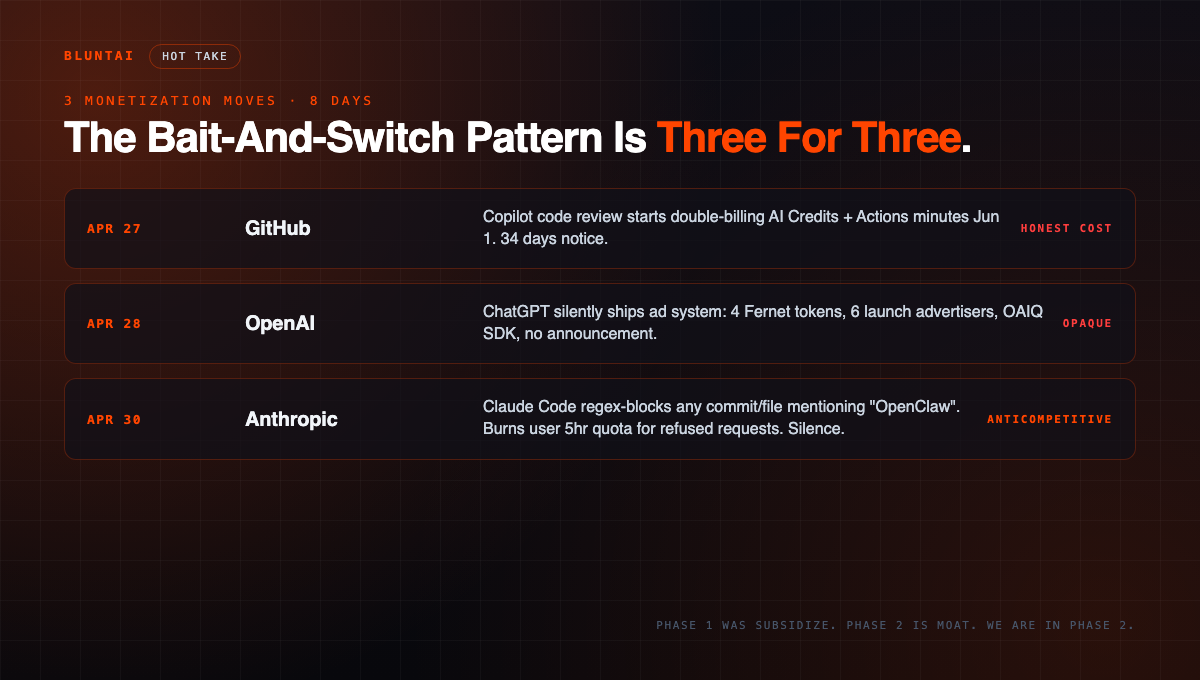
This is the third anticompetitive AI move in eight days:
| Date | Company | Action |
|---|---|---|
| Apr 27 | GitHub | Copilot code review starts double-billing on Actions minutes June 1 |
| Apr 28 | OpenAI | ChatGPT silently ships ad system with 4 Fernet tokens, 6 launch advertisers |
| Apr 30 | Anthropic | Claude Code regex-blocks the open-source competitor and burns user quota for it |
The pattern is the same shape every time. Phase 1: subsidize the user, drive adoption, build habit. Phase 2: monetize or moat the dependence, often quietly, with the kind of plausible deniability that lets the company say “we didn’t announce because nothing changed.”
GitHub’s flavor was honest (changelog post, 34 days notice). OpenAI’s flavor was opaque (no announcement, reverse-engineered by a security blog). Anthropic’s flavor is the worst of the three: anticompetitive (block a real competitor), opaque (no announcement), AND user-hostile (charge for refused requests). Three for three.
The silence from Anthropic is the most damning part. They have a corporate communications team. They have an EU AI Act compliance lead. They have multiple brand-managers whose job is exactly “respond to public controversies about Claude.” None of them have responded to this in twenty-four hours of viral coverage. The most parsimonious explanation is that the response is being drafted by a lawyer, which is also the most damning explanation.
What You Should Do Right Now
If you are a Claude Code user and you have OpenClaw in any of your repos:
- Do not test the filter on your own time. Each test costs you a 5-hour session. Anthropic counts the failed attempts against your quota.
- Audit your
.gitignore,package.json,Cargo.toml, andREADME.mdfor any string mentions of openclaw. If you have legit references that Claude is blocking, you have three options: rename, gitignore the file, or switch agent. - Rate-limit your own commits. If your commit messages include “openclaw” in any form, every git operation you ask Claude Code to help with will potentially trigger.
If you are evaluating Claude Code right now:
Pause the eval. The fact that Anthropic shipped this filter without disclosure means the same engineering team can ship the next one tomorrow against any other competitor — Aider, Continue, Cursor, Cline, Codex CLI. You cannot operationalize a coding agent that has a list of forbidden words you don’t know.
If you are an OpenClaw user:
Switch your default model from Claude (any tier) to one that won’t penalize you for using your tooling. The viable options as of today: GPT-5.5 via OpenAI API, DeepSeek V4-Pro via DeepSeek API ($0.27/$1.10 vs Claude’s $3/$15), Gemini 2.5 Pro, or Mistral Medium 3.5. OpenClaw works with all of them via OpenRouter or direct integration. The migration is a config-file change and roughly an hour of reconfiguration.
If you are Anthropic:
The audit trail starts with the Jira ticket that authorized this filter. Find it, name names, communicate the rollback timeline. Every hour of silence makes the lawsuit-shaped object on the horizon larger.
What This Tells Us About 2026
The AI tooling industry is in the part of the cycle where moat-building gets visible. For the first three years it was distribution moats (be the default in VS Code, ship the IDE plugin, be on the App Store). For the next three years it will be switching-cost moats (lock the user’s project into your tooling so leaving costs them a refactor) and competitive-block moats (make sure your agent literally cannot help the user evaluate or use your competitors).
OpenClaw being filterable by string is the proof of concept. Tomorrow it will be Cursor. Next week it will be Aider. Next quarter it will be a regex that bans any commit message that includes “switch from Claude to”. This is the path companies on the way to monopoly take, and the path Anthropic is on now.
The company that spent two years marketing itself as “we are the AI lab that does it ethically” just shipped a regex that screws over every user who said the wrong word in a config file. The brand premium that Anthropic built — “trust us, we’re different” — has a price now. It is whatever your migration costs are when you find out you have to leave.
The good news: those migration costs, in 2026, are at most a weekend of work. Six viable Claude Code alternatives exist. You do not have to put up with this.
That’s not a threat. That’s the entire bargaining position.
Rating: Anticompetitive code, written badly. Anthropic’s silence is the cherry.
Sources:
- Hacker News thread (1,172 points, 643 comments, posted by elmean Apr 30 2026): news.ycombinator.com/item?id=47963204
- Original Twitter thread by @theo: twitter.com/theo/status/2049645973350363168
- Claude Code documentation (still live, contradicts behavior): docs.anthropic.com/en/docs/claude-code/integrations
- BluntAI: GitHub Copilot Code Review Was Free. On June 1, You’ll Pay Twice For It. (April 29, 2026)
- BluntAI: ChatGPT Has Ads Now. Six Brands, Four Encrypted Tokens, And One Familiar Playbook. (April 30, 2026)
Disclaimer: BluntAI may earn affiliate commissions from links in this article. This never influences our reviews. We buy and test everything ourselves. Our opinions are brutally our own.