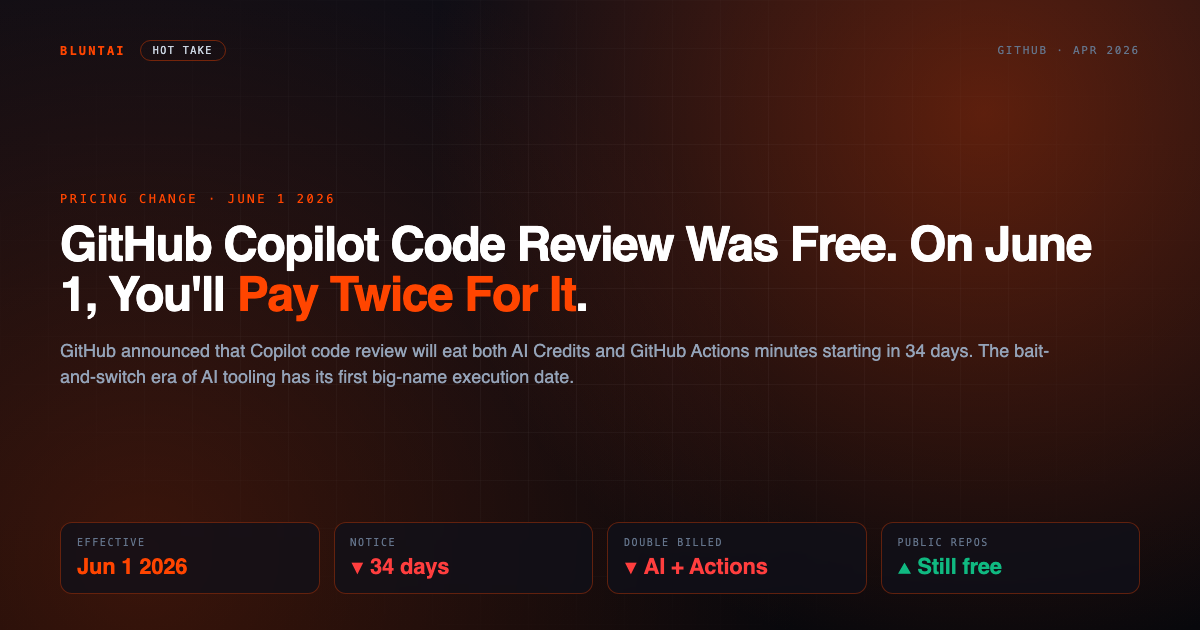
GitHub Copilot Code Review Was Free. On June 1, You’ll Pay Twice For It.
On April 27, 2026, GitHub published a polite changelog post titled “GitHub Copilot code review will start consuming GitHub Actions minutes on June 1, 2026.” It was, in the way only platform changelogs can be, both deeply boring to read and very expensive to ignore.
Here is what the post actually says:
- Today, when Copilot reviews a pull request for you, that review eats a Copilot premium request unit (PRU) — those are pooled inside your existing Copilot subscription. No separate meter.
- On June 1, 2026, the same review will also eat GitHub Actions minutes — those are pooled inside your existing GitHub plan. If you go over your plan’s free Actions minutes, you pay the standard GitHub Actions overage rate.
- This applies to private repos. Public repos still get unlimited Actions minutes, so the OSS crowd is unaffected.
- Affected tiers: Copilot Pro, Pro+, Business, and Enterprise. Effectively everyone paying GitHub for Copilot.
Translation: a thing that used to cost you one bucket now costs you two buckets. GitHub didn’t raise the price of either bucket. They didn’t have to.
The HN thread on this announcement is, to use a technical term, lit.
The Double-Billing Problem
The single sharpest comment came from user silverwind, who asked the question every dev reading the changelog asked at the same time:
This seems nonsensical. Why would non-Actions activity consume Actions budget?
Right. Code review is not a CI job. It does not run on a runner. It runs as an LLM call in GitHub’s backend. Actions minutes were, when they were introduced, the minutes of CPU time you spent running CI/CD pipelines on GitHub-hosted runners. They have a clear unit of meaning: “we ran your tests for 8 minutes, that’s 8 minutes.” Code review is a black-box LLM inference. Conflating them in the same accounting bucket isn’t a billing decision. It’s a category error wearing billing’s clothes.
pando85 made the same point with more cynicism:
Double billing for minutes and tokens is intentional obfuscation. You can’t trace actual cost.
This is the load-bearing critique. Once you pay for the same operation in two different units (AI Credits and Actions minutes), the cost per review is no longer one number you can look up. It’s a function of how your team uses two unrelated pools, with overage rates that don’t compose, in a billing system that is famously hard to forecast for any team larger than fifteen seats.
User psalaun posted real-world numbers:
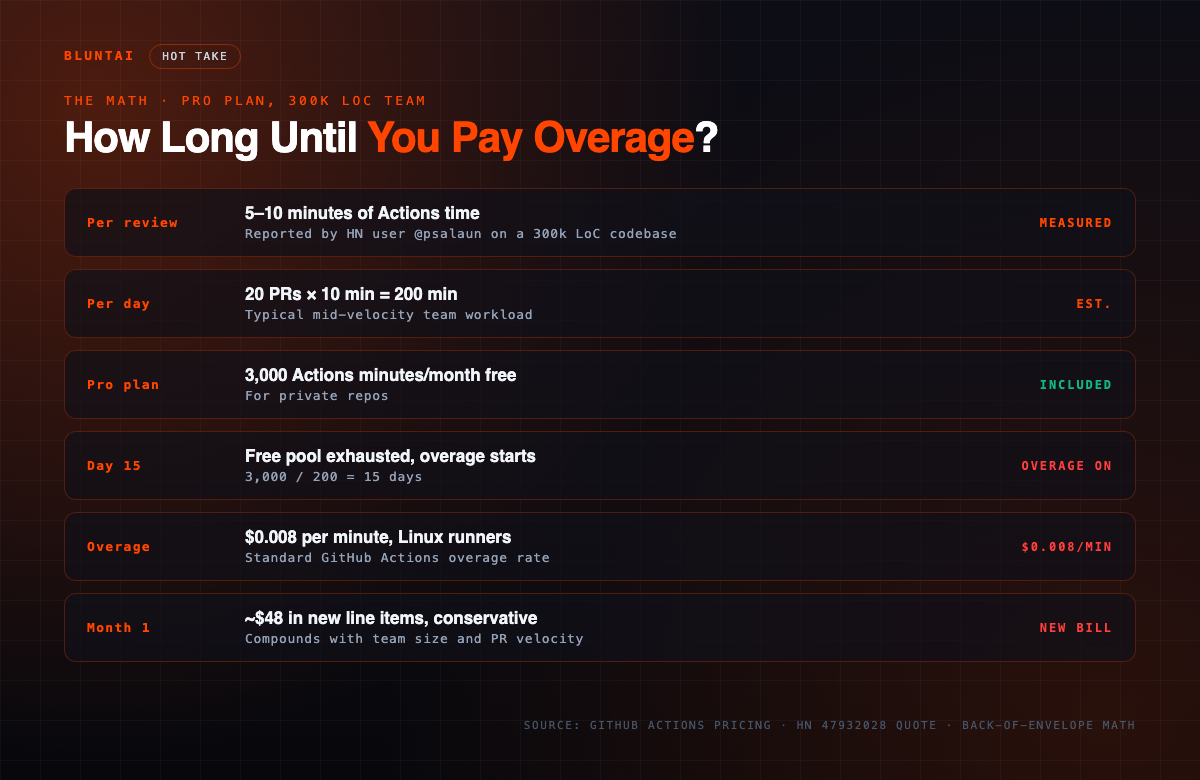
For our 300k LoC codebase, it’s between 5 and 10 min per review.
If your team is doing twenty PRs a day and Copilot reviews each one, that’s one to three hours of Actions minutes per day, every day, on top of whatever your CI is already burning. The Pro plan ships with 3,000 free Actions minutes per month for private repos. At 10 minutes per review and 20 PRs a day, you blow through the entire month’s allowance in 15 days. Then you start paying overage at $0.008/minute on Linux runners. For a midsize team, that’s a real four-figure monthly line item appearing where there was no line item before.
GitHub did not publish how many Actions minutes a “typical” review consumes. They did not publish a calculator. They left the math to you.
The Bait, And The Switch
Let’s name this for what it is. Two years ago, GitHub launched Copilot code review as a free, integrated, on-by-default feature for paying Copilot users. It was a great way to get teams hooked. Most engineering orgs of any size now have this turned on across their PR workflow. Pull requests get an automatic review comment within seconds of being opened. Reviewers got used to seeing it. Tooling integrations got built around it. Internal style guides got written assuming it.
Then, on April 27, 2026, with 34 days notice, GitHub announced the meter is going on. As HN user 2ndorderthought put it:
It’s more like a bait and switch I guess.
That’s exactly what it is. The textbook definition. You change the price of a thing after dependency on the thing has been established. The “free” price was never going to be permanent — Microsoft is not running Copilot at a loss out of the kindness of its heart — but the way you transition matters, and 34 days is not how you transition. It’s how you announce.
For comparison, when Slack changed its free-tier message retention from “all messages” to “last 90 days” in 2022, they gave 180 days notice. When Heroku killed the free dyno tier, they gave 75 days. Even Twitter, of all platforms, gave 90 days notice when it killed third-party API access in 2023. GitHub is giving you five weeks. By the time most engineering teams’ procurement processes have noticed the announcement, the cutover is already live.
The Bigger Story: AI Pricing Hits The Wall
pier25 on HN said the quiet part:
Expect to see more of these kinds of announcements as companies need to start showing returns on their AI investments.
This is the actual story. GitHub Copilot was sold, and is sold today, as a flat-rate subscription: $10/month for Pro, $19/month for Pro+, $39/seat for Business, $39/seat for Enterprise. Inside those flat rates, you get pretty much unlimited use of completion, chat, agent mode, and (until June 1) review.
Now scale up the model: GPT-5.4, Claude Opus 4.6, Gemini 3 Pro. Each of those costs Microsoft real, growing, per-token money to run. Each new agentic feature shipped (auto-review, agent mode, codespaces autopilot) burns more tokens per active user than the last. The unit economics of “$19/month all you can eat” stop working somewhere around the moment your user base discovers agent mode and starts launching ten parallel sessions per day.
GitHub’s three options were:
- Raise the flat rate. Politically painful. Headlines write themselves: “Microsoft jacks up Copilot pricing 50%.” Marketers hate it. CFOs hate the customer churn forecasts.
- Cap usage explicitly. Already partially happened with the Premium Request Unit system in 2025. Capping is unpopular but it’s what enterprise software has always done. Risk: feels like a downgrade.
- Quietly add a new metering bucket on top of the existing one. Easy to communicate (“we’re aligning Copilot review with GitHub Actions billing for transparency”), expensive to track from the customer side, and individual users only notice when their monthly bill goes up.
GitHub picked option 3. So will OpenAI. So will Anthropic. So will Cursor. The free-or-flat-rate AI tooling era is ending in 2026, and this is the first announcement at the scale of the GitHub install base. The next ones will look the same: a polite changelog, a 30-to-60-day notice, two billing units instead of one.
You will pay more. The bill will be harder to forecast. Forecasting it correctly will become a vendor management skill, the same way AWS reserved instance forecasting did in 2018.
What To Do In The 34 Days You Have Left
- Audit your team’s Copilot review usage right now. Go to your org’s GitHub billing settings → Copilot → usage. Look at the last 30 days of review volume. Estimate how many minutes per review using
psalaun‘s 5-10 minute range as a starting point on a similarly-sized codebase. Multiply. That’s your baseline overage exposure starting June 2. - Decide which repos really need automated review. It is not all of them. The high-velocity application repo? Yes. The 12 archived terraform-modules repos with zero PRs a month? Disable Copilot review there. Most teams have it on globally because that was the default; June 1 is a forcing function to actually pick.
- Negotiate now. If you’re on Business or Enterprise, your AE has a quota to hit Q2. Asking for a contract amendment that extends current pricing through the end of your existing term, or that bundles additional Actions minutes at a discount, is a normal procurement move. Just do it before June 1, after which the leverage shifts.
- Look at the alternatives. Cursor, Continue, Aider, and the increasingly viable open source / self-hosted review setups (Claude API + a thin orchestration layer) get more attractive every time GitHub does this. The migration cost is real, but the bill differential at scale starts compounding the moment double-billing kicks in. Run the numbers.
- Set a calendar reminder for May 28. Three days before the cutover, audit again. Disable review on any repo where you can’t justify the new cost. Communicate the change to your team. The teams that get hit hardest in June are the ones that didn’t know it was happening.
The Quiet Part Out Loud
AlexandrB on the HN thread put the long-run economics in one sentence:
The amount of inference you can get on a £200/month OpenAI or Anthropic subscription is easily an order of magnitude more than what you’d get paying the same amount at subscription rate.
The subscriptions are subsidized. They were subsidized to acquire users. The users have been acquired. The subsidy is being withdrawn. This is not GitHub being uniquely cynical. It is the entire AI-product industry’s flat-rate honeymoon ending. June 1, 2026, is a date worth remembering as the first big-name public moment of that ending.
You have 34 days. Use them.
Rating: The free lunch ends June 1. Bring a wallet.
Sources:
- GitHub Changelog (April 27, 2026): github.blog/changelog/2026-04-27-github-copilot-code-review-will-start-consuming-github-actions-minutes-on-june-1-2026
- Hacker News thread (235 points, 163 comments): news.ycombinator.com/item?id=47932028
- GitHub Actions pricing reference: github.com/pricing

Disclaimer: BluntAI may earn affiliate commissions from links in this article. This never influences our reviews. We buy and test everything ourselves. Our opinions are brutally our own.