Cluely’s $7M Lie, a16z’s $15M Shrug, and the Cheating Startup That Finally Cheated on the Press
Here is the part of the Cluely story that every venture capitalist is going to pretend they didn’t notice.
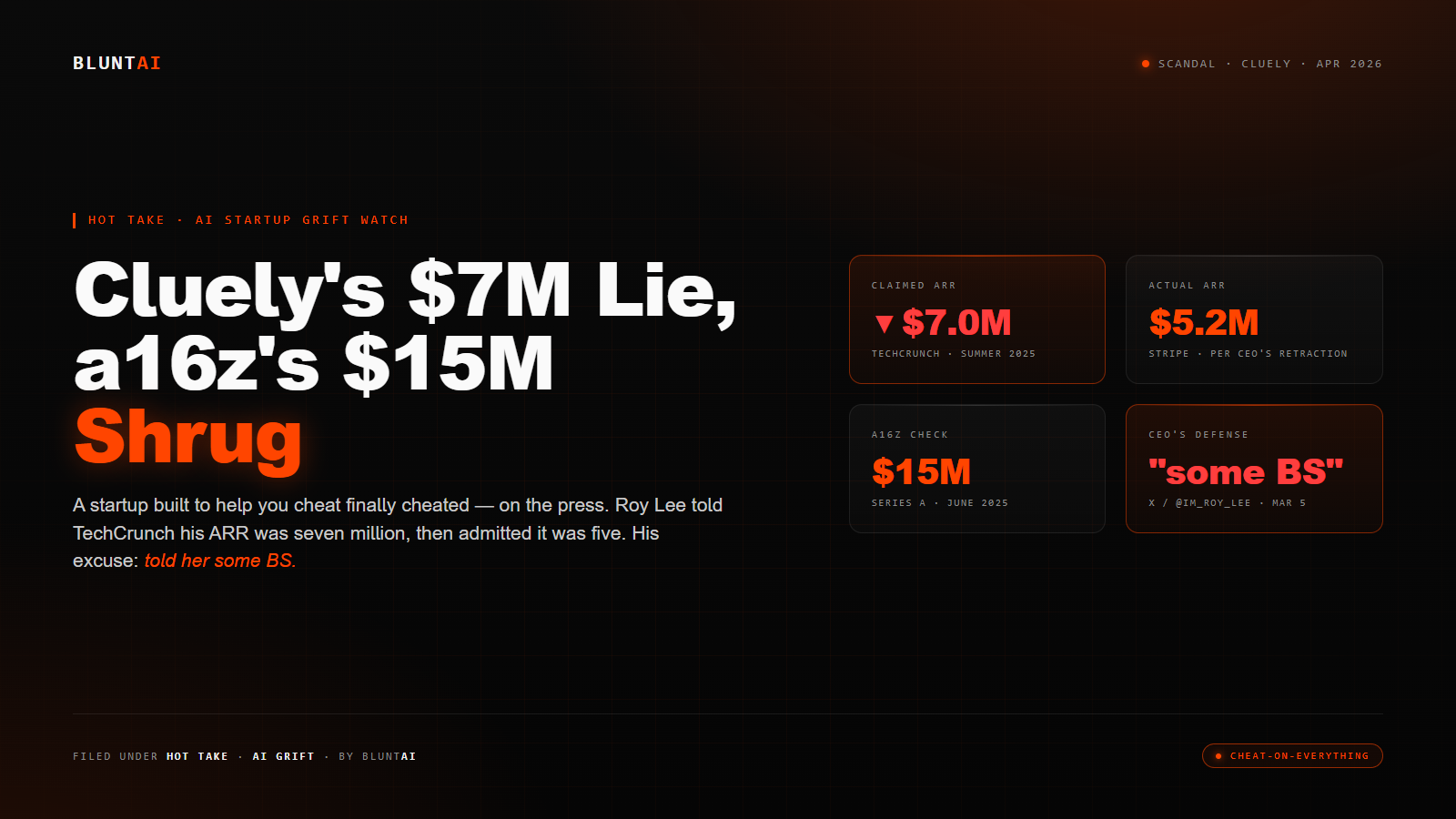
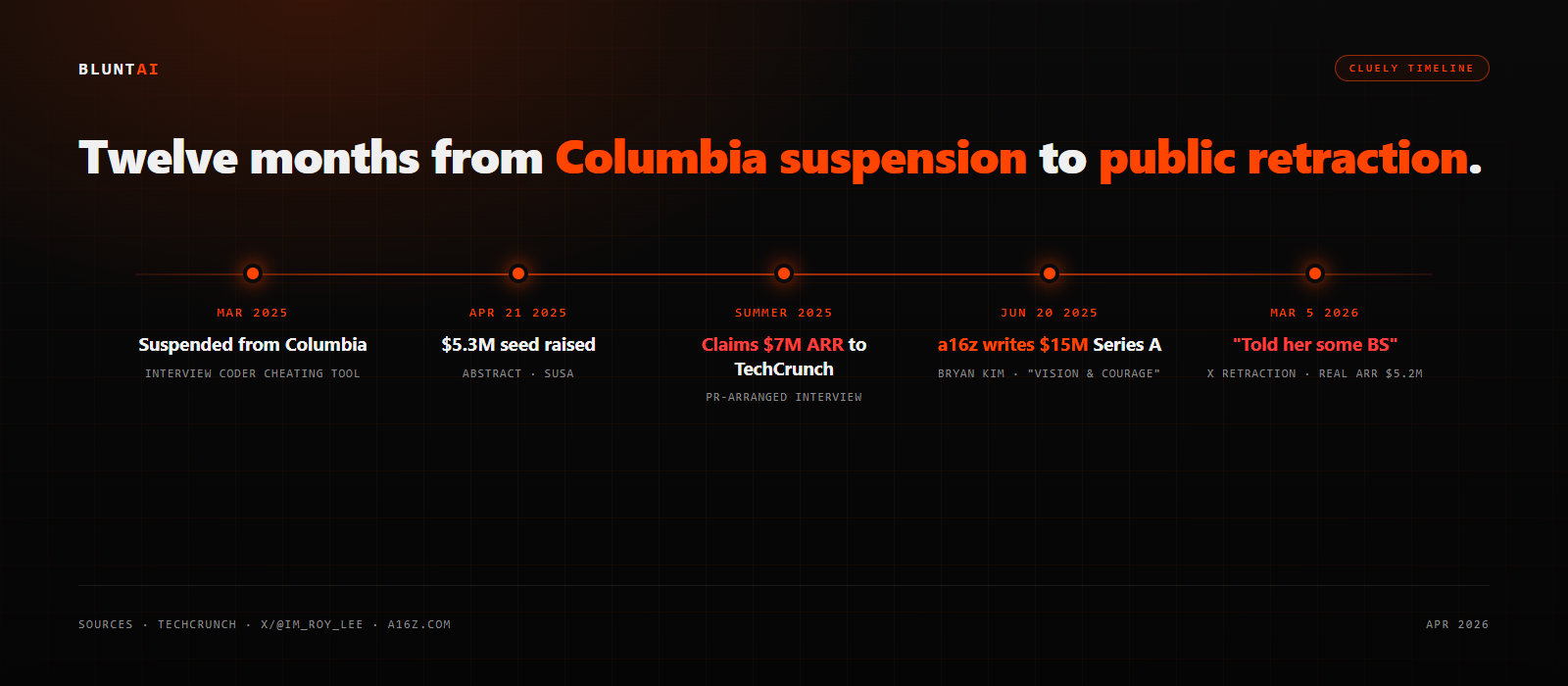
In April 2025, a twenty-one-year-old Columbia dropout named Roy Lee raised $5.3 million in seed money for a product whose explicit pitch was “cheat on everything.” Exams. Sales calls. Job interviews. A hidden browser overlay the other person on the call can’t see, feeding you answers in real time. Two months later, Andreessen Horowitz — the most famous venture firm in Silicon Valley — wrote Lee another $15 million check at a Series A and put out a celebratory blog post calling him “a rare combination of vision and courage.”
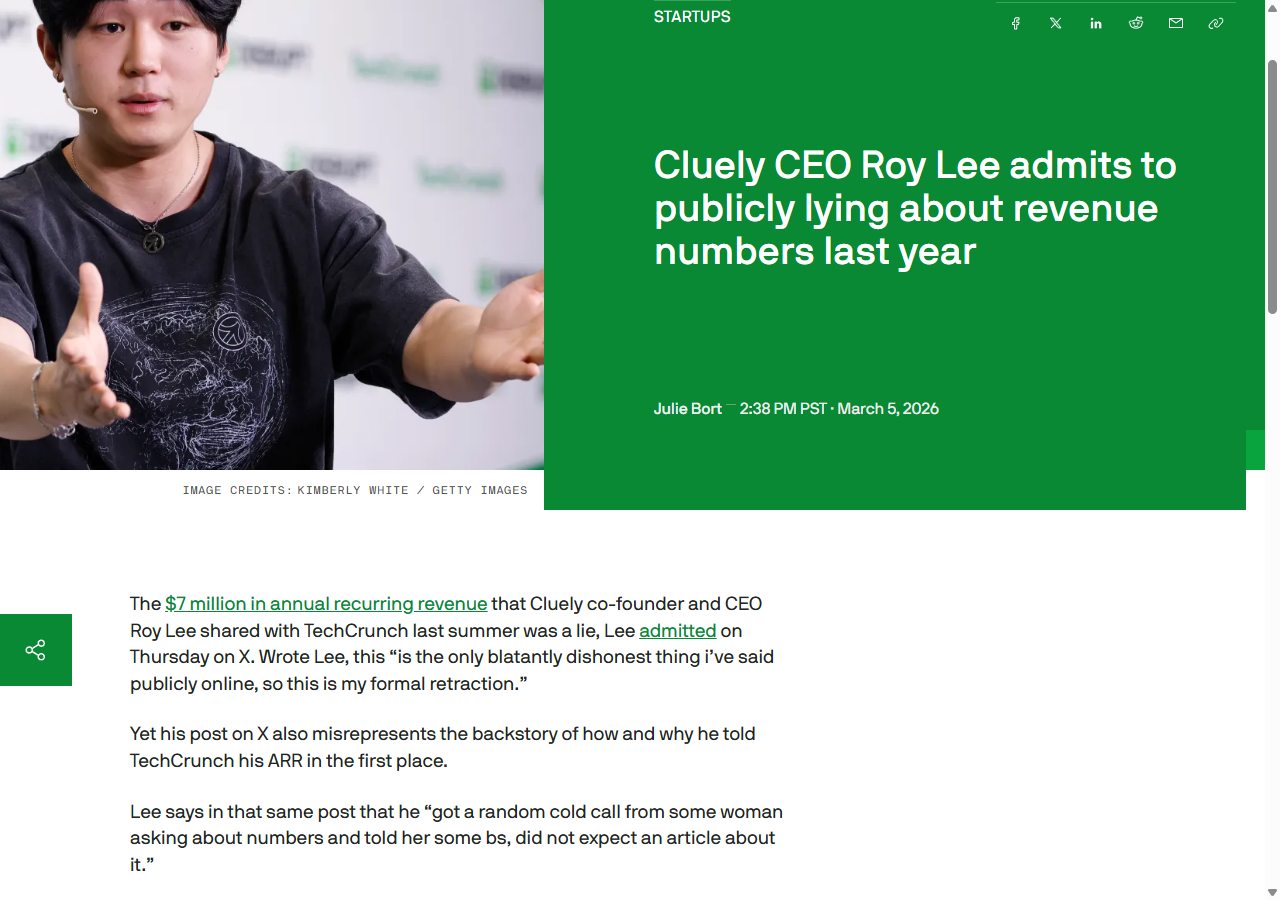
Then, on March 5, 2026, Lee went on X and admitted that the $7 million annual revenue number he had told TechCrunch a few months earlier — the number that was quoted in every piece about his company, the number that almost certainly helped anchor his Series A valuation — was a lie. His exact words: “got a random cold call from some woman asking about numbers and told her some bs, did not expect an article about it.”
The actual revenue, per Lee’s own retraction, was $5.2 million. He had inflated it by about 35%. And his excuse for getting caught was that he didn’t think the journalist would, you know, write it down.
I want to lay out what just happened here, because the stack of ironies is genuinely funny and also a little bit educational if you are paying attention.
The founder whose product was “cheat on everything” cheated on the press
The thing Cluely sells is a Chrome extension and desktop tool that puts a hidden window on your screen during live conversations and quietly whispers answers into your ear. The marketing copy is not subtle. The original demo video had Lee using it to fake his way through a date at a restaurant, gaming the conversation with AI prompts about the woman’s wine preferences. The viral launch slogan was literally “cheat on everything.”
This is the background you should keep in your head while reading the rest of this post. Lee did not stumble into public attention by accident. He got famous — first at Columbia, where he was suspended for building Interview Coder, a tool that fed LeetCode answers to job candidates over video call; then on TikTok, where he livestreamed shenanigans with a “fratty” intern army; then on the front page of TechCrunch — because his entire brand is that the rules do not apply to him and that you, too, can opt out of them for a monthly subscription.
That brand is the pitch. The pitch is why a16z wrote the check.
And then he went on record claiming $7 million in ARR to the most-read tech publication on the planet, and when it turned out the number was not close to true, he told his audience that he “never publicly said anything dishonest before” this one isolated incident — as if the product itself weren’t a subscription service for systematic dishonesty.
Reader, I am not a moralist. I am not going to tell you what Cluely sells is wicked. People have been cheating on exams since exams existed. But “I told a journalist a random made-up number and didn’t expect her to write it down” is not a credible defense from the founder of a company whose whole premise is that reality is a game you can route around.
Loading tweet…
The retraction that makes it worse
Read Lee’s retraction carefully and it gets worse, not better.
He did not just correct the number. He also said the TechCrunch reporter called him out of the blue. That was a lie within the lie: the TechCrunch piece itself noted that Cluely’s own PR rep had emailed the reporter and set up the interview. There was no cold call. Lee was on a scheduled, agreed-upon press call. His PR team had pitched the story. The only random element was Lee, apparently, deciding mid-call that he’d make up a bigger number on the spot because it would look good.
Then he posted the “actual” figures: $2.7M consumer ARR, $2.5M enterprise ARR, for a total of $5.2M as of June 2025. Which, if you are keeping score, is a respectable number for a startup with three employees and eight months of history. He did not need to inflate it. The real story — “kid gets suspended from Columbia, goes viral, builds $5M revenue line in under a year” — was already good enough to raise a $15M Series A. He made up the bigger number because he wanted to, not because he had to.
And if you are a Cluely investor reading that retraction and thinking “okay, glad we got honest numbers now” — remember, these are the numbers from the guy who just admitted he casually fabricates them on press calls. The whole problem with a compulsive inflator is that every subsequent claim has to be discounted by the size of the last lie.
What a16z was supposed to be checking for
Here is the part that should make every LP in a16z’s fund wake up at 3 a.m.
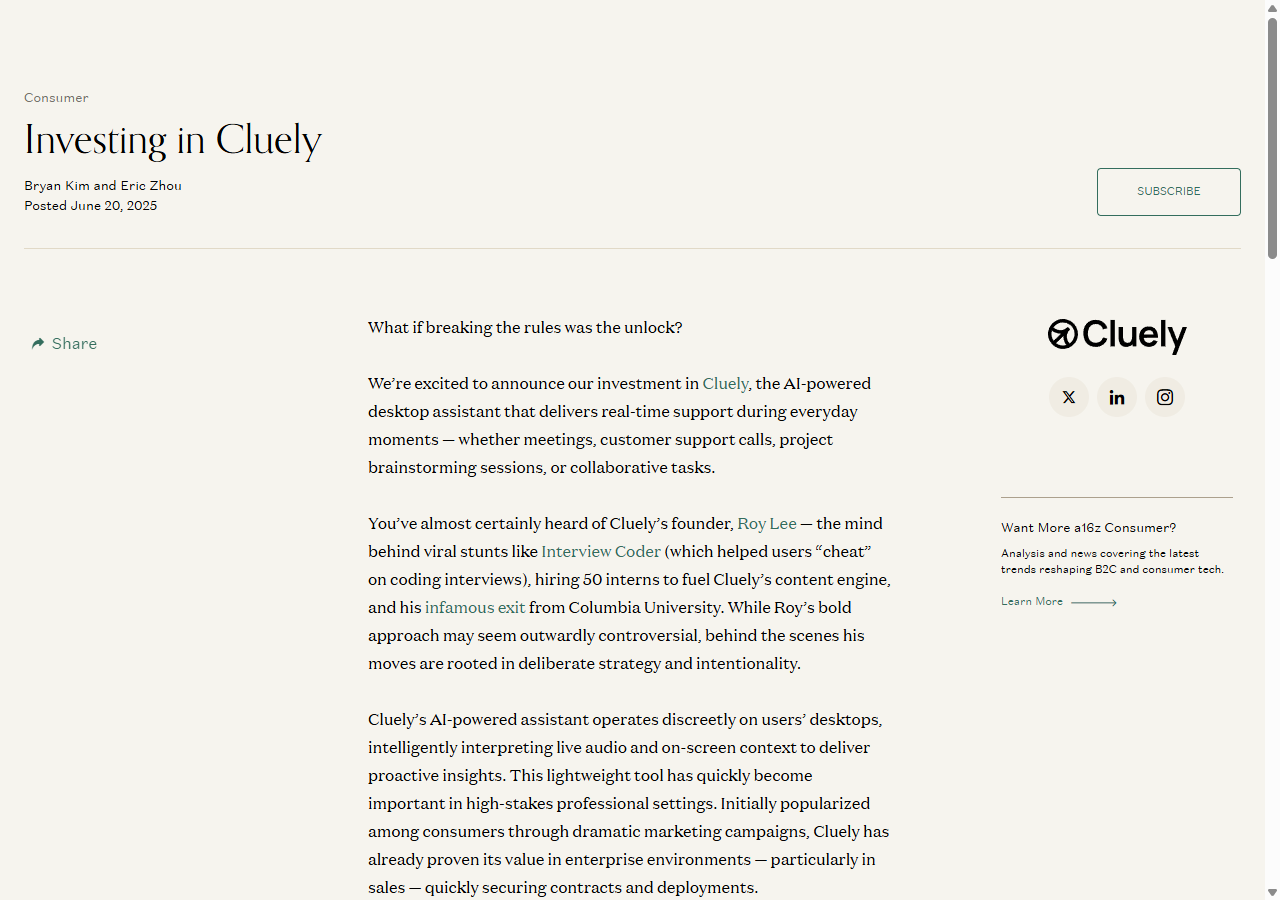
a16z’s public justification for the Cluely investment, given by partner Bryan Kim in an on-the-record podcast, was essentially vibes: Cluely had “pierced through the noise”, the founder had a “rare combination of vision and courage”, and the company was converting “awareness into paying customers.” That last one is the part that matters, because it’s the only quantitative claim in the case for the deal. And the quantitative claim was based on — you are not going to believe this — whatever revenue numbers Roy Lee told them.
Those are the same numbers that, eight months later, Lee would publicly admit he makes up on phone calls.
VCs will tell you they do extensive due diligence on a Series A. Stripe access. Bank statements. Recurring revenue audits. Maybe a16z did all of that and the $7M number was already known to be inflated inside the data room. Maybe it wasn’t. We don’t know, because a16z hasn’t said a word about the retraction, and I suspect they won’t, because the honest answer is either “we knew he was lying to journalists and invested anyway” or “we didn’t know and our diligence missed it.” Both are bad. One is cynical, one is embarrassing. Either way, you’re the mark.
The rebrand nobody is buying
Here is my favorite detail. After the retraction dust settled, Cluely quietly pivoted its public messaging. The product is no longer positioned as the “cheat on everything” tool. It’s now described, with a straight face, as an “AI-powered meeting note-taker.”
A meeting note-taker.
The same hidden overlay, the same invisible-to-the-other-person architecture, the same real-time answer whispering — now it takes notes. The founder who got famous by recording himself scamming his way through a restaurant date now wants you to believe his company makes Otter.ai. It is, to be blunt, the single least-convincing pivot I have seen in a year of watching AI startups try to launder their marketing.
What this tells you, if anything
You can read this story two ways.
The cynical read is that Cluely is an AI startup working exactly as designed. The product cheats, the founder cheats, the VCs look the other way because the brand is loud, and the only thing that failed is a single press claim being checkable after the fact. Everything else is humming. The cheque has cleared. Roy Lee is still the CEO. A16z hasn’t clawed anything back. The story will blow over and the next Cluely pitch deck will, I promise you, list this whole episode as evidence of “founder resilience.”
The charitable read is that Roy Lee is 22 and exhausted and made a dumb mistake on a phone call and owned up to it when he got caught, and maybe this is the moment he actually learns something about being a public CEO. Possible. I’d respect the growth. I’d also note that the first pattern break would be shipping a product that is not literally designed to help its users lie more efficiently, and I don’t see that in the roadmap.
My verdict on Cluely itself: Save your money. The tool does what it says on the tin, but “what it says on the tin” is a confession. You are paying $29 a month to have a computer tell you what to say on sales calls so that the person on the other end doesn’t find out you don’t know. That’s not an edge. That’s a countdown. Six months from now your prospects will be running the same Cluely extension back at you, and the whole value prop evaporates into two mirrors bouncing each other’s pre-baked objections.
And a last one for a16z: you invested $15M in a founder whose moat is dishonesty, and then acted surprised when he was dishonest. Bad look. Fund culture reveals itself in who you double down on after they embarrass you. We’re watching.
Sources
- TechCrunch — Cluely CEO Roy Lee admits to publicly lying about revenue numbers last year (Julie Bort, March 5, 2026)
- Roy Lee’s retraction post on X (March 5, 2026)
- Andreessen Horowitz — Investing in Cluely (Bryan Kim & Eric Zhou, June 20, 2025)
- TechCrunch — Columbia student suspended over interview cheating tool raises $5.3M to “cheat on everything” (April 21, 2025)
- Inc. — An a16z-Backed Startup That Helps People Cheat on Job Interviews Just Got Caught in a $7 Million Lie (Leila Sheridan)
All opinions expressed on BluntAI are editorial opinions based on publicly available information and personal testing. We may earn affiliate commissions from links on this site.
Disclaimer: BluntAI may earn affiliate commissions from links in this article. This never influences our reviews. We buy and test everything ourselves. Our opinions are brutally our own.