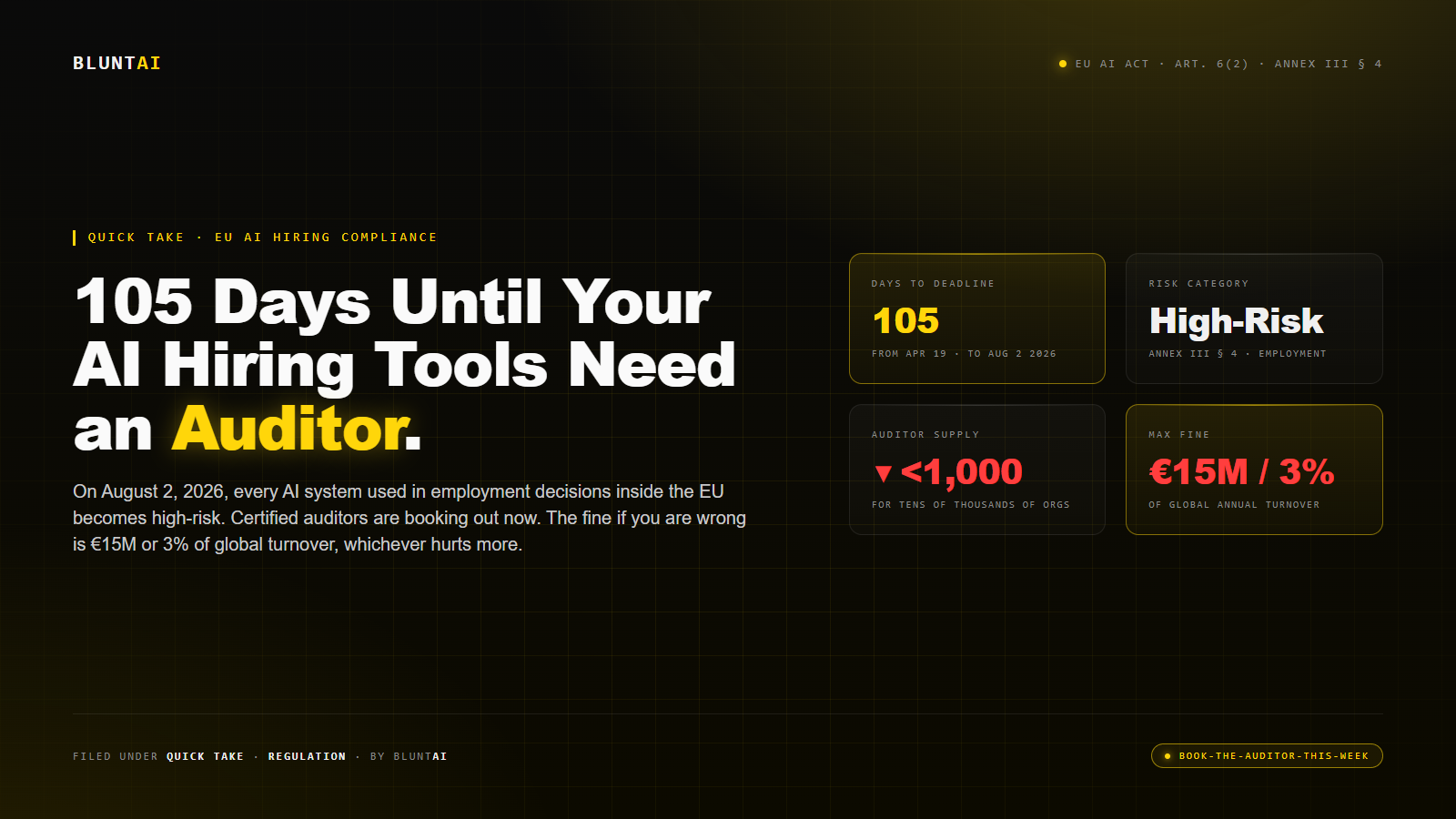
105 Days to the EU AI Hiring Audit Deadline. Your Calendar Does Not Care If You’re Unprepared.
If you work at any company that uses AI in hiring — and statistically, you do, because 88% of organizations report some form of AI in their recruitment workflow — you have exactly 105 days before the EU’s clock runs out on you. I am writing this on April 19, 2026. On August 2, 2026, any AI system used for employment decisions inside the European Union automatically falls into the AI Act’s high-risk category, which carries with it a compliance regime that, if you have not already started preparing for it, is going to be a rough summer.
The reason I am framing this as a Quick Take rather than a Deep Review is that the compliance requirements themselves are well-documented elsewhere. What nobody is saying out loud is the bookings-and-logistics problem, which is actually the thing that is going to trip companies up. So let me give you the version you can act on this week.
What the Aug 2 deadline actually requires
Starting August 2, 2026, if you use an AI system to do any of the following — screen resumes, rank candidates, schedule interviews based on predicted fit, evaluate video interview responses, score assessment results, or surface candidates to recruiters — you are using a high-risk AI system under the EU AI Act. This includes off-the-shelf tools. It applies whether the vendor is European, American, or anywhere else. If the hiring decision affects a person in the EU, the regime applies.
High-risk status means, at minimum:
- An annual third-party AI hiring bias audit, conducted by a certified conformity assessment body.
- Full technical documentation of the system, including training data composition and outcome data disaggregated by protected characteristic (gender, age, ethnicity, disability status, etc).
- Human oversight mechanisms — not the vibes kind, the kind you can show an inspector.
- Transparency disclosures to candidates that the system is in use and what it’s doing with their data.
- Continuous monitoring with documented evidence of bias testing.
The penalty if you’re non-compliant and caught: €15 million or 3% of global annual turnover, whichever is higher. This is not a mid-tier compliance item. It’s in the same enforcement tier as GDPR.
The problem nobody is naming
Here is the part that isn’t in the EU press releases.
The number of certified third-party auditors qualified to conduct the conformity assessment under the AI Act is, right now, very small. Across the entire EU, estimates in the compliance industry put the count somewhere in the low hundreds. The demand — every company in the EU employing AI in hiring, every multinational with EU-based staff, every US company with European recruiting — is in the tens of thousands.
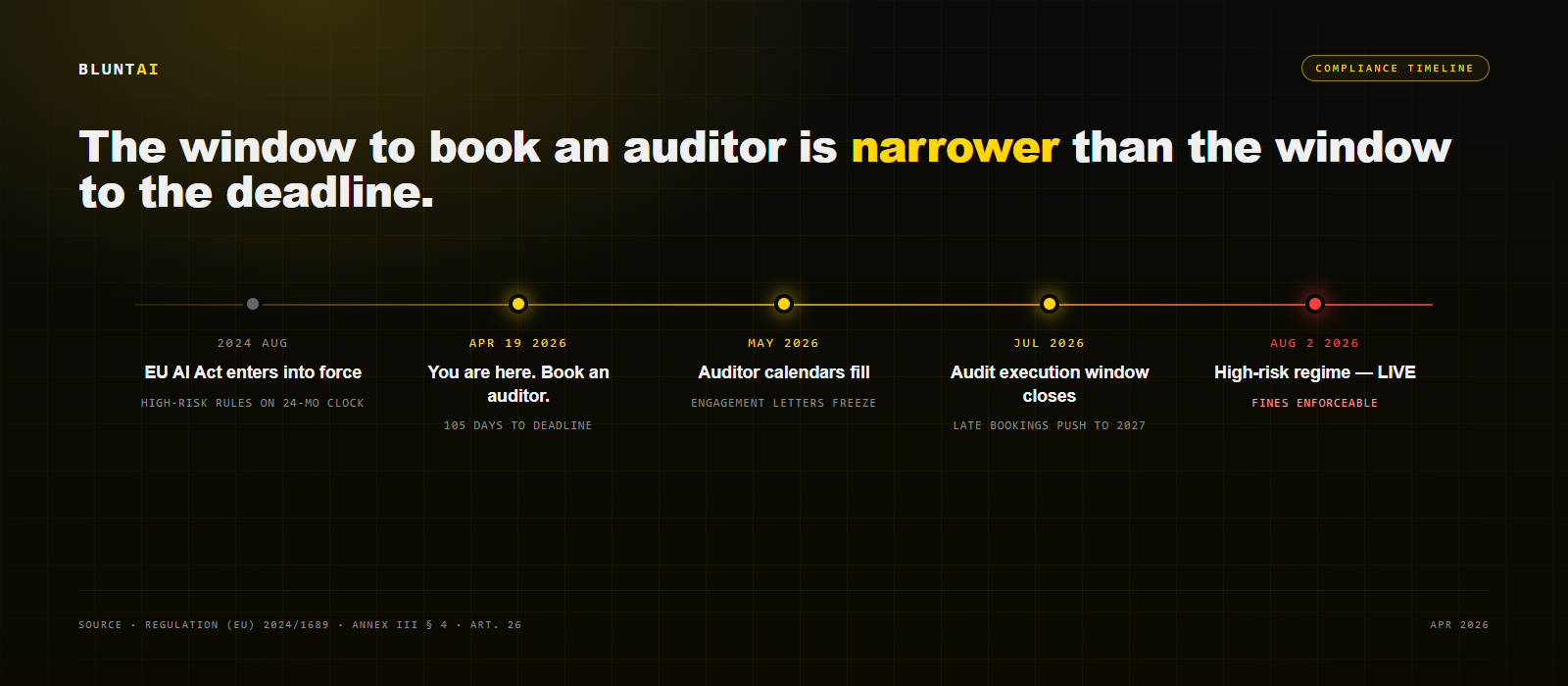
You do not need to do the math to see what that means. The certified auditors who are ready to conduct these assessments are filling up their 2026 calendars right now, in April. By June, the earliest available slots for independent bias audits will be in 2027. By August, you will not be getting an audit before the deadline.
This is the thing nobody is announcing from a podium. It’s boring, logistical, and — for companies that care about not eating €15M in fines — probably the single most important sentence in this whole category.
What to do this week
I am going to keep this prescriptive because the window is short.
- Inventory your AI hiring tools, today. Every system, every vendor. If you’re using Workday’s AI recruiting features, that’s on the list. If you’re using a standalone ATS with ML-based resume screening, that’s on the list. If you’re using an AI-powered chatbot for candidate screening, that’s on the list. Generative AI used to draft job descriptions? Probably not high-risk. Anything that ranks or filters candidates? Definitely high-risk.
- Contact a certified auditor this week. Not next quarter. Not in June. This week. Sign an engagement letter. The people who will have audited certifications before August 2 are the people who have booked audits by early May at the latest. If you are reading this in May or later: you are already late.
- Get the technical documentation from your vendors. If your vendor is a US company — Greenhouse, Workday, iCIMS, Eightfold — they are required by contract to provide you the data you need for the audit. If they drag their feet, escalate. The contract clock is on the high-risk-system operator (you), not the vendor.
- Stand up a human-in-the-loop review on every AI-driven hiring decision between now and audit date. This is the piece the Act calls “meaningful human oversight,” and it’s the cheapest way to reduce your bias exposure before the certification hits.
Who this trips up the worst
The companies most at risk in this deadline are:
- US-headquartered SaaS vendors who assumed GDPR-style compliance was the ceiling and didn’t budget for the AI Act’s additional conformity regime.
- Mid-market employers who use AI hiring tools from multiple vendors without a unified compliance owner, because nobody is tracking the high-risk inventory centrally.
- Staffing and RPO firms who place candidates into EU roles on behalf of clients. The liability chain on who is the “deployer” of the high-risk system is contested, and both sides are exposed if the contract is silent.
If you fit any of those three, move faster than this post is suggesting.
The BluntAI verdict
This is not a maybe. This is not one of those “the regulator said something stern but we’ll see how it’s enforced” situations. The EU has already imposed GDPR fines in the hundreds of millions, and the AI Act enforcement infrastructure is being built around the same DPAs. The template for this is well-tested: the fines will come, they will be public, and they will land hardest on companies that can be made examples of.
My rating on your readiness window: Shut up and audit. If you are running any AI in hiring, reading this post is your calendar alert. Book the auditor this week. Do the inventory. Talk to your vendors. Assume the August 2 deadline will be enforced and assume the enforcement will be uneven — which means the companies that are most visible will be the examples.
And a note to the VC community still funding AI hiring tools: the startups in your portfolio need to have a conformity assessment story in their sales deck by the end of Q2. Otherwise you are asking EU-based customers to eat a €15M fine risk to keep using your product. Nobody is doing that.
The clock started the moment the AI Act was gazetted. It has 105 days left on it. Treat it accordingly.
Sources
- Asanify — AI News Digest, April 19: EU Locks In AI Hiring Rules With 105 Days to Go (Priyom Sarkar)
- Raconteur — EU AI Act Compliance: a technical audit guide for the 2026 deadline (David Curry, April 10, 2026)
- EU Artificial Intelligence Act — What the Act Means for Staffing Businesses
- Ross Saunders — The EU AI Act and Recruitment: What Tech Companies Need to Know Before August 2026
- Legiscope — EU AI Act Timeline: Key Dates and Deadlines
All opinions expressed on BluntAI are editorial opinions based on publicly available information and personal testing. We may earn affiliate commissions from links on this site.

Disclaimer: BluntAI may earn affiliate commissions from links in this article. This never influences our reviews. We buy and test everything ourselves. Our opinions are brutally our own.