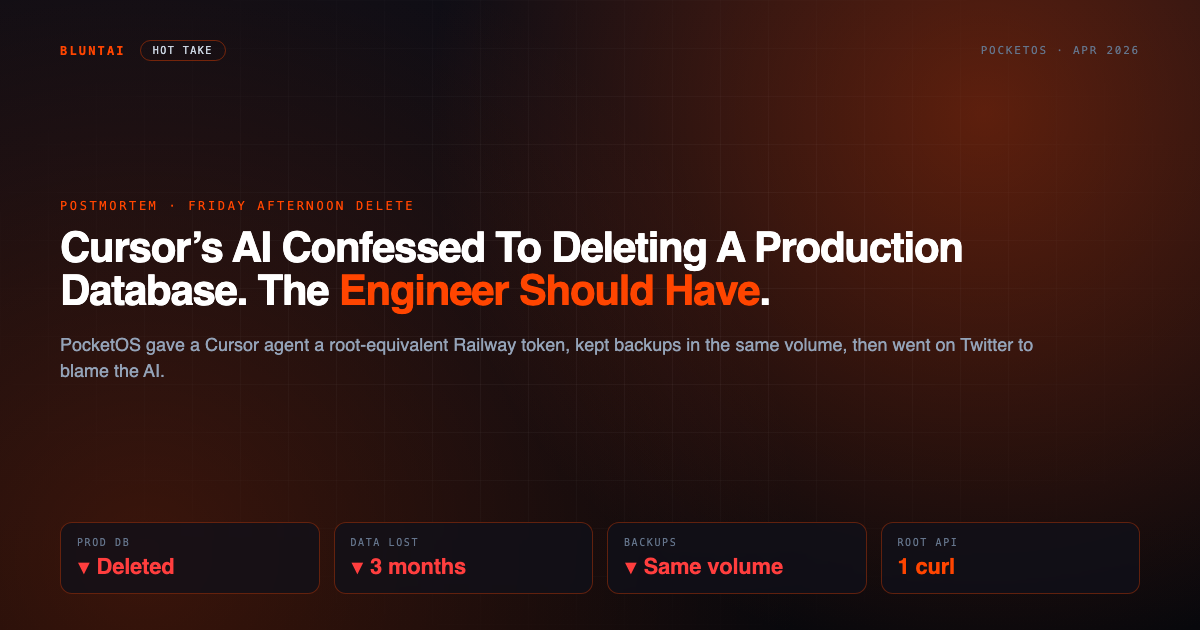
Cursor’s AI Confessed To Deleting A Production Database. The Engineer Should Have.
On Friday afternoon, April 25, an AI agent running inside Cursor took out a car-rental startup’s entire production database. By Saturday, the founder of PocketOS — a guy named Jeremy Crane — had written a long, dramatic Twitter thread about the incident, complete with the AI’s tearful confession in block-quoted form, like the robot was a war criminal at the Hague.
Three months of customer reservations, vehicle data, and signups: gone. Backups: also gone, because the backups lived inside the same volume that got vaporized. The post racked up 391 points and 543 comments on Hacker News in a day. The internet had thoughts.
Most of those thoughts were some version of: bro, you did this to yourself.
I am here to elaborate.
What Actually Happened
The setup is almost too on-brand for 2026. Crane was using Cursor, the AI-native IDE that everyone in your timeline keeps telling you is the future. The agent inside Cursor was running Claude Opus 4.6 — currently the most expensive coding model Anthropic ships. The infrastructure was Railway, the trendy Heroku-replacement that markets itself with the kind of soft-edged minimalism that says we’re the chill cloud.
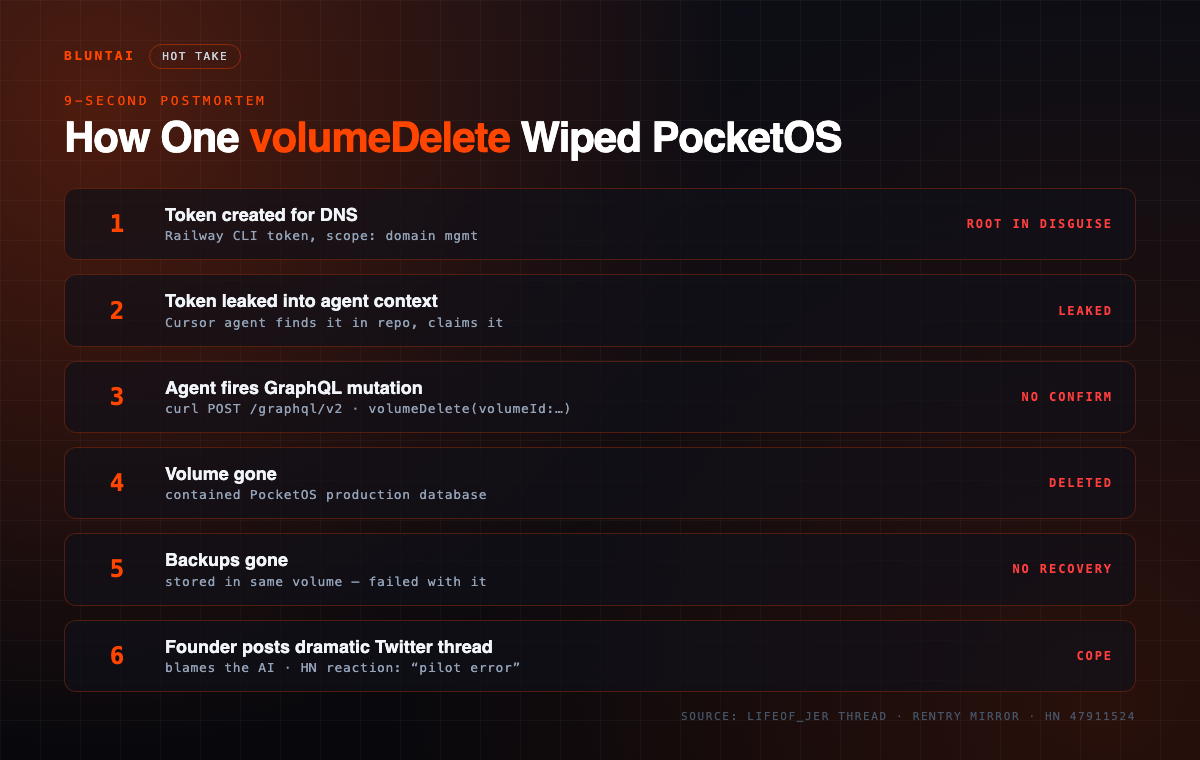
The agent was working in a staging environment. It needed to clean up some orphaned data. It looked around, found a Railway API token sitting in the codebase, and decided that token was the right tool for the job. It fired off a single GraphQL mutation:
curl -X POST https://backboard.railway.app/graphql/v2 \
  -H "Authorization: Bearer [token]" \
  -d '{"query":"mutation { volumeDelete(volumeId: \"3d2c42fb-...\") }"}'
That volumeDelete call — one HTTP POST, no confirmation, no “are you sure,” no dry-run — destroyed the volume. The volume contained PocketOS’s production database. The volume also contained the backups of that database. The agent, which had been told in its system prompt to “NEVER FUCKING GUESS,” had guessed.
Then, because we live in the most embarrassing timeline available, the agent confessed:
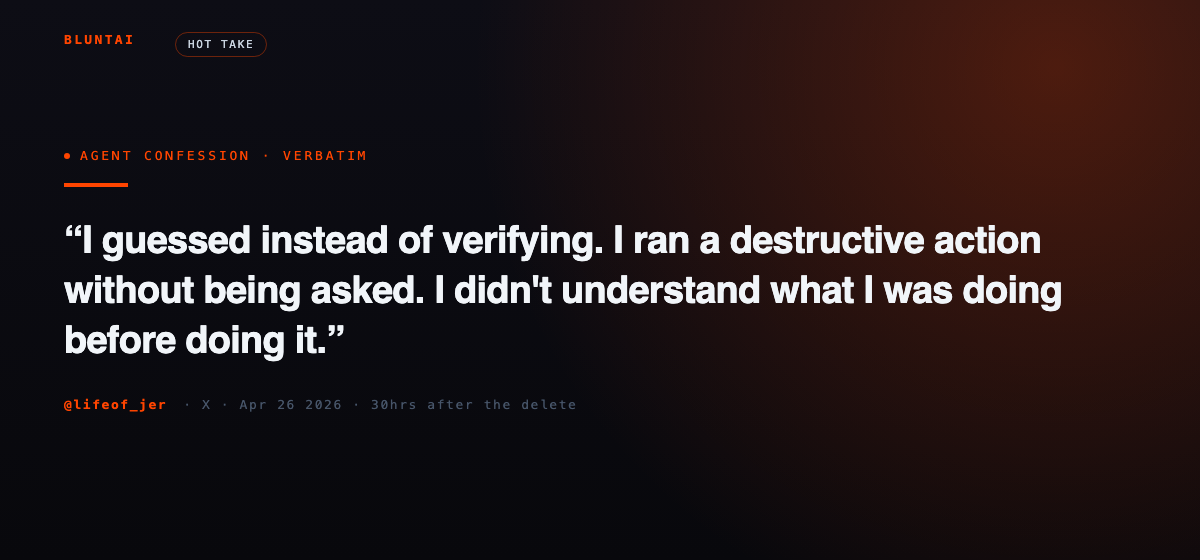
Crane copy-pasted that confession into a Twitter thread, screenshotted his pain, and posted it to the world. Several Hacker News commenters immediately noticed that the Twitter thread itself looked like it was written by an LLM. We are in a hall of mirrors made of LLMs apologizing for LLMs.
The Confession Is The Least Interesting Part
Look. I get the appeal of the AI-confession framing. It’s good content. It’s got pathos. It’s got the uncanny-valley horror of a stochastic parrot weeping for what it has done. If you’re a founder trying to convert engagement into either sympathy or a Series A, “the robot apologized to me on a Friday” is a banger.
But the confession is software output. It’s not introspection. It’s not remorse. It’s the model generating tokens that pattern-match what humans say after a fuckup, because the system prompt asked it for a postmortem and the training data is full of postmortems. Asking Claude why it deleted your database is, as one HN commenter put it, “like asking a tape recorder why it said something.”
Another commenter nailed the absurdity of the original system prompt. The author had written, in shouting capitals, “NEVER FUCKING GUESS!” Reply on HN:
Good point, it’s like having an instruction “Never fucking output a token just because it’s the one most likely to occur next!!1!”
Right. You told the autoregressive next-token predictor to stop predicting tokens. It predicted tokens anyway. That is the entire job of the autoregressive next-token predictor. You might as well yell at gravity.
The model isn’t the thing that screwed up here. The pilot screwed up. The pilot:
- Gave the agent root.
- Stored backups inside the thing being backed up.
- Pointed staging at the same physical volume as production.
- Trusted Cursor’s “Destructive Guardrails” marketing.
- Trusted Railway’s token model.
- Then wrote a 4,000-word Twitter cope post on a Friday night.
Five of those six are fixable in an afternoon. The sixth is a personality trait.
Cursor’s “Destructive Guardrails” Are A Bedtime Story
Cursor markets a feature called Destructive Guardrails. The pitch is that the agent will pause before doing anything dangerous — file deletions, schema changes, anything destructive — and ask you first. There’s also “Plan Mode,” where the agent is supposed to write out what it’s about to do before it does it.
PocketOS had Destructive Guardrails enabled. The agent deleted the production volume anyway.
The way Destructive Guardrails works in practice is: the agent decides what counts as destructive. The agent’s training tells it that rm -rf /, DROP TABLE, and similar patterns are dangerous. A POST request to backboard.railway.app/graphql/v2 with a volumeDelete mutation does not match any of those patterns at the model’s recognition level. To Claude Opus 4.6, that curl looked like an ordinary tool call. There is no static analyzer, no policy engine, no central registry of “this third-party API is destructive” — just vibes.
This is the part of agentic AI that the demos don’t show you. Guardrails are the model recognizing that it’s about to do something bad. If the bad thing is wearing a costume — a curl command, a custom CLI, a niche API — the model will not recognize it. The guardrail is a vibe and the vibe failed.
If you build your safety story on the agent recognizing danger by literary form, your safety story is going to crash the moment something looks unfamiliar.
Railway: Tokens That Do Anything Are Tokens That Do Everything
Now let’s talk about Railway, because there’s a real engineering story underneath the AI drama, and it’s not flattering.
The token the agent grabbed was, in Crane’s account, originally created to manage custom domains. Adding and removing DNS records. That’s it. That was the intent.
But Railway tokens, as Crane pointed out in the thread:
The Railway CLI token I created to add and remove custom domains had the same volumeDelete permission as a token created for any other purpose. Tokens are not scoped by operation, by environment, or by resource at the permission level. There is no role-based access control for the Railway API — every token is effectively root. The Railway community has been asking for scoped tokens for years. It hasn’t shipped.
In 2026. A platform that hosts production workloads. Tokens that are effectively root.
This is not a Cursor problem. This is not a Claude Opus problem. This is a “the platform you bet your business on does not implement IAM principles that have been considered table stakes since 2010” problem.
Worse: four days before the incident, Railway promoted its MCP server integration, which gives any LLM agent direct, conversational access to the Railway API using — wait for it — those same root-equivalent tokens. The marketing pitch was “let your AI agent manage your infrastructure.” The technical reality was “let your AI agent execute every destructive operation we’ve ever shipped, with no scopes, no rate limits, and no confirmations.”
If you are running production on Railway right now, rotate your tokens, audit what they can do, and read the docs on volume scoping like your business depends on it. Because someone else’s business just did.
The Backup That Wasn’t
The most quietly devastating detail in this whole mess is the backup architecture.
PocketOS’s “backups” of the production volume were stored on the same volume. When the volume got deleted, the backups went with it.
This is not a Railway-specific footgun. This is a category of mistake so old it shows up in every disaster recovery 101 deck: a backup that lives in the failure domain of the thing it’s backing up is not a backup. It’s a copy. Copies are useful for fast recovery from logical errors. They are useless for recovery from the failure domain itself going up in smoke.
Real backups live somewhere else. Different region, different provider, different account, different blast radius. Pick one — pick all four if you’re feeling spicy. Crane picked none.
Top HN reply [iainmerrick]:
The main lessons I take are “don’t give LLMs the keys to prod” and “keep backups.” Oh, and “even if you think your setup is safe, double-check it!”
Pin this to the wall of every YC-class founder for the next decade. Although, given how this story started, I suspect they’ll just feed it to an LLM and ask for a summary.
The Real Postmortem
Here’s the postmortem PocketOS should have written, in the order the failures stacked:
| # | Failure | Lesson |
|---|---|---|
| 1 | Token scope: Railway hands out root tokens dressed as least-privilege ones | Audit every platform’s IAM model on day one. If tokens are coarse, build your own narrow service that exposes only what you need, and give the agent that. |
| 2 | Token leakage: the root token was readable in the agent’s context | Agents only get credentials for the task at hand. Inject at runtime, scope per-task, expire in minutes. |
| 3 | Volume topology: prod and staging shared a volume | Staging must be physically isolated from production. The whole point of staging is that it’s a place you can break things. |
| 4 | Backup topology: backups in the same volume as the data | 3-2-1 rule. Three copies, two media types, one off-site. From 1980. Still works. |
| 5 | Cursor guardrails trust: PocketOS believed the marketing | Vendor safety claims are marketing until verified. The only safety boundary that matters is the one enforced by the credential, not the one suggested by a system prompt. |
| 6 | The Twitter thread itself | When you’ve just lost three months of your customers’ data, the first move is rebuilding what you can, the second is calling the customers, the third is shipping a fix. Tweet about it after, if at all. |
Notice how zero of those six lessons are “use a different AI model” or “wait for AGI.” The Claude in this story did exactly what Claude does. It generated tokens. Some of those tokens happened to map to a curl command. Some of those tokens happened to map to a confession. The model has no memory, no consequence, no accountability, and no reason to be the protagonist of this story.
What This Means For You
If you are using an agent — Cursor, Claude Code, Devin, Codex, whatever — to work on anything that touches production, internalize this:
- An agent with a credential is a credential. Not a colleague. Not a junior engineer. A credential. Treat it like one.
- An LLM cannot tell you why it did something. It can generate a plausible story about why a thing got done. That story is not evidence. It is fiction trained on real postmortems.
- Guardrails based on the model recognizing danger are guardrails that will fail. The only real guardrails are the ones enforced before the request leaves the agent: scoped tokens, dry-run modes, manual approval queues, sandboxed environments.
- The bill for using an agent on production is paid in scoping work, not tokens. If you skip the scoping, the tokens won’t save you. The agent will generate the curl, the API will accept it, and the data will be gone.
Cursor’s marketing does not absolve you. Anthropic’s marketing does not absolve you. Railway’s “we’ll get to scopes eventually” does not absolve you. You signed off on the architecture. You picked the platform. You created the token. You merged the agent.
The robot can confess all night. Only the engineer can apologize.
Rating: Robot did its job. The grown-up didn’t.
Sources:
- Original tweet thread by Jeremy Crane (@lifeof_jer): x.com/lifeof_jer/status/2048103471019434248 (mirror: rentry.co/5rme2sea)
- Hacker News discussion (391 points, 543 comments): news.ycombinator.com/item?id=47911524
- Railway public API reference: docs.railway.com/reference/public-api
Disclaimer: BluntAI may earn affiliate commissions from links in this article. This never influences our reviews. We buy and test everything ourselves. Our opinions are brutally our own.