Snap’s “Crucible Moment”: Fire 1,000 People, Watch the Stock Pop 7%, Call It AI
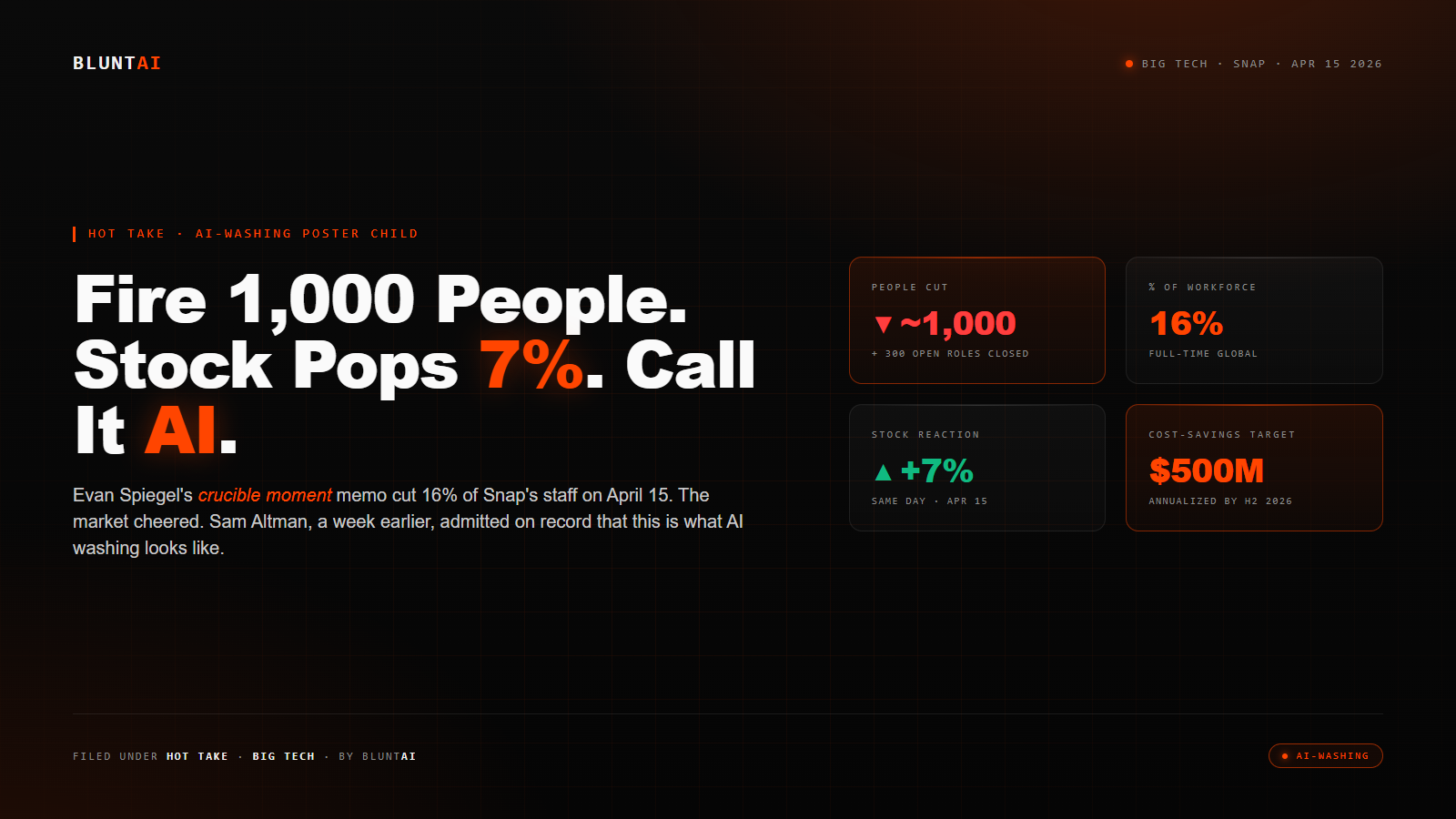
On April 15, Evan Spiegel woke his company up and told about a thousand people to pack up their laptops. Sixteen percent of Snap’s full-time workforce, plus another three hundred open roles that were suddenly not open. The number the CEO wanted you to write down is the annualized savings: $500 million by the second half of 2026. The word he wanted you to associate with the cut is “crucible.” And the reason he gave you for needing the crucible — the reason, specifically, that a decade-old social media company is now experiencing an existential “moment” that requires pulling a fifth of the team out of the building — is “rapid advancements in artificial intelligence.”
Now here is the detail that should make you tilt your head. Snap’s stock went up 7% on the day. Not down. Up. Wall Street read the press release, processed a thousand human careers being ended on the spot, and decided the company was now worth meaningfully more than it was the morning before. That is the rational outcome under current incentives, and it is exactly the pattern that the term “AI washing” was invented to describe.
I want to walk through what Snap actually said, what it didn’t, and why the same week Sam Altman — of all people — went on the record admitting that a lot of the 2026 tech layoffs are using AI as a convenient cover story.
The framing
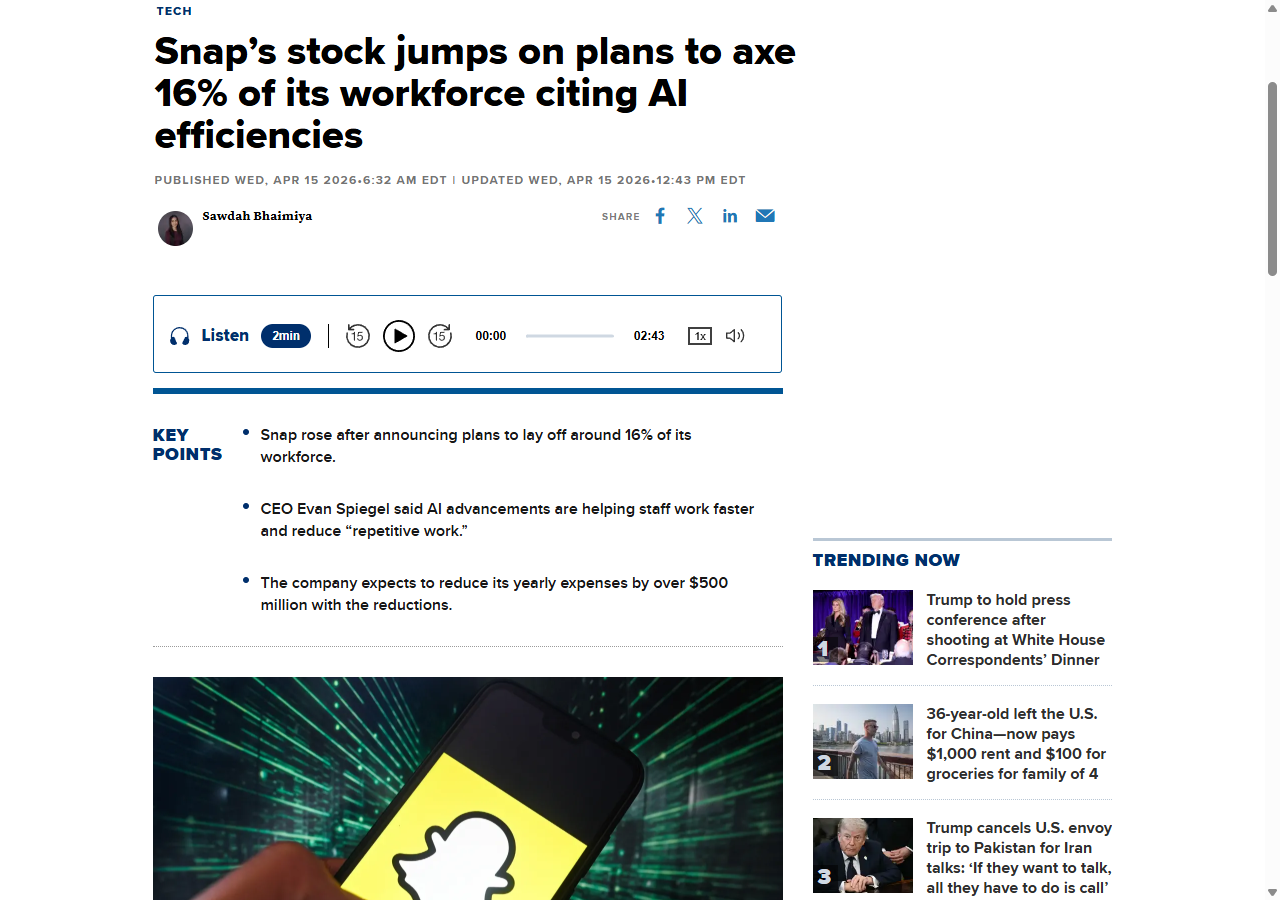
Spiegel’s memo to staff, which leaked and was published by basically every outlet that covers the industry, calls this a “crucible moment, requiring a new way of working that is faster and more efficient, while pivoting towards profitable growth.” The AI language is in there: “rapid advancements in artificial intelligence enable teams to reduce repetitive work, increase velocity, and better support the community, partners, and advertisers.”
Strip out the corporate poetry and the message is simple: we were too big, we are now smaller, we will be profitable faster, AI is what makes the smaller version work.
I am not going to argue that AI has zero role at Snap. The company has shipped chatbots, a suite of generative AR tools, some on-device ML for Spectacles, a partnership with Perplexity. It is a real product workstream. It is not the reason a thousand people got fired.
The reason a thousand people got fired is that Snap has been a publicly-traded company for nine years and has been reliably unprofitable for almost all of them. Investors have been patient, but patience has a price, and the price is a CEO writing a memo that makes it sound like the company is being pulled into a compelling new future by an inevitable technological force, rather than pushed into a necessary correction by a spreadsheet.
Those are two different stories. The first one makes the stock go up 7%. The second one does not. Snap picked the first.
The receipt
Here is the receipt for that read.
Look at what Snap kept versus what it cut. Spiegel’s memo emphasized hiring freezes on “non-strategic” roles and the elimination of layers of middle management. Engineering was hit less than ops, but ops got gutted. The “AI and ML” teams were explicitly not the target — if anything, the surviving structure is more concentrated around them. This is the standard Oracle-shaped layoff: trim the expensive customer-facing machinery, keep the bets on the frontier.
If AI efficiency were actually already unlocking massive productivity gains at Snap, you would expect to see it in the headcount ratios: engineers doing more per head, ops teams doing more per head, support responding to tickets at higher throughput. The internal reporting that’s leaked so far suggests these gains are projected, not realized. Spiegel is not telling investors “AI has already made us this much more efficient, so we can cut.” He is telling them “we are cutting, and we project AI will fill the gap.” Those are not the same sentence, and the second one is an IOU, not a delivery.
The stock market did not parse the difference. It rewarded the cut. The delivery — or the absence of it — will show up eighteen months from now in the revenue-per-employee line.
The CEO of OpenAI, of all people, admits it
This is the part that deserves more attention than it’s getting.
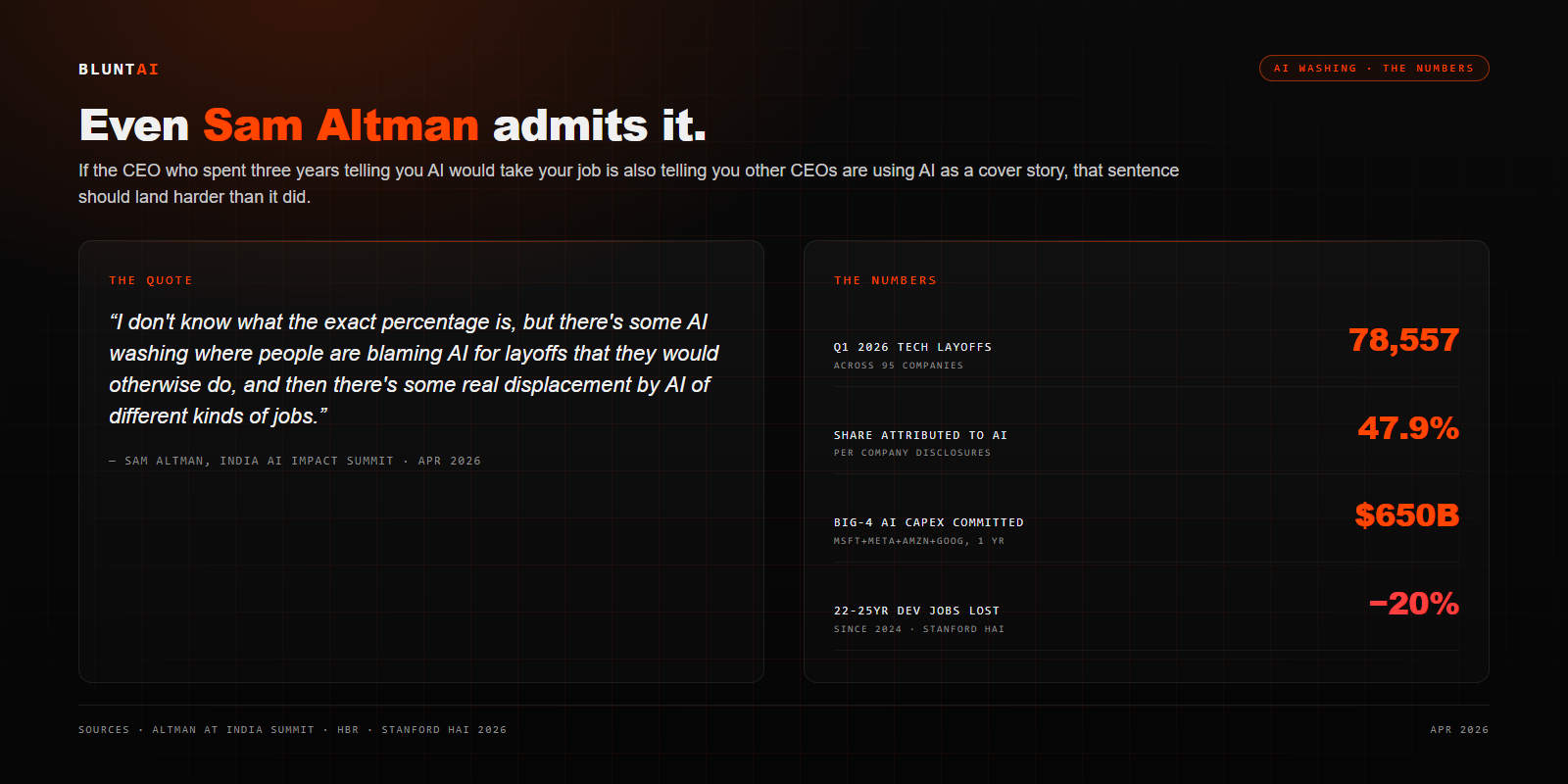
At the India AI Impact Summit in early April, Sam Altman — the loudest voice in the industry about AI replacing labor — was asked directly what percentage of the 2026 tech layoffs are genuinely driven by AI versus being repackaged as such. His answer:
> “I don’t know what the exact percentage is, but there’s some AI washing where people are blaming AI for layoffs that they would otherwise do, and then there’s some real displacement by AI of different kinds of jobs.”
Altman has every commercial incentive to inflate the number, and even he is telling you some of it is theater.
Harvard Business Review published an article in January with a headline that is too quiet for what it’s actually saying: “Companies Are Laying Off Workers Because of AI’s Potential — Not Its Performance.” Unpack that. The layoffs are happening because of a belief about where AI will be, not because AI is there yet. Which means — and this is the unsettling part — even the companies doing the layoffs don’t fully know if the gains they’ve priced in will show up on schedule.
Stanford’s 2026 AI Index, released earlier this week, put a number on adjacent reality: software developer employment in the 22-to-25 age bracket is down nearly 20% since 2024, while the headcount of older, more experienced developers keeps growing. The cuts are hitting the entry level first. Some of that is AI. Some of it is post-pandemic overhiring normalizing. You cannot cleanly separate the two, and neither can anyone else, which is precisely what makes “AI” such a convenient narrative for any executive who wants to trim headcount without being the bad guy.
What Snap is really telling you
Here is the version of Snap’s story that would not have made the stock go up 7%, but would be closer to the truth:
“We have been losing money at a slower rate than before, but still losing money, and our public-market investors are no longer willing to fund that position indefinitely. We need to reduce our cost base by about $500M a year to put profitability within realistic reach. Some of that cut will come from tasks that AI tools genuinely do replace, mostly at the entry level. Most of it comes from the company being larger than the revenue can currently justify. We apologize to the people affected, and here is four months of severance.”
Nobody puts that out. It’s an unflattering admission, and it triggers a stock move the other direction. So instead, you get the “crucible moment” memo. And 1,000 people find out on a Tuesday that their role has been eliminated.
The BluntAI verdict
Snap itself is not the most interesting company in this story. The more interesting company is whichever one is next, and the pattern to watch for is simple. If the CEO’s memo:
- leads with “AI unlocks a new way of working,”
- announces a cost-savings target that happens to match one year of the payroll being eliminated,
- does not disclose concrete productivity metrics already achieved from AI adoption,
- and coincides with a stock pop,
you are looking at AI washing. The label Sam Altman put on it is correct, even when it is applied to his own industry’s cuts. Every executive memo in 2026 is now a rhetorical document first and a factual disclosure second.
I am not saying the AI-driven job-displacement story is fake. It is not. Stanford’s numbers are real. Entry-level software work really is disappearing. But that authentic displacement is being used, right now, to smuggle through a much larger wave of ordinary cost-cutting that would have happened anyway.
My rating on the Snap cut specifically: Save your money. Not on using Snapchat (it still works). On buying the narrative. The stock will give some of that 7% back when the delivery window closes and the projected efficiency gains need to start showing up in quarterly reports. I would not want to be on the inside of the next earnings call if Spiegel has to explain why the cut didn’t produce what the memo promised.
And if you’re a tech worker reading this, the Blunt advice is: a memo that uses the word “crucible” is not a promise. It is a disclosure that your role is a line item.
Sources
- CNBC — Snap’s stock jumps on plans to axe 16% of its workforce citing AI efficiencies (April 15, 2026)
- Variety — Snap Axing 1,000 Staffers, 16% of Headcount; CEO Evan Spiegel Cites AI as Helping Boost Efficiency (Todd Spangler)
- Deadline — Snap Cutting 16% Of Full-Time Workforce; CEO Says AI Offers “New Way Of Working”
- TechCrunch — AI layoffs or ‘AI-washing’?
- Harvard Business Review — Companies Are Laying Off Workers Because of AI’s Potential, Not Its Performance
- Newsweek — What is “AI washing”? New theory as tech industry hits scary layoff milestone
All opinions expressed on BluntAI are editorial opinions based on publicly available information and personal testing. We may earn affiliate commissions from links on this site.

Disclaimer: BluntAI may earn affiliate commissions from links in this article. This never influences our reviews. We buy and test everything ourselves. Our opinions are brutally our own.