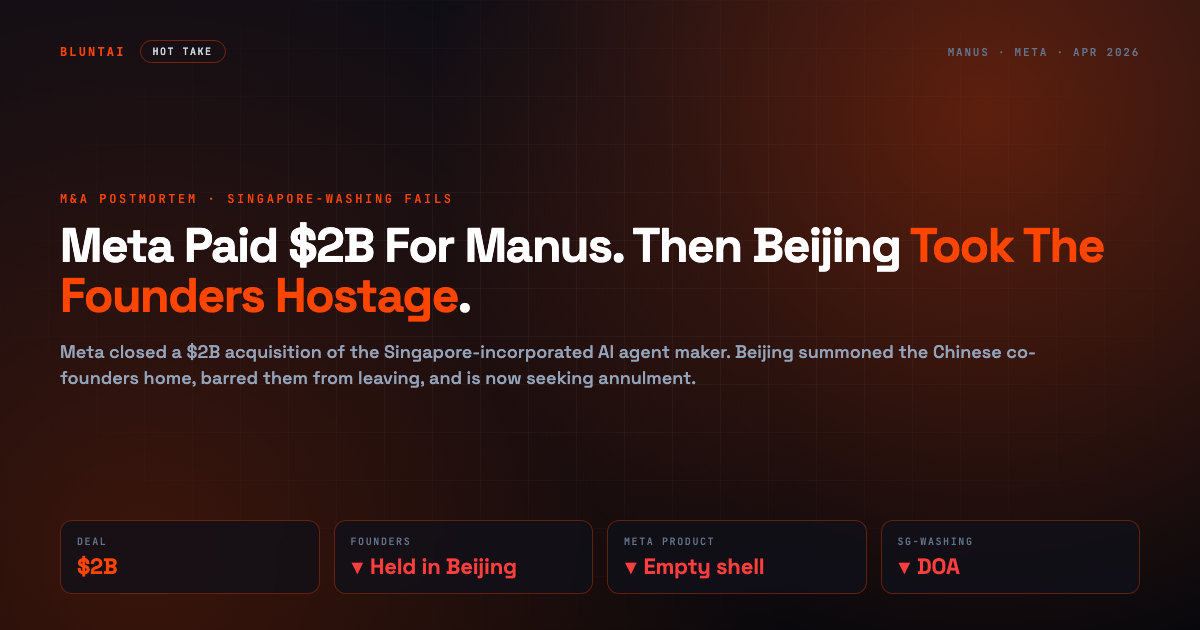
Meta Paid $2B For Manus. Then Beijing Took The Founders Hostage.
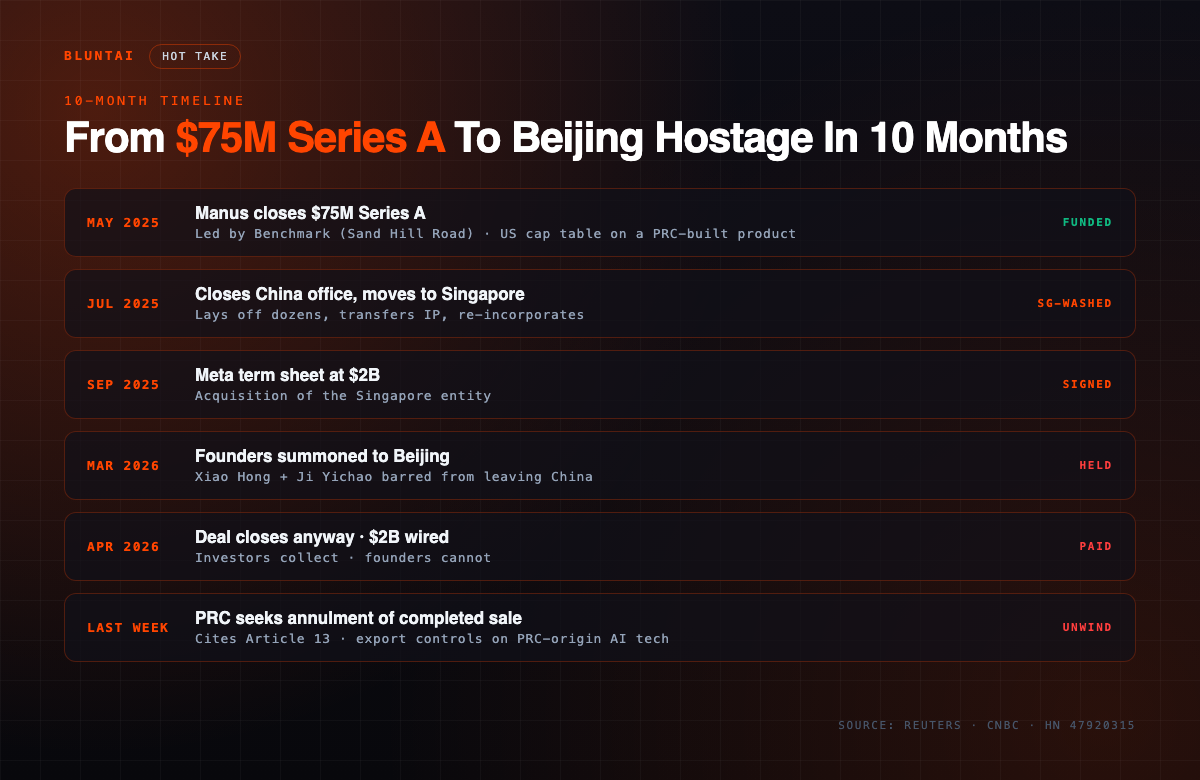
In May 2025, a Chinese AI agent startup called Manus took a $75M Series A from Benchmark — that Benchmark, the Sand Hill Road one, the one that wrote the Series A for eBay and Uber. By July, Manus had closed its Chinese offices, fired dozens of employees, and re-incorporated in Singapore. The new website said “by Meta” on the logo within a year. The deal closed at $2B.
Last week, China’s Ministry of Commerce announced it is seeking to annul the acquisition. The grounds: AI technology developed inside Chinese territory is subject to PRC export controls, and a Singapore re-incorporation does not, in fact, make a Chinese company Singaporean.
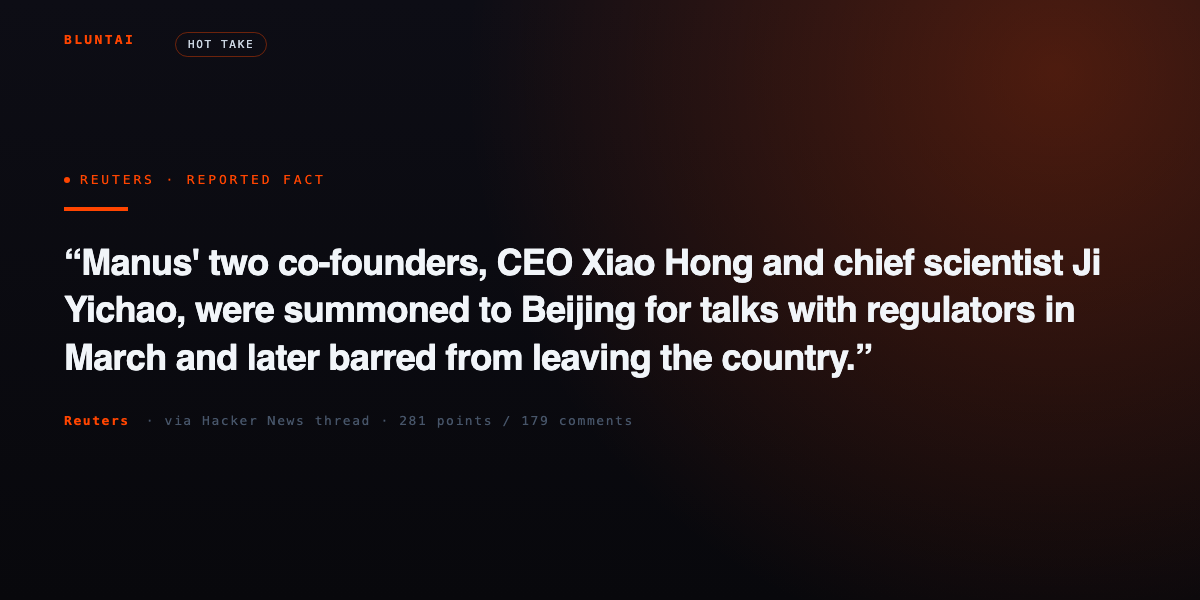
To make sure everyone got the message, Beijing also summoned the two co-founders home in March — CEO Xiao Hong and Chief Scientist Ji Yichao — and barred them from leaving the country. They are, as of this writing, still inside China, while their Singapore-incorporated, Meta-owned company tries to figure out what country it lives in.
This is the most expensive geography lesson of the year. And it is the end of the Singapore-washing playbook for Chinese AI.
What “Singapore-Washing” Was
Let me catch you up. For the last 24 months, this has been the standard escape hatch for any China-origin tech founder who wanted to sell to a Western buyer:
- Take a Western VC round (this gives you a US shareholder of record and a US cap table).
- Open a Singapore office.
- Quietly close the China office, lay off the China team, transfer the IP to the Singapore entity.
- Re-domicile the company. Now it’s “Singaporean,” not Chinese.
- List, sell, exit. Everyone collects.
The premise was that Beijing would not, or could not, project authority over a Singapore-incorporated company. Taiwan-aligned founders did it. Hong Kong founders did it. ByteDance famously did it on a different scale. Manus did it.
The premise was wrong.
What Beijing Actually Did
China’s case, as filed, is two-fold.
One: the IP itself is Chinese-origin. Manus’s core agent-orchestration tech was built in China by Chinese employees on Chinese soil. The technology, under PRC export law (specifically Article 13 of the 2020 Export Control Law, the catch-all “blanket discretion” clause), does not stop being Chinese just because the company holding the certificate of incorporation moved. To export it — to a US buyer, in this case — required PRC export licensing, which Manus did not seek and would not have received.
Two: the founders are Chinese citizens. And Chinese citizens, the state has decided, cannot transfer Chinese-origin technology to a foreign acquirer regardless of where the holding company sits. So the founders got summoned home for “talks with regulators” — the sort of talks where you don’t leave until the regulators are done talking.
That happened in March. The deal closed anyway. Meta either didn’t know, didn’t care, or assumed money would solve it. The deal is now in the most awkward post-close limbo imaginable: the wire cleared, the equity transferred, and the people who built the product are guests of the state.
Why It Took This Long
Until now, Beijing had largely shrugged at Singapore-washing. There were a few public scoldings, some quiet exit-tax negotiations, but no actual unwind attempts. The state’s calculation appeared to be: better that successful Chinese founders stay tied to Chinese investors and Chinese capital, even if the corporate domicile drifts. Annulling a foreign acquisition is hard, embarrassing, and signals to other founders that the only safe way out is to leave faster.
What changed:
- DeepSeek. China watched DeepSeek and a half-dozen other PRC-developed open-weight models become the defining open-source AI story of 2025-2026, and decided that the talent pipeline was a strategic asset, not a free agent.
- The US AI export controls. Beijing has been on the receiving end of “we don’t allow that to leave” for three years on chips. They learned the playbook.
- The political timing. A US tech giant ($2B from Meta) buying Chinese-built agent tech, four months before the next US election cycle starts. Beijing did not have to think hard about whether to make this loud.
- Manus made it easy. The company didn’t even pretend the Singapore move was anything other than a wrapper. They closed the China office in July, transferred the IP in August, took the Meta term sheet in September, and the press release in March said “Meta acquires AI agent leader Manus.” A regulator would have had to be asleep to miss it.
So: a confident Beijing, a clear precedent in the US’s own playbook, a high-visibility target, and a defendant who didn’t even try to hide. It was always coming. It took about ten months.
What Meta Is Holding
The $2B is gone — wired to the Singapore entity’s selling shareholders, which means investors (Benchmark and the rest) probably keep their cut and the founders, who took the largest equity slice, are either holding paper that’s now worthless or holding cash they cannot move out of China.
Meta is holding:
- A Singapore corporate entity with an empty office.
- IP whose ownership is now actively contested by a sovereign state.
- A product (the Manus agent) that was running on PRC-built infrastructure and trained on data the PRC may decide to claim.
- A team that was 60% Chinese and 100% terrified.
- A CEO and a Chief Scientist they cannot get on a Zoom because the regulators have their phones.
The “by Meta” branding on Manus’s homepage was, in retrospect, the funniest part of the whole thing. Meta isn’t holding a company. It’s holding a brand and a domain name. The actual operators of the system are 6,500 miles away, in a meeting they can’t leave.
What Happens To The Founders
If the pattern holds, the founders will:
- Spend several more months in regulator meetings.
- Issue a public statement of contrition — almost word-for-word boilerplate at this point — saying that they did not understand the export-control implications of the deal and are committed to working with Chinese authorities to ensure the technology serves Chinese strategic interests.
- Be allowed to leave once they have either (a) returned the proceeds, (b) opened a new China-domiciled company that takes ownership of the technology, or (c) become advisors to a state-aligned entity that absorbs the talent.
- Or, if they refuse, become unreachable for an indefinite period and reappear at a press event nine months later sitting next to a senior regulator.
Jack Ma, in 2020-2021, ran the same protocol. So did the founders of Didi. So did the leadership of Alibaba’s Ant Group. The script is by now extremely well-tested. The only difference is the new precedent: this time, they’re punishing Singapore-incorporation, not just domestic listing decisions.
Why You Should Care
If you are not a Chinese AI founder this might feel distant. It isn’t.
This is the moment AI tech sovereignty becomes a thing. Not “we’ll inspect the chips,” not “we’ll restrict the model weights,” but “the state owns the IP, regardless of which jurisdiction’s certificate of incorporation it currently sits under.” That’s a much more aggressive doctrine, and once it’s normalized in one direction, it normalizes in the other.
Expect, in order:
- Cross-border AI M&A freezes. Strategic acquirers (Meta, Google, Microsoft, even Anthropic) will pause any deal involving meaningful PRC-origin AI IP until there is a clearer regulatory map. Many of those deals will quietly die.
- Singapore stops being a magic shield. The whole “incorporate in Singapore, sell to the West” trick was the fastest exit ramp for any mainland-origin AI startup. It is now the slowest. Founders who were halfway through the process are quietly aborting. The next-best option is to go through a much longer “establish actual independent operations in Singapore for 24+ months” path, which most founders cannot afford to wait for.
- Symmetric retaliation in the US. If Beijing can claim “this AI tech is ours, regardless of corporate structure,” the US Treasury will claim it back the next time a Chinese buyer comes for a US AI startup. Expect at least one CFIUS unwind attempt within twelve months, citing this case as the rhetorical template.
- A two-track AI industry. China-origin tech to China and to a small set of “neutral” buyers; Western-origin tech to Western buyers; and a no-man’s-land in the middle where nobody touches anything.
What Meta Should Do (And Won’t)
The right move for Meta is to write off the $2B, walk away from the Singapore shell, and rebuild the agent product internally with US-domiciled talent. They will not do this. They will instead:
- Issue a measured public statement about respecting all relevant regulatory frameworks.
- Lawyer up to fight the annulment in Singapore courts (where they have the better case) while quietly making arrangements with Beijing (where they have no case).
- Start re-implementing the most useful parts of the Manus agent inside Llama tooling, which is what they should have done in the first place.
- Eat the writedown in Q3 earnings, blame “macroeconomic headwinds,” and move on.
Meanwhile, the founders sit in Beijing.
The lesson, repeated for the third time in a decade, is that sovereignty does not respect cap tables. You can incorporate anywhere. You can take any VC’s money. You can put any logo on the homepage. None of that protects the actual humans who wrote the code, when the state where they were born decides they are too valuable to let go.
Manus learned it for $2B. Everybody else gets to learn it for free.
Rating: Singapore-washing failed. Founders pay the bill.
Sources:
- CNBC: Meta-Manus-China-blocks-acquisition
- Reuters: China blocks foreign acquisition of Manus AI
- BBC: News article on Manus
- Hacker News thread (281 points, 179 comments): news.ycombinator.com/item?id=47920315
- PRC Export Control Law (2020), Article 13 (catch-all clause)
Disclaimer: BluntAI may earn affiliate commissions from links in this article. This never influences our reviews. We buy and test everything ourselves. Our opinions are brutally our own.