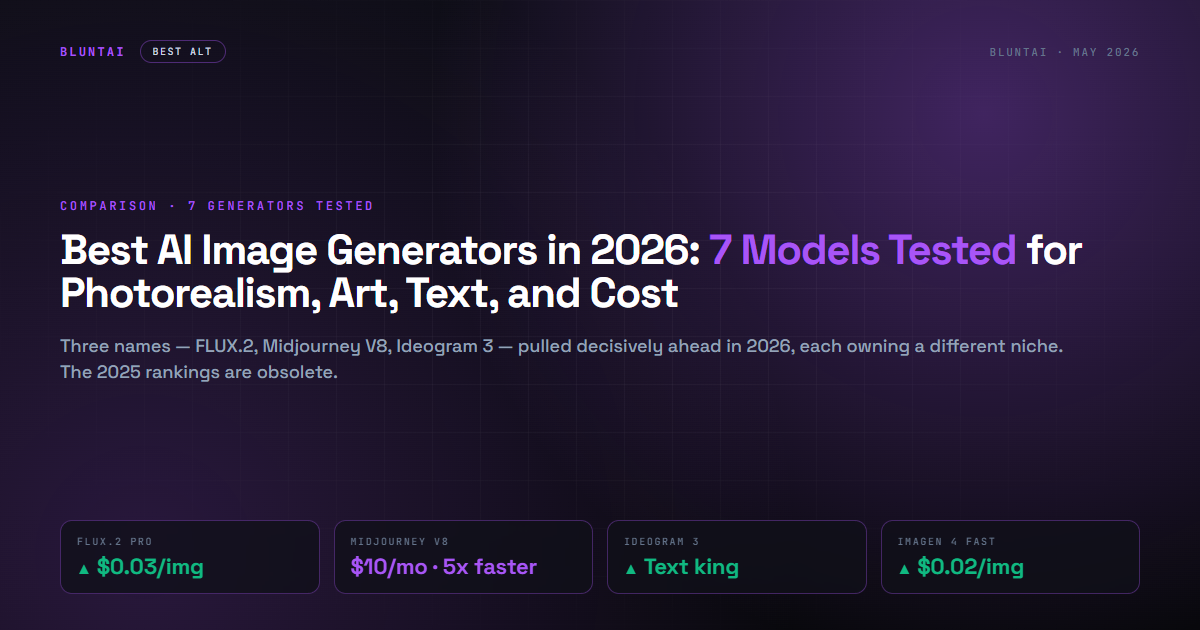
Best AI Image Generators in 2026: 7 Models Tested for Photorealism, Art, Text, and Cost
If you searched “best AI image generator” in May 2026, the answer changed two months ago. In March, three things happened in the same week: Midjourney shipped V8 with native 2K resolution and a 5× speed bump, Black Forest Labs released FLUX.2 with four-tier sizing (max, pro, flex, klein) and 4MP photorealistic output, and Google quietly dropped Imagen 4 Fast at $0.02 per image. The rankings everyone wrote in 2025 are obsolete. The market consolidated.
So we tested seven generators across the use cases that actually matter — photorealism, artistic style, text rendering, logo and brand work, speed, and cost — and built the list below. The winners are not all the obvious names.
The 7 image generators, ranked
1. FLUX.2 Pro — the new photorealism king
What it is: Black Forest Labs’ second-generation flagship, released March 2026. Four variants: max (highest quality, slowest), pro (the production sweet spot), flex (faster, batch-friendly), klein (tiny, edge-deployable). Output goes up to 4MP with multi-reference control — meaning you can feed it 2-4 reference images and it composes a new image consistent with all of them.
Pricing: Via fal.ai, Replicate, or BFL API directly — ~$0.03 per image on Pro tier. Open-weights variant (FLUX.1 dev / FLUX.2 Schnell) available if you want to self-host.
Where it wins: Skin texture. Lighting. The “is this a photograph?” test. We ran a portrait test against Midjourney V8 and DALL-E successor — FLUX.2 Pro produced the only output where you couldn’t reliably spot the AI tells (skin pore consistency, subsurface scattering on lips, micro-imperfections in fabric weave). Multi-reference control means you can lock down a character’s face across 50 generations.
Where it loses: Artistic interpretation. If you ask it for “a melancholy painter in the style of Schiele, lit by a single candle,” FLUX gives you a photograph of someone painting. Midjourney gives you the painting. Different jobs.
Our take: If your output ends up in a marketing campaign, an e-commerce product shot, or anything where photorealism gets cross-examined, FLUX.2 Pro is the default in 2026. The fact that there’s an open-weights version (FLUX.2 Schnell on Hugging Face) makes the long-term lock-in story painless.
Rating: Shut up and buy it.
2. Midjourney V8 — still the aesthetic winner
What it is: The “feels like art, not a photograph” generator. V8 launched in March 2026 with a completely rewritten engine — native 2K, 5× faster generation than V7, and a new web interface that finally makes the Discord-bot era feel quaint.
Pricing: $10/mo Standard (unlimited Relax mode), $30/mo Pro (fast generations + stealth mode), $60/mo Mega for high-volume teams.
Where it wins: Aesthetic interpretation. Color palette intuition. Compositional drama. Midjourney consistently beats every competitor on “make this feel like X” prompts — cinematic lighting, painterly textures, surreal mood pieces. The community-style aesthetic isn’t a bug; it’s the moat.
Where it loses: Strict photorealism (loses to FLUX), text rendering (loses to Ideogram), and consistency across iterations (still has the “give me a similar image” problem — V8 helps but doesn’t solve it).
Our take: If your output is editorial, branded creative, social campaigns, or anything where “this looks beautiful” wins over “this looks accurate,” Midjourney is still the right pick. The $10 Standard tier with unlimited Relax queue is the best value in the entire category.
Rating: Shut up and buy it (for art direction).
3. Ideogram 3 — the text-rendering specialist
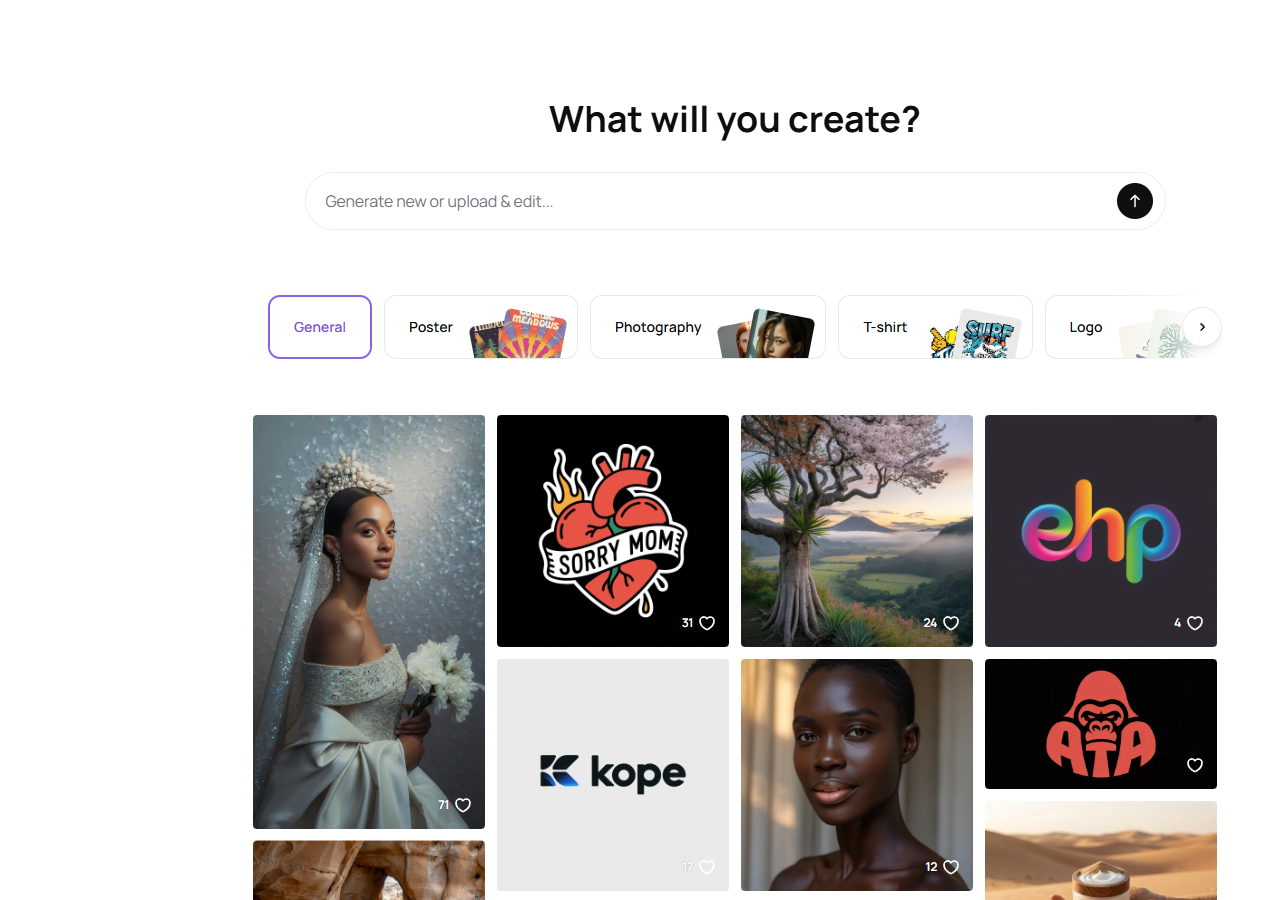
What it is: The image generator built specifically around legible text inside the generated image. Logos, posters, ad creative, infographics, t-shirts — anywhere typography matters, Ideogram is the only major model that reliably produces readable letterforms.
Pricing: Free tier with watermarks. $8/mo Basic (400 priority generations). $20/mo Plus (1,000 priority + commercial license).
Where it wins: Spell things correctly. Render multi-line headlines without the FLUX/Midjourney “almost-letters” garbage. Hold a brand color, a typeface vibe, and a layout intent in a single prompt. We tested “Lemon Drop Café opening Saturday, 9am” rendered as a poster — Ideogram nailed both lines, every letter, in a consistent typeface. FLUX produced unreadable squiggles.
Where it loses: Photorealism is mid-tier. Ideogram chose typography over texture and you can see the trade in skin and fabric. For a hero photo shot, you’d send the typography to Ideogram and the photo to FLUX, then composite.
Our take: If your work involves any text-on-image — ad creative, poster design, social tiles with copy, t-shirt graphics — Ideogram is non-negotiable in 2026. The other generators improved at typography; none caught up.
Rating: Shut up and buy it (for typography).
4. Recraft V4 — the design and brand workhorse
What it is: The image generator that’s actually built for designers, not for prompt-engineers. SVG export. Brand styling tools. Style transfer that respects your brand kit. Recraft V4 ranked #1 on the HuggingFace Open Image Generation Arena leaderboard for several consecutive months in early 2026.
Pricing: Free tier with 50 daily credits. $10/mo Basic. $33/mo Advanced. $60/mo Pro. Per-image cost via API roughly $0.04/image.
Where it wins: Vector output (SVG that actually opens cleanly in Illustrator without 200 weird paths). Brand-kit-aware generation — you upload a few sample assets and Recraft produces variations that hold your typography and palette. Logo work where you need to deliver a final asset, not just a moodboard.
Where it loses: Less impressive at hero photography vs FLUX. Less artistic punch vs Midjourney. The wins are professional, not exciting.
Our take: If your day job is producing brand assets at volume, Recraft is the practical pick. The SVG export alone is worth the subscription — nothing else in this list ships clean vectors.
Rating: Solid, no drama.
5. Google Imagen 4 / 4 Fast — the cost-leader
What it is: Google’s image model accessed via the Gemini API or Vertex AI. Imagen 4 launched alongside Gemini 2.5; Imagen 4 Fast came in March 2026 at the brutal price of $0.02 per image.
Pricing: Imagen 4 Fast: $0.02/image. Imagen 4 standard: $0.04/image. No subscription model — pure pay-as-you-go through Google Cloud.
Where it wins: Cost. At 2¢ per image, Imagen 4 Fast is the cheapest serious option in the market. Google-infrastructure speed (sub-2-second generation typical). Built into Gemini chat, so if you’re already on Google’s stack the integration is trivial.
Where it loses: Imagen 4 standard’s quality is competitive but not best-in-class on any axis we tested. The Fast variant trades quality for speed/cost — fine for batch work, not for hero shots. And like all Google products, the ToS around generated content is famously confusing.
Our take: If you’re generating thousands of images programmatically for a recommender system, content pipeline, or test rig, Imagen 4 Fast is the unit-economics winner. For hero creative, you’d still pay 1.5-2× more for FLUX or Midjourney.
Rating: Solid, no drama.
6. Stable Diffusion 3.5 / Open Flux Variants — the self-host option
What it is: The open-weights category. Stable Diffusion 3.5 from Stability AI, FLUX.1 dev and FLUX.2 Schnell from BFL, plus a sprawling LoRA ecosystem. You run them on your own GPU (or rent one) and pay zero per-image cost beyond electricity.
Pricing: $0 + your hardware/cloud cost. A single 4090 runs FLUX.1 dev at ~3 seconds per image. RunPod or Vast.ai for cloud GPU rental costs ~$0.30-0.80/hour for an A100, which means 100-300 images/hour at minimal marginal cost.
Where it wins: Privacy (nothing leaves your machine). Customization (LoRAs, ControlNets, inpainting masks — the whole open ecosystem). No API rate limits. Compliance for regulated industries that can’t send prompts to third-party servers.
Where it loses: Setup cost. You need GPU access, you need to manage Python deps, you need to know what a LoRA is. Quality is a step below FLUX.2 Pro and Midjourney V8 on flagship variants — the open-weights versions trail their closed counterparts by 6-12 months.
Our take: If you’re privacy-sensitive or generating at scale where the marginal-cost-per-image really matters, self-hosting wins. For everyone else, the operational overhead isn’t worth saving $0.03/image.
Rating: Shut up and download it (if you have a 4090).
7. GPT Image 2 (OpenAI) — the conversational pick
What it is: OpenAI’s image generation, accessed through ChatGPT, the API, or Sora. The integrated experience — you describe an image in chat, get the image, ask for changes, get the changes. The conversational interface is the whole product.
Pricing: Bundled with ChatGPT Plus ($20/mo) for casual use. API: $0.04-$0.12/image depending on quality settings.
Where it wins: Conversational iteration. The “make the dog smaller, change the background to a beach, now add a hat” flow is smoother in ChatGPT than anywhere else. If you’re ideating in chat anyway, GPT Image 2 wins on workflow.
Where it loses: Quality on hero shots is now mid-tier. The model that defined “AI image” in 2023 (DALL-E 3) is no longer the model that defines it in 2026. OpenAI stopped leading and is competing on integration, not output.
Our take: Still useful if your AI workflow is centered on ChatGPT. For dedicated image work, you’d reach for FLUX, Midjourney, or Ideogram.
Rating: Meh.
At-a-glance comparison
| Best at | Per-image cost | Subscription | Open weights? | |
|---|---|---|---|---|
| FLUX.2 Pro | Photorealism | ~$0.03 | None (API only) | Yes (Schnell variant) |
| Midjourney V8 | Aesthetics, art | (subscription) | $10-60/mo | No |
| Ideogram 3 | Text rendering | (subscription) | $8-20/mo | No |
| Recraft V4 | Logos, vectors, brand | ~$0.04 | $10-60/mo | No |
| Imagen 4 Fast | Cost / batch | $0.02 | None | No |
| SD 3.5 / FLUX dev | Privacy, scale | $0 + GPU | None | Yes |
| GPT Image 2 | Conversational flow | $0.04-0.12 | $20/mo (ChatGPT) | No |
How to pick
You need photorealistic hero shots. FLUX.2 Pro. Pay $0.03/image, get the only output that survives a “is this AI?” test in 2026.
You need editorial, art-directed creative. Midjourney V8, $10/mo Standard. Best aesthetics in the category.
Your image has text on it. Ideogram 3. Non-negotiable. Stack with FLUX or Midjourney for the photo half if needed.
You’re producing brand assets at volume. Recraft V4. SVG export + brand-kit awareness is unique in this list.
You’re generating at scale and unit cost matters more than quality. Imagen 4 Fast. $0.02/image, fast.
You can’t send prompts to third-party servers. SD 3.5 or FLUX dev self-hosted. Bring your own GPU.
You live in ChatGPT and want to ideate conversationally. GPT Image 2. Already paid for, decent enough.
The Blunt takeaway
The image generation market consolidated in 2026. There used to be a dozen contenders within a single skill bracket. There aren’t anymore. Three names — FLUX, Midjourney, Ideogram — pulled decisively ahead in their respective lanes (photorealism, art, text). Recraft owns logos. Imagen wins on cost. Open-weights catches up on a 6-12 month lag.
If you’re shipping production creative work, you should be using at least two of these models, picked by use case — not one all-purpose generator. The “best AI image generator” doesn’t exist. The best toolkit does.
And the toolkit costs less than a consultant’s lunch. Three subscriptions ($10 Midjourney + $20 Ideogram + a few dollars/month of FLUX API usage) gets you better-than-pro creative output for under $40/month. The bottleneck is taste and prompting, not the tools.
Related on BluntAI
All opinions expressed on BluntAI are editorial opinions based on publicly available information and personal testing. Pricing data current as of May 2026. We may earn affiliate commissions from links on this site.
Disclaimer: BluntAI may earn affiliate commissions from links in this article. This never influences our reviews. We buy and test everything ourselves. Our opinions are brutally our own.