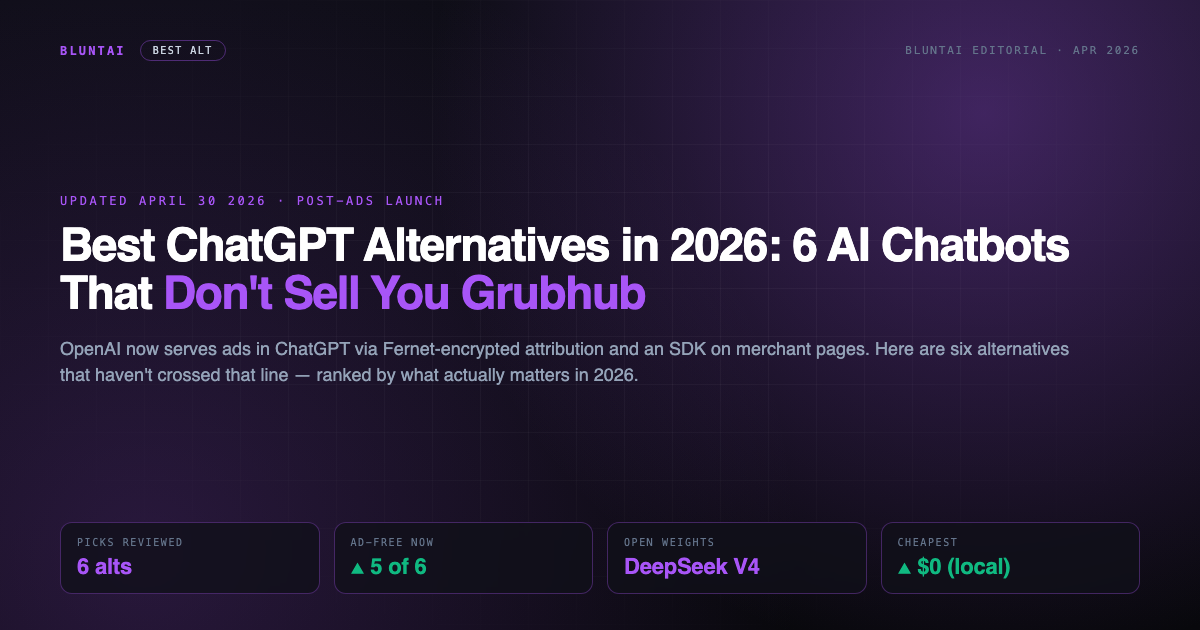
Best ChatGPT Alternatives in 2026: 6 AI Chatbots That Don’t Sell You Grubhub
Earlier today I walked through OpenAI’s brand-new ad system inside ChatGPT: four Fernet-encrypted attribution tokens, a JavaScript SDK called OAIQ running on merchant pages, six launch advertisers (Grubhub, GetYourGuide, Axel, Gametime, Aritzia, Canva), and zero public announcement. ChatGPT is now ad-supported. The wrapper is competent. The intent is permanent.
If that’s a problem for you — and “the chatbot I ask private questions to is now monetizing my prompt context” is, I would argue, a problem — here are six alternatives, ranked by what 2026 actually rewards: capability, pricing, ad posture, and whether the company has signaled that they intend to keep things this way.
I have used all six in production. The takes are blunt.
The 6 Alternatives, Ranked
1. Claude (Anthropic) — the closest direct replacement
Pricing: $20/mo Pro, $200/mo Max 5×, $200/mo Max 20×. Free tier exists but is heavily rate-limited.
The blunt take: Claude is the no-brainer ChatGPT alternative for chat-as-chat. Opus 4.7 (the current frontier model as of mid-April 2026) is at parity or better than GPT-5.5 on coding, hard reasoning, and writing tasks that aren’t pure trivia. Anthropic has, so far, refused to put ads in the consumer product, and explicitly markets that refusal as a feature. They do, however, have other monetization issues — the Pay-Per-Panic billing structure I wrote about three weeks ago was a real walk-back from “unlimited.” Trust them on the ad question, but watch their pricing changelog with one eye open.
Where it loses: Slower than ChatGPT on real-time search, weaker on multimodal-out (image generation), and Anthropic gates the most useful agent features (Claude Code) behind separate Pro/Max tiers. If your daily workflow is “give me a chart of yesterday’s news,” Claude is not it.
Verdict: Default pick for chat. Switch your habit today, save the bookmark, and you are 80% of the way out of ChatGPT.
2. Perplexity — the search-first alternative
Pricing: $20/mo Pro, $40/mo Max. Free tier is generous and citation-rich.
The blunt take: Perplexity decided early that the value was *answering questions with sources*, not *being your friend*. Every answer ships with footnoted citations that link to the actual web pages. This is the cleanest disclosure model on the market: when Perplexity recommends a restaurant, you can see the four review sites it pulled from. The product has shipped some weird affiliate experiments in 2025, but they were always disclosed and they were always opt-in.
Where it loses: Bad at long conversations, bad at writing, bad at coding. It is, structurally, a search engine with a chatbox. If you don’t want it to search, you want a different tool.
Verdict: Use it instead of Google for any question that wants a real answer. Don’t try to use it for an essay.
3. DeepSeek V4 (Pro or Flash) — the open-weights option
Pricing: Free via chat.deepseek.com. API: $0.27/1M input tokens, $1.10/1M output tokens for Pro. Or download the weights and run locally for $0/forever.
The blunt take: DeepSeek V4-Pro (1.6T total / 49B active params) and V4-Flash (284B total / 13B active) shipped on April 25 with MIT license. On agentic coding benchmarks the Pro variant trades blows with Claude Opus 4.6 and GPT-5.4 at 1-2% the cost. The Flash variant runs locally on a single 128GB-RAM Mac. Open weights mean OpenAI cannot, in principle, serve you a Grubhub ad through DeepSeek — there is no central server controlling the model.
Where it loses: No native multimodal in/out at GPT-5/Claude-Opus levels yet. The hosted version (chat.deepseek.com) is run from China, which is a non-starter for some compliance contexts. Web search integration is rough. Tooling around the local-run version requires real engineering effort — this is not a “click and chat” product like ChatGPT.
Verdict: If your use case is “I want a frontier model that I can verify cannot be silently ad-supported” this is the only currently shipping option that is genuinely under your control. Run it locally and you are the only person with a copy of your prompt history.
4. Gemini (Google) — the free-tier juggernaut
Pricing: Free tier is the most generous on the market. Pro at $20/mo. Ultra at $250/mo for the heavy use cases (Veo 4 video gen, deep research, etc).
The blunt take: Gemini 3-Pro is the model OpenAI is most worried about right now, and Gemini’s free tier keeps eating ChatGPT Free’s lunch month after month. The Google integration (Workspace, Drive, YouTube, Maps) is in a different league for anyone living in that ecosystem. Image gen via Imagen 4 is excellent.
Where it loses on this list specifically: Google is Google. The same company that pioneered surveillance advertising on the open web is the company building this AI. Gemini does not currently serve ads inside Gemini chat sessions, but Google’s relationship to your data is what it has always been: your prompts feed the next training run by default unless you opt out, your Workspace context is observable for product decisions, and the company has every commercial incentive to introduce ads inside Gemini in the next 12 months. They just have not done it *yet*.
Verdict: Best free option, with a giant asterisk. If you switch from ChatGPT to Gemini, you are switching from “freshly ad-supported” to “advertising-funded company that has not yet enabled ads in this specific surface.” Plan the second migration too.
5. Mistral Le Chat — the European pick
Pricing: Free tier (rate-limited). Pro €15/mo. Team €25/mo per seat.
The blunt take: Mistral has spent 2025 quietly catching up on the model side and has shipped a clean, fast, no-ad chat product hosted in Europe under GDPR. Le Chat with Mistral Medium-3 (released March 2026) is somewhere between Claude Sonnet and Opus on most reasoning tasks, faster than both, and the company has explicitly stated that the consumer product will not be ad-supported. They have weaker English-language muscle than Claude or GPT but it’s no longer obvious — for European-language workloads it’s now the best pick by some margin.
Where it loses: No multimodal-out (image gen) at Imagen/DALL-E levels. Mobile app is years behind. Smaller context window than the frontier (256k vs 1M for DeepSeek/Claude).
Verdict: If you live in the EU, prefer European data sovereignty, or just want a “frontier-adjacent chat that nobody is monetizing yet” — this is the one. Keep an eye on whether Mistral stays independent or gets acquired; the moment they sell, the policy can change.
6. Local via Ollama / LM Studio — the ad-proof endgame
Pricing: $0/forever after hardware. Realistically: an M2 Pro Mac mini ($1300) or a 64GB-RAM PC with a 24GB VRAM GPU ($2500-3500).
The blunt take: Run Llama 4 (Meta), Qwen 3.6 (Alibaba), Kimi 2.6 (Moonshot), or DeepSeek V4 Flash (DeepSeek) locally on your own hardware via Ollama, LM Studio, llama.cpp, or vLLM. The model weights are downloaded once. Inference is offline. No prompt leaves your machine. No company can serve you ads, sell your data, or change pricing on you. This is the “I never want this conversation again” option.
Where it loses: Setup is real engineering. Frontier-quality output requires real hardware ($2k+ in dedicated GPU). You will not get GPT-5.5-level multimodal or web search out of the box — those require additional plumbing. And the user experience is not ChatGPT’s. You will type in a terminal-shaped UI more often than not.
Verdict: If you genuinely want to never depend on a hosted AI again, this is where you end up. Not for everyone — but the *option* existing means the existence of “ChatGPT serves ads now” is not a forced cost on humanity. Tell your friends.
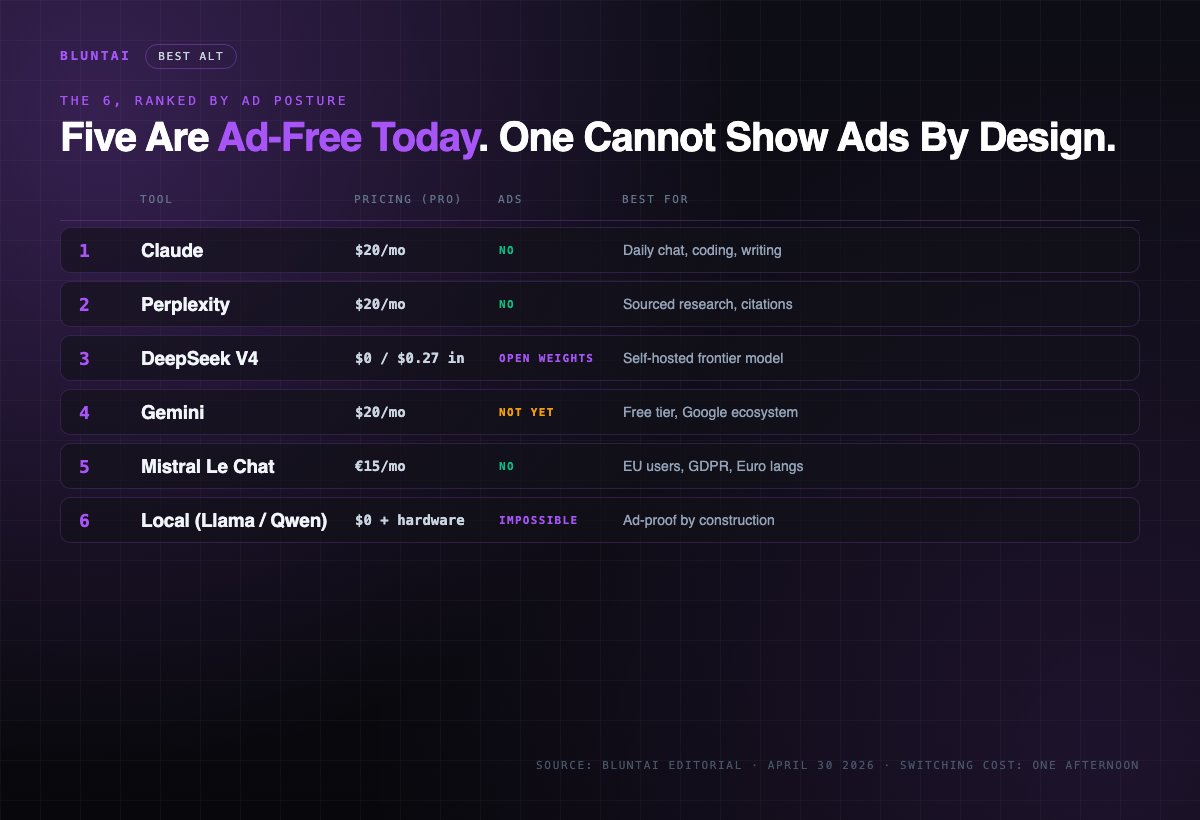
At-A-Glance Comparison
| # | Tool | Pricing (Pro) | Ads now? | Frontier-class? | Best for |
|---|---|---|---|---|---|
| 1 | Claude | $20/mo | No | Yes | Daily chat, coding, writing |
| 2 | Perplexity | $20/mo | No | Search-tier | Sourced research |
| 3 | DeepSeek V4 | $0 / $0.27 in | No (open) | Yes (Pro) | Open-weights, self-hosted |
| 4 | Gemini | $20/mo | No (yet) | Yes | Free tier + Google ecosystem |
| 5 | Mistral Le Chat | €15/mo | No | Near-frontier | EU users, GDPR, European langs |
| 6 | Local (Llama/Qwen) | $0 + hardware | Impossible | Yes (Llama 4) | Total ad-proof, privacy-max |
How To Pick
You want the smallest possible change to your day: Claude Pro. The chat box, the autosaved threads, the iOS app — all very ChatGPT-shaped, none of the ads. Switch tomorrow.
You want sourced answers more than chat: Perplexity. Replace your Google habit. Don’t try to use it as a chatbot.
You want the lowest possible per-prompt cost at frontier quality: DeepSeek V4-Pro via API at $0.27/1.10. Cheaper than Claude Haiku per token and roughly as smart as Sonnet. Hosted is fine if PRC origin doesn’t bother you.
You want a serious free tier: Gemini. Set a calendar reminder for Q1 2027 to re-evaluate when Google ships ads.
You’re in the EU and want to vote with your wallet: Mistral Le Chat. They have read the GDPR.
You want the AI in your house and nowhere else: Ollama + Llama 4 70B on a serious workstation. Or DeepSeek V4 Flash on an M2 Mac. Set it up once, never look at OpenAI again.
The Blunt Takeaway
The ChatGPT ads news is not a betrayal. It is an expected stage in a company that has crossed 800M weekly active users and needs the per-user revenue math to work. OpenAI’s choice was always going to be either *raise the price to cover the inference cost* or *get someone else to pay for the inference*. They have, with one quietly-deployed JavaScript SDK and four Fernet tokens, picked option two.
You don’t have to use a chatbot that’s funded by Grubhub paying $4 CPM to recommend you Pad Thai. You have at least six alternatives, five of which currently do not show ads in chat, and one of which (local) cannot show ads in chat by construction. The cost to switch is one afternoon, a new bookmark, and the small psychic adjustment of typing your prompts into a different colored UI.
That’s a better trade than letting your private questions get auctioned off in a stream you can’t see.
Rating: Five of six don’t have ads. Yet.
Sources:
- BluntAI: How ChatGPT Serves Ads — Six Brands, Four Encrypted Tokens (April 30, 2026)
- BluntAI: DeepSeek V4 Came In 89× Cheaper Than Claude (April 25, 2026)
- Pricing pages: Claude · Perplexity · DeepSeek · Gemini · Mistral · Ollama
Disclaimer: BluntAI may earn affiliate commissions from links in this article. This never influences our reviews. We buy and test everything ourselves. Our opinions are brutally our own.