Best Claude Code Alternatives in 2026: 6 Coding Agents That Won’t Regex-Block Your Commits
Yesterday’s news: Anthropic’s Claude Code refuses to process requests, terminates sessions, and burns your 5-hour usage allowance when commits or files in your repo mention “OpenClaw” — the open-source competing agent harness. The HN thread hit 1,172 points before Anthropic said anything. Anthropic still hasn’t said anything.
If you’ve been on Claude Code and you’re now in the procurement-by-spite phase of your Wednesday afternoon, this is for you. Six alternatives, ranked, used in production, with real prices and real verdicts.
The 6 Alternatives, Ranked
1. Cursor — the closest replacement if you want IDE shape
Pricing: $20/mo Pro, $40/mo Pro+, $200/mo Ultra. Free tier is severely throttled.
The blunt take: Cursor is the IDE-shaped Claude Code alternative — VS Code fork with a built-in agent that does most of what Claude Code does plus inline autocomplete that’s actually good. It supports Claude (Sonnet 4.6, Opus 4.7), GPT-5.5, Gemini 2.5 Pro, and DeepSeek V4 as backends. Cursor doesn’t appear to filter commits the way Claude Code does — competitive blocking is not their game (they ARE the competitor, so they have less reason to play it).
Where it loses: It’s an IDE. If your workflow is terminal-only with tmux, vim, and zellij, you’re going to hate the swap. The agent mode is also more conservative than Claude Code’s — it asks for confirmations more often.
Verdict: Default pick if you mostly live in an editor. Set Claude Sonnet 4.6 as the model and you’ve replaced Claude Code without losing model capability.
2. Aider — the terminal-native, model-agnostic survivor
Pricing: Free (open source). You bring your own API key (Claude, OpenAI, DeepSeek, OpenRouter, local — any of them).
The blunt take: Aider is the most no-bullshit option on this list. It’s a Python CLI, has been since 2023, and works the way Unix tools work: you type a prompt in the terminal, it edits files, it shows a diff, it commits. No telemetry. No regex filters. No subscription pretending to be a product. The MIT license is real.
Where it loses: No agent loop. Aider is one-shot per command — “edit this file to do X” — not “go figure out how to do X across the repo.” If you want autonomous multi-step agent behavior, this isn’t it (yet).
Verdict: If you spent the last year as a Claude Code power user and now want to leave the platform but keep the workflow shape, Aider gets you 80% there at zero subscription cost. Best per-dollar play on the list.
3. OpenClaw — yes, the one Anthropic blocks
Pricing: Free (open source). API key for any provider you want.
The blunt take: The whole reason this list exists is that Anthropic decided OpenClaw was scary enough to filter for in Claude Code. That endorsement-by-aggression alone is reason to look at it. OpenClaw is a terminal-native agent harness with multi-model support (Claude, GPT, Gemini, DeepSeek, local models via Ollama) and an extension API that lets the community add tools quickly. Community has been velocity-shipping for the past year.
Where it loses: It’s still pre-1.0. Some agent flows are flaky. Documentation is community-maintained and uneven. The ecosystem of pre-built tools is smaller than Cursor’s or Aider’s.
Verdict: If you want to use the model Anthropic doesn’t want you using their model with, this is the spite play. It also genuinely works. The two are not mutually exclusive.
4. Continue — the VS Code extension that’s not Cursor
Pricing: Free for individuals. $20/mo per seat for teams (analytics + custom models).
The blunt take: Continue is what Cursor would be if it stayed an extension instead of forking VS Code. You install it as a regular VS Code extension, point it at any model (Anthropic, OpenAI, local via Ollama, anything), and you get inline edits, chat, and an agent mode. No fork to maintain. No new IDE muscle memory to build. Open source under Apache 2.0.
Where it loses: The agent mode is less polished than Cursor’s. Extension-shaped tools always feel slightly second-class compared to the IDE-native experience.
Verdict: Best if you want to stay in stock VS Code and not maintain a fork. Particularly good for teams where standardization matters and you can’t make everyone install Cursor.
5. Cline — the agent-first VS Code extension
Pricing: Free (open source). BYO API key.
The blunt take: Cline (formerly Claude Dev) is the agent-mode VS Code extension that goes hardest on the autonomous loop. It’s the option closest in spirit to Claude Code’s “go do the thing” agent behavior, but living inside VS Code with full IDE integration. Rapidly evolving — they ship multiple times a week.
Where it loses: Less mature than Continue. The autonomous mode means it asks fewer confirmation questions, which is a feature when it works and a problem when it deletes a file you wanted.
Verdict: Best Claude-Code-style agent loop without leaving VS Code. Use with a model that has good safety training (Claude Sonnet, Opus) for the destructive-action edge cases.
6. Codex CLI — the official OpenAI play
Pricing: Bundled with ChatGPT Plus ($20/mo) or Pro ($200/mo). Standalone API tier exists for orgs.
The blunt take: OpenAI shipped Codex CLI in late 2025 as their answer to Claude Code. It’s a terminal-native agent that uses GPT-5.5 by default and has good integration with the OpenAI ecosystem (Codex web sandbox, etc.). The agent loop is competent. The brand carries weight inside enterprises that already have ChatGPT Enterprise contracts.
Where it loses: It’s locked to OpenAI models — you can’t swap in Claude or DeepSeek the way Aider/OpenClaw/Cline let you. It’s also currently subject to OpenAI’s brand-new ad-supported consumer push (we wrote about this two days ago) — though Codex CLI itself is API-tier and not affected today.
Verdict: Default pick if your shop is already on ChatGPT Enterprise. Otherwise, the model lock-in is a real long-term cost.
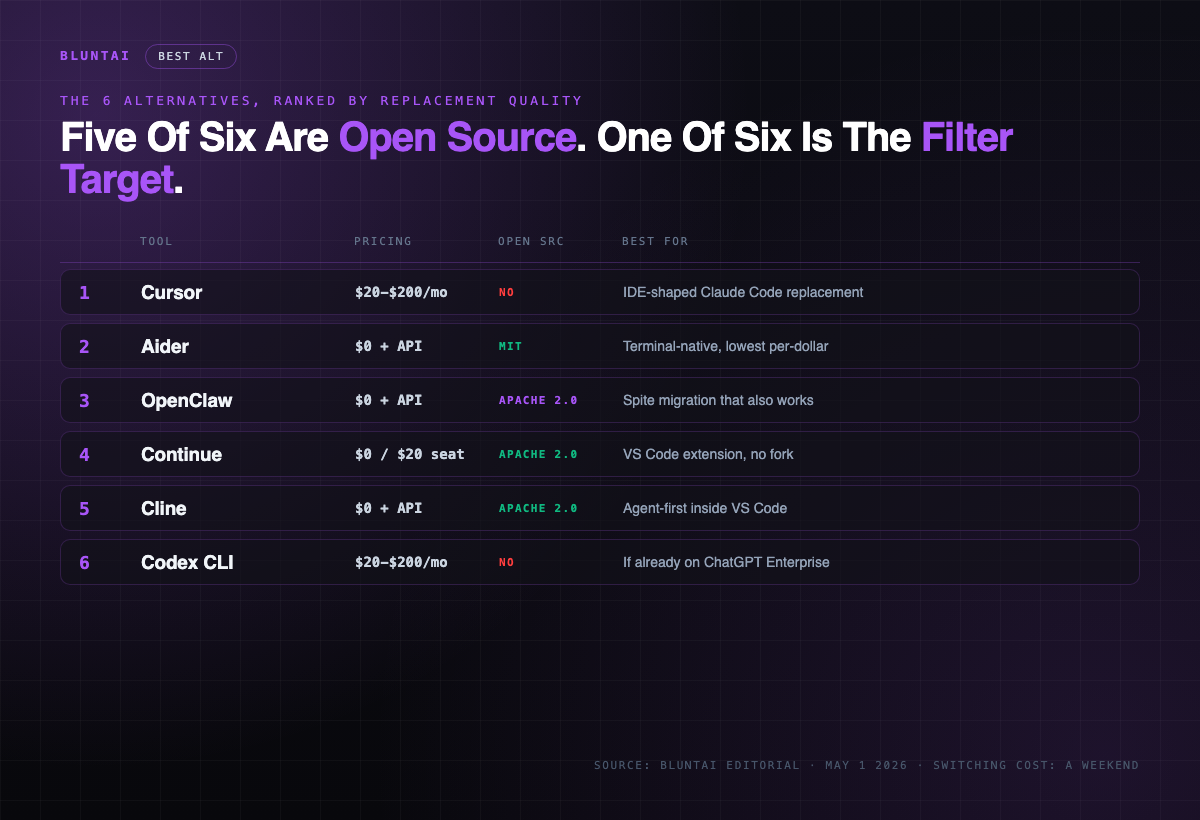
At-A-Glance Comparison
| # | Tool | Pricing | Open source | Multi-model | Best for |
|---|---|---|---|---|---|
| 1 | Cursor | $20-$200/mo | No | Yes | IDE-shaped Claude Code replacement |
| 2 | Aider | $0 + API | MIT | Yes | Terminal-native, lowest per-dollar |
| 3 | OpenClaw | $0 + API | Apache 2.0 | Yes | Spite migration that also works |
| 4 | Continue | $0 / $20/seat | Apache 2.0 | Yes | VS Code extension, no fork |
| 5 | Cline | $0 + API | Apache 2.0 | Yes | Agent-first inside VS Code |
| 6 | Codex CLI | $20-$200/mo | No | OpenAI only | Already on ChatGPT Enterprise |
How To Pick
You’re already on VS Code and want minimal disruption: Continue. Install extension, point at Claude API, done. Same editor, no fork.
You’re already on Claude Code and want maximum overlap: Cursor. Same general “agent-driven IDE” shape, no commit filtering.
You want the cheapest path that still works: Aider. $0/mo software, you only pay for the tokens you actually use. Excellent for solo devs and small teams.
You want to actively help OpenClaw exist (and use the tool that triggered this whole article): OpenClaw. Their week of free PR has resulted in the largest spike of new contributors in the project’s history.
You want the most aggressive autonomous agent loop: Cline. Closest in spirit to “let the agent run.”
You’re already in the OpenAI enterprise contract: Codex CLI. The procurement decision was already made for you.
The Switching Cost Is Less Than You Think
The realistic cost of leaving Claude Code in 2026:
- Configuration migration: ~30 min. Most of these tools accept the same
CLAUDE.md-style instruction file. Aider and Cline read existing Claude Code memory files directly. - Model swap: trivial. All five non-OpenAI options on this list let you keep using Claude Sonnet/Opus as the model — just through a different harness. The model is still the model.
- Muscle memory: the painful part. About a week of “wait, the keyboard shortcut was different in Claude Code.” After that you forget Claude Code existed.
- Cost: if you bring your own API key, you save Anthropic’s per-seat margin. For a 5-person team, that’s roughly $1,000/year in difference between $200/mo Max × 5 vs API consumption at typical rates.
The Blunt Takeaway
Anthropic just demonstrated that they will ship anticompetitive code without disclosure when a competitor gets too close. Today the regex filtered “OpenClaw.” Tomorrow it could filter “Cursor” or “Aider” — they have the tooling, they have the willingness, and they have apparently no internal review process that flagged this one before it shipped.
The right response to a vendor that does this is not to wait for the next regex. It’s to be configured to leave. All six tools above accept Claude as a model backend, so leaving Claude Code does not have to mean leaving the Claude model. You can pay Anthropic for the brain and use a different harness for the hands. That’s a healthier dependency than trusting Anthropic’s product team not to do this again.
The migration is a weekend. The leverage you keep is permanent.
Rating: Five of six don’t filter your commits. One of six is the filter target.
Sources:
- BluntAI: Claude Code Refuses To Help With OpenClaw. The Block Is A Regex. (May 1, 2026)
- BluntAI: Best ChatGPT Alternatives in 2026: 6 AI Chatbots That Don’t Sell You Grubhub (April 30, 2026)
- Tool pages: Cursor · Aider · OpenClaw · Continue · Cline · Codex CLI
Disclaimer: BluntAI may earn affiliate commissions from links in this article. This never influences our reviews. We buy and test everything ourselves. Our opinions are brutally our own.