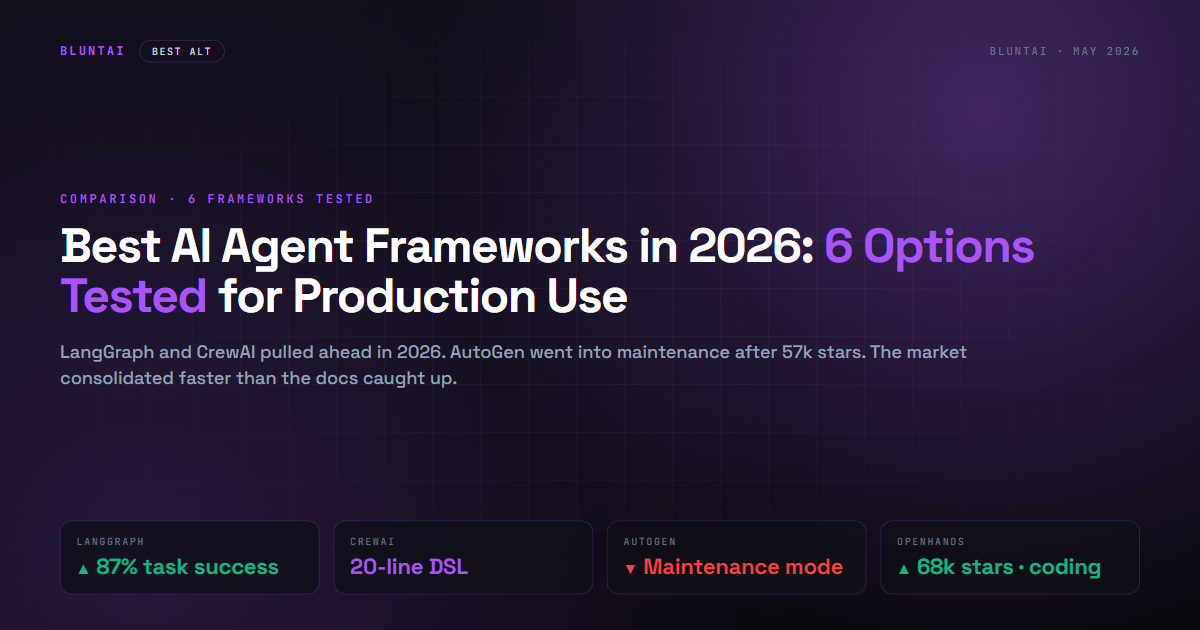
Best AI Agent Frameworks in 2026: 6 Options Tested for Production Use
If you’re building an AI agent in May 2026, the framework decision is also a bet on which ecosystem still ships in 2027. Microsoft put AutoGen into maintenance mode in late 2025. LangChain pivoted hard around LangGraph, sunsetted half the legacy primitives, and rewrote the docs three times. Google released ADK with the A2A protocol. CrewAI signed enterprise deals with Docusign, Genpact, and Havas. The list of “frameworks worth installing” is shorter than it was last year, but the survivors are dramatically more capable.
We tested six of the most-used agent frameworks across production-readiness, learning curve, multi-agent coordination, observability, and ecosystem health. Here is the short list — and a few warnings about which one you should skip.
The 6 frameworks, ranked
1. LangGraph — the production-grade default
What it is: LangChain’s stateful agent runtime. Models agent workflows as state machines: nodes (functions), edges (transitions), and a typed state schema that flows through the graph. Built for production with checkpointing, streaming, time-travel debugging, and tight integration with LangSmith for observability.
Pricing: Open source (MIT license). Optional LangSmith for hosted observability and tracing — free tier with 5K traces/month, paid tiers from $39/user/month. Optional LangGraph Platform for managed deployment.
Where it wins: Highest production readiness in the category. State management, retries, checkpointing, and resume-from-failure are first-class. The graph paradigm scales to genuinely complex workflows (multi-step research, document QA pipelines, customer support escalations) without the spaghetti you get when you try to bolt branching onto a “chain.” LangSmith observability is the best in the field — you see every model call, every tool invocation, every state transition.
Where it loses: Learning curve. You need to learn what a graph is, what a state schema is, and how reducers work. The official tutorial is long for a reason. Documentation has been rewritten three times in 18 months — older Stack Overflow answers are routinely wrong. The LangChain orbit is opinionated, and if you fight the abstractions you’ll have a bad time.
Our take: For anything that needs to actually ship, LangGraph is the default. The benchmarks (87% task success rate in independent tests) match the operational story. If you’re building an agent that real customers will hit, this is the framework you’ll wish you started with.
Rating: Shut up and buy it.
2. CrewAI — the role-based fast lane
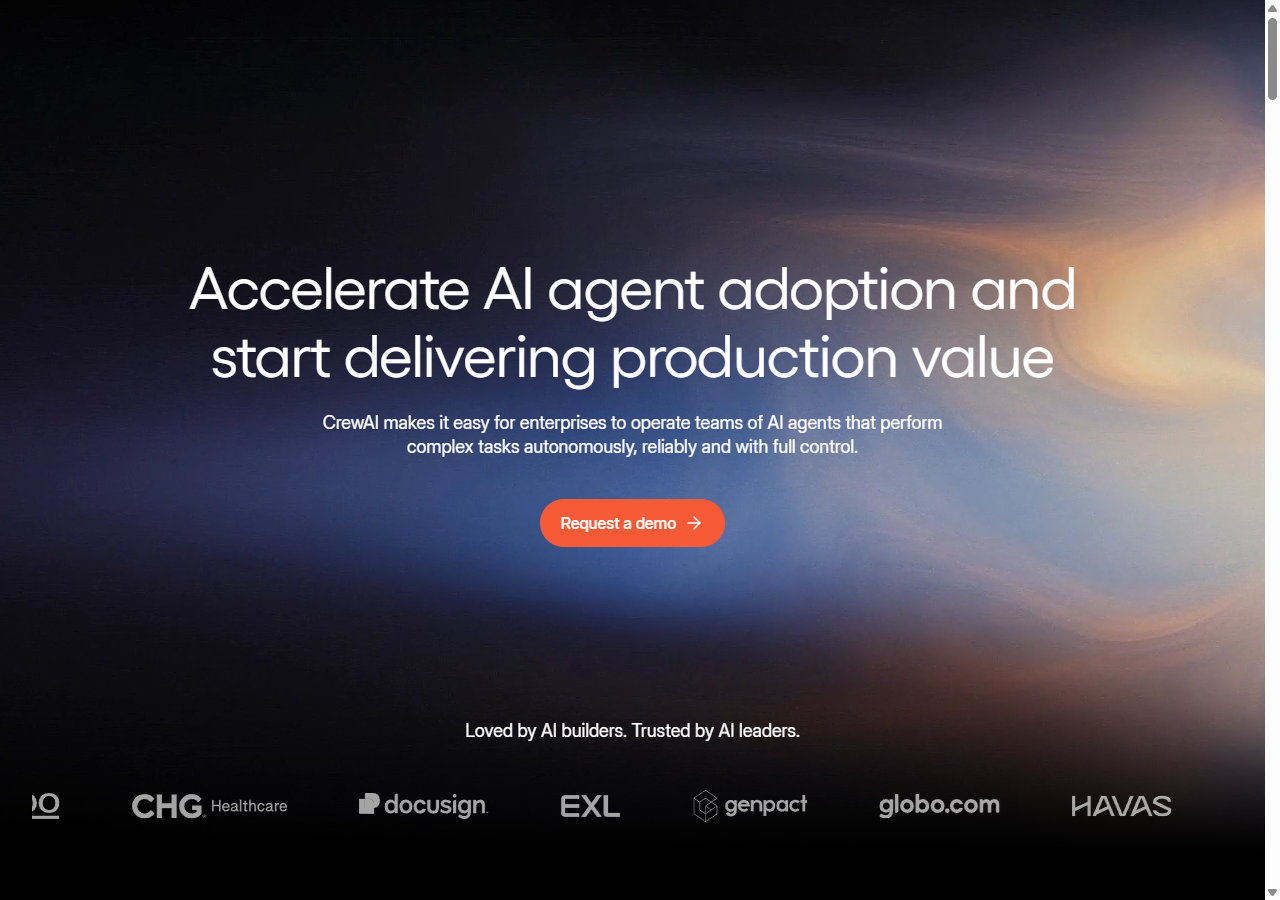
What it is: A multi-agent framework where you define “crews” — teams of agents with named roles (researcher, writer, editor, etc.) that collaborate through a structured process. The DSL is dramatically simpler than LangGraph: 20 lines gets you a working multi-agent crew.
Pricing: Open source core (MIT). CrewAI Enterprise for production deployments with observability, compliance, and SLA — pricing on request, typically $30K-100K/year for mid-size teams.
Where it wins: Lowest barrier to entry of any production framework. The role-based abstraction maps naturally to how teams actually work — you describe what each agent’s job is, give them tools, and CrewAI handles coordination. 1.8s average latency in benchmarks (faster than most). Enterprise customer logos (Docusign, Genpact, Havas, CHG Healthcare) signal real production use, not just GitHub stars. Native support for the A2A (Agent-to-Agent) protocol means CrewAI agents can talk to agents from other frameworks.
Where it loses: Less flexible than LangGraph for non-team-shaped workflows. If your agent is a single autonomous loop (rather than a coordinated crew), CrewAI is overkill — you’d use a simpler framework or write the loop yourself. Observability is decent but not LangSmith-grade.
Our take: CrewAI is the right pick when you’re modeling a workflow that genuinely is a team — research → draft → review → publish, or sales triage → enrich → score → route. The DSL keeps you out of state-machine hell, and the enterprise customer list is the credibility signal that matters.
Rating: Shut up and buy it (for team-shaped workflows).
3. Google ADK — the Vertex AI native option
What it is: Google’s Agent Development Kit, released April 2025 and steadily improved through 2026. Hierarchical agent tree where a root agent delegates to sub-agents. Tight integration with Vertex AI, Gemini models, and Google Cloud services. Native support for the A2A protocol.
Pricing: Open source (Apache 2.0). Cloud costs flow through Vertex AI / GCP — no separate framework fee.
Where it wins: If you’re already on Google Cloud, ADK is the path of least resistance. Gemini 2.5 Pro at $1.25/$10 per million tokens is the cheapest production-tier model with reasoning, and ADK feeds it natively. The hierarchical agent tree maps cleanly to delegation patterns. A2A interop means you can mix ADK agents with CrewAI or LangGraph agents in the same pipeline.
Where it loses: If you’re not on GCP already, the integration story turns into “wire up service accounts, IAM roles, and Vertex endpoints just to start.” Documentation is GCP-pilled — examples assume you have a project, region, and billing account. The community is smaller than LangChain’s by an order of magnitude.
Our take: ADK is great if Google Cloud is already your home base. If not, the friction outweighs the benefit. The bet here is on the A2A protocol becoming the standard for agent interop — which it might, given Google’s leverage.
Rating: Solid, no drama (on GCP). Meh (off GCP).
4. Microsoft AutoGen — the legacy heavyweight in maintenance
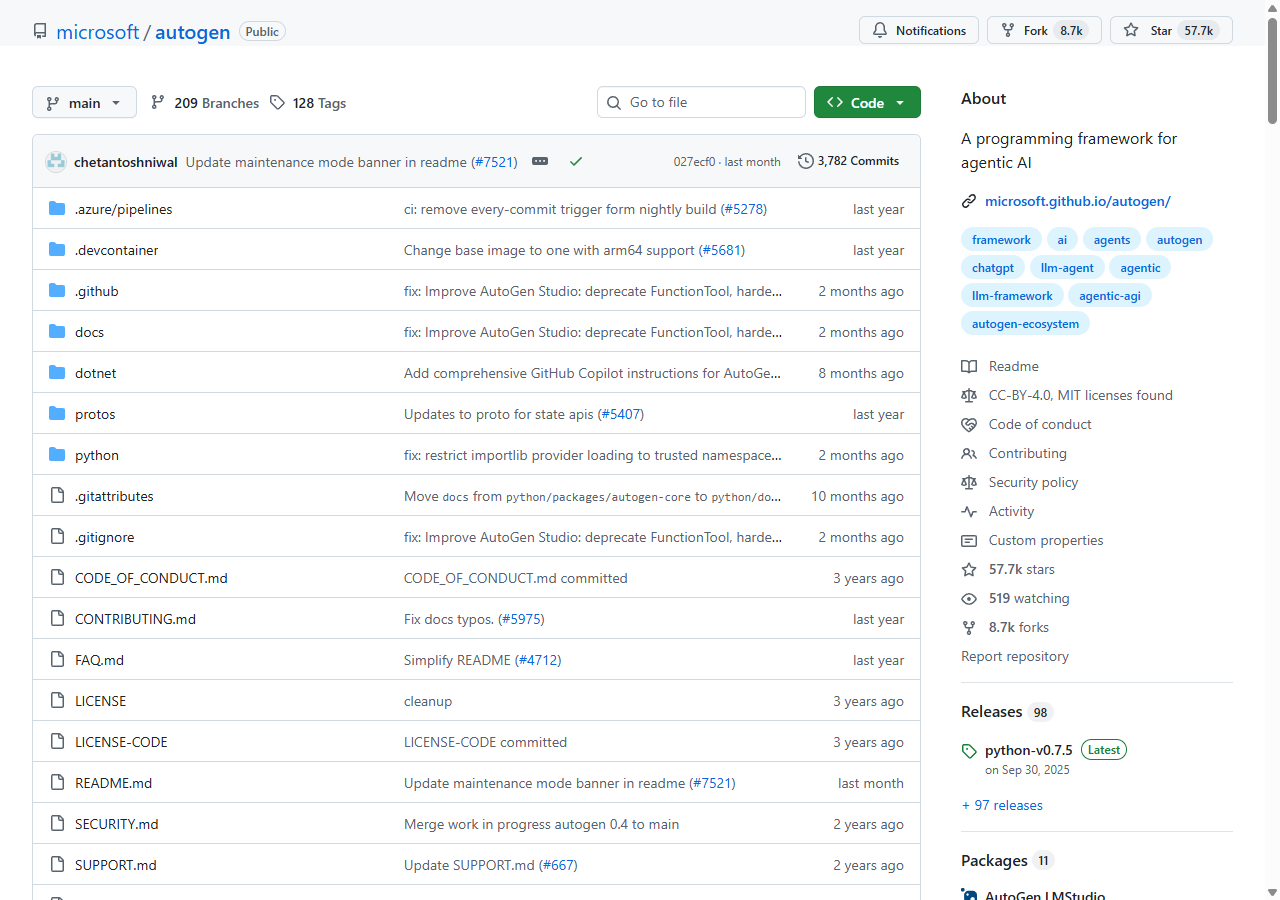
What it is: Microsoft’s multi-agent conversation framework. The original sin and original strength of AutoGen is the GroupChat pattern — multiple agents debate, vote, build consensus, then act. Released 2023, hit 57.7k GitHub stars, used as the reference implementation in dozens of academic papers.
Pricing: Open source (MIT, with some CC-BY-4.0 docs).
Where it wins: Multi-party conversations. If your use case is “have three agents debate the right answer before committing,” AutoGen has the most diverse conversation patterns of any framework — round-robin, selector-based, hierarchical, group-chat. Microsoft Research backing means the academic papers behind the patterns are public and rigorous.
Where it loses: Maintenance mode. Last release (python-v0.7.5) is from September 30, 2025 — over seven months stale at time of writing. The README banner explicitly notes the maintenance status. Microsoft’s energy moved to AG2 (a community fork) and to integrating agent patterns directly into Azure AI Foundry. AutoGen still works, but the future of the codebase is uncertain.
Our take: If you’re already on AutoGen and shipping, don’t panic — the code still runs. For new projects, the maintenance status alone is a reason to start somewhere else. The conversation patterns AutoGen pioneered are now available in LangGraph (subgraph composition) and CrewAI (manager processes) without the abandonment risk.
Rating: Meh (legacy use). Save your money (new projects).
5. OpenHands — the autonomous coding specialist
What it is: An open-source autonomous AI software engineer (formerly OpenDevin). 68,000 GitHub stars, MIT license. Runs as a containerized agent in a sandbox where it can read, write, and execute code. Closer to “fire and forget” than any general-purpose framework.
Pricing: $0 + your model API costs (Anthropic, OpenAI, OpenRouter, local Ollama). Self-host the runtime via Docker.
Where it wins: Highest autonomy of any framework in this list. Designed specifically for software engineering tasks — describe a feature, walk away, come back to a PR. The sandboxed runtime is a real safety win compared to letting an agent run shell commands directly on your machine. Active community (251+ contributors, releases every 2-3 weeks).
Where it loses: Single-purpose. OpenHands is for coding. If your agent needs to do customer support, summarize emails, or run sales workflows, OpenHands is the wrong shape. Setup is heavier than the others (Docker, runtime config, model selection). Cost discipline is on you — autonomous loops with no token cap can run up bills.
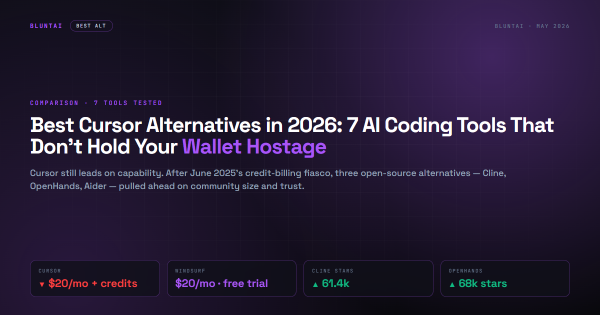
Our take: If your agent’s job is to write code, OpenHands is more capable than any general-purpose framework configured for the same task. We covered this in detail in our Cursor alternatives roundup — OpenHands made the list there too. For non-coding agents, you’re on LangGraph or CrewAI.
Rating: Solid, no drama (for coding agents).
6. OpenAI Swarm / Agents SDK — the lightweight option from the model maker
What it is: OpenAI’s lightweight agent orchestration. Swarm was the experimental release; the production version landed in 2025 as the OpenAI Agents SDK. Tightly coupled to OpenAI’s API — handoffs between agents work natively, function calling is first-class, and the streaming UX is excellent if your stack is GPT-only.
Pricing: Open source SDK. You pay OpenAI for model usage at standard API rates.
Where it wins: Minimal abstraction. If you’ve already accepted that you’ll run on OpenAI models forever, the Agents SDK is the cleanest way to wire up multi-agent handoffs without learning a graph framework. Streaming and function calling are battle-tested. The handoff primitive is genuinely elegant.
Where it loses: Vendor lock-in. The Agents SDK assumes OpenAI’s tool-calling format, OpenAI’s pricing, OpenAI’s evals. Swapping to Claude or Gemini means rewriting most of the orchestration. Not a great bet given how much pricing volatility we’ve seen from OpenAI’s competitors and from Anthropic’s own changes in 2026.
Our take: If you’re committed to OpenAI and you don’t want to learn LangGraph, the Agents SDK is fine. For everyone else, you’re trading lock-in for surface-area savings, and that’s not a great trade in 2026.
Rating: Meh (unless you’re OpenAI-only).
At-a-glance comparison
| Best at | Learning curve | License | Production-ready | Status | |
|---|---|---|---|---|---|
| LangGraph | Stateful workflows | High | MIT | Yes | Active |
| CrewAI | Team workflows | Low | MIT | Yes | Active |
| Google ADK | GCP-native delegation | Medium | Apache 2.0 | Yes (on GCP) | Active |
| AutoGen | Multi-party conversations | Medium | MIT | Was, now risky | Maintenance |
| OpenHands | Autonomous coding | Medium | MIT | Yes (coding only) | Active |
| OpenAI Agents SDK | OpenAI-native handoffs | Low | MIT | Yes (lock-in) | Active |
How to pick
You’re shipping a production agent that real customers will hit. LangGraph. State management, observability, and resume-from-failure are non-negotiable for production, and LangGraph has all three.
You’re modeling a workflow that’s actually a team. CrewAI. The role-based DSL is the right abstraction, and the enterprise customer list is the credibility.
You live on Google Cloud. Google ADK. Native Vertex/Gemini integration plus A2A protocol bet.
Your agent’s job is to write code autonomously. OpenHands. Sandboxed runtime + dedicated coding focus beats any general framework.
You’re committed to OpenAI and want minimum framework overhead. OpenAI Agents SDK. Accept the lock-in, get clean handoffs.
You inherited an AutoGen codebase. Keep it for now, plan migration to LangGraph or CrewAI within 12 months. The maintenance status will become a liability.
The Blunt takeaway
The agent framework market consolidated around two players in 2026: LangGraph for production stateful systems, CrewAI for team-shaped workflows. Everything else is either a specialist (OpenHands for coding, ADK for GCP) or a legacy choice (AutoGen) or a vendor-lock bet (OpenAI Agents SDK).
The most expensive framework decision is picking one in maintenance mode and discovering 18 months later that the security patches stopped, the docs went stale, and the community moved on. AutoGen is the cautionary tale of 2026 — 57k GitHub stars and a Microsoft brand didn’t save it from the slow drift toward irrelevance.
If you’re starting today, start with LangGraph. If you outgrow the abstraction or your workflow is genuinely team-shaped, switch to CrewAI. Skip the rest unless your specific use case demands them.
Related on BluntAI
- Best Cursor alternatives in 2026
- Best AI image generators in 2026
- Why Anthropic broke trust with developers
All opinions expressed on BluntAI are editorial opinions based on publicly available information and personal testing. Pricing and status data current as of May 2026. We may earn affiliate commissions from links on this site.
Disclaimer: BluntAI may earn affiliate commissions from links in this article. This never influences our reviews. We buy and test everything ourselves. Our opinions are brutally our own.