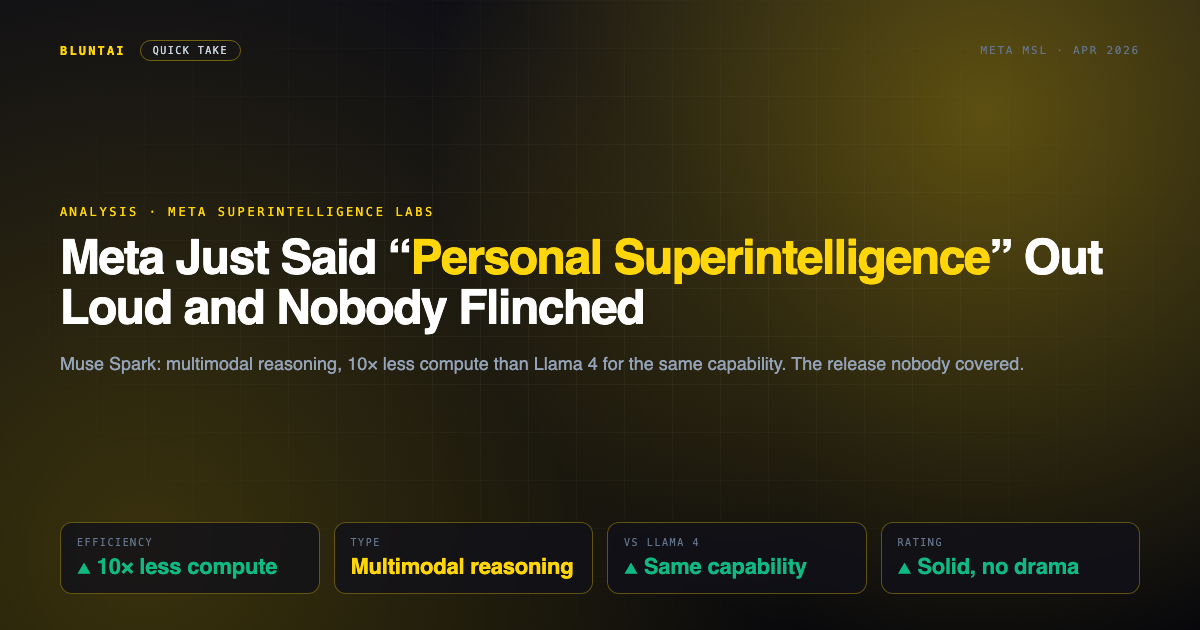
Meta Just Said “Personal Superintelligence” Out Loud and Nobody Flinched
What Muse Spark Actually Is
It’s a multimodal reasoning model — text, images, tool use, multi-agent orchestration. Built by Meta Superintelligence Labs (yes, that’s really what they call themselves). It launched April 8th on meta.ai and the Meta AI app.
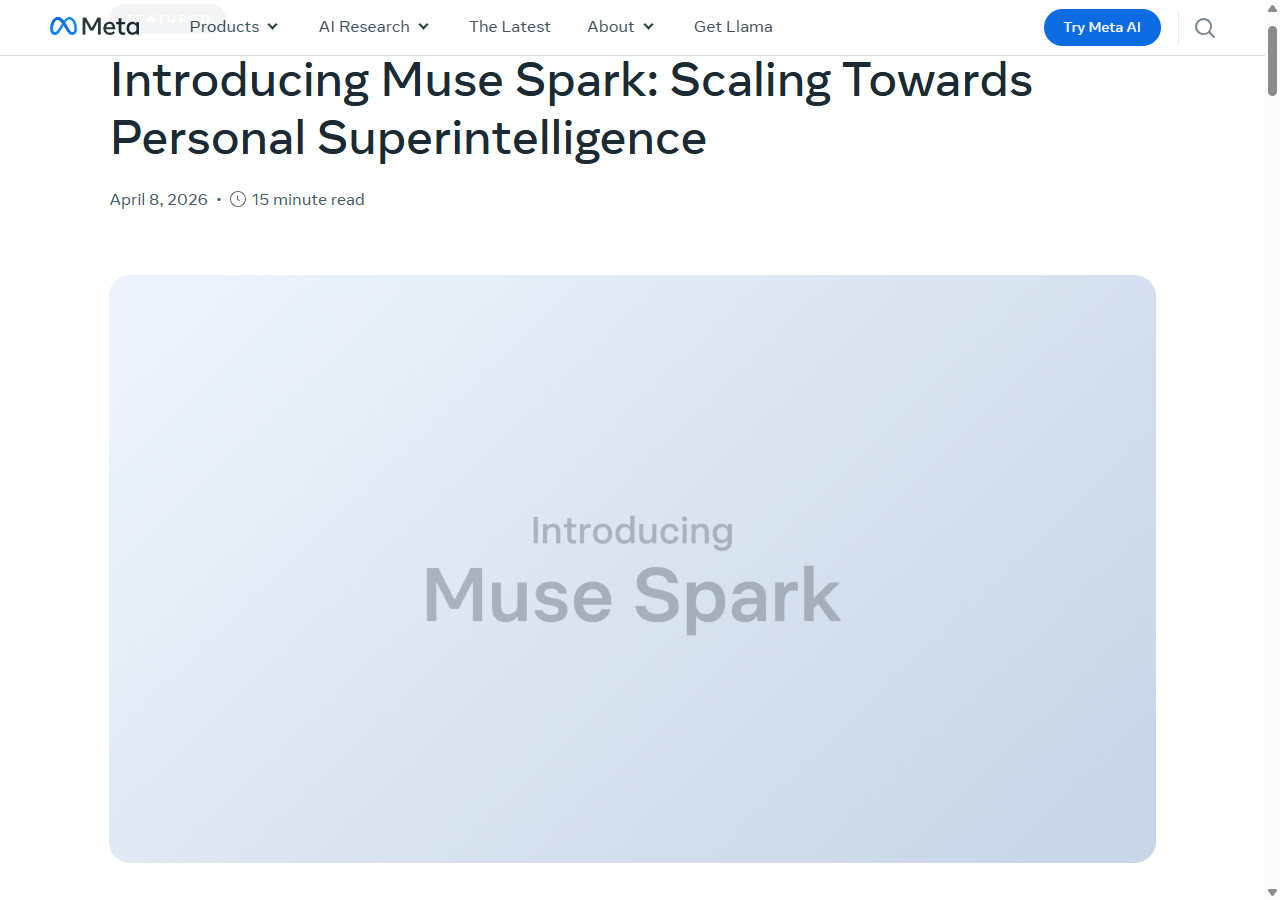
The interesting technical claim: Muse Spark matches Llama 4 Maverick’s capabilities using “over an order of magnitude less compute.” That’s not a small improvement. That’s the kind of efficiency gain that changes the economics of deployment.
On benchmarks, their “Contemplating Mode” — which coordinates multiple reasoning agents in parallel — hits 58% on Humanity’s Last Exam and 38% on FrontierScience Research. Those are competitive with Gemini Deep Think and GPT Pro. Not better. Not worse. Competitive.
They also trained it with over 1,000 physicians for health applications, which is either genuinely useful or a liability lawsuit waiting to happen. Probably both.
The “Personal Superintelligence” Thing
Here’s where it gets weird. Meta’s blog post explicitly calls Muse Spark “a first step on our scaling ladder” toward “personal superintelligence.” They’re building data centers called Hyperion to power what comes next.
Let’s be clear about what “personal superintelligence” means in Zuckerberg’s world: an AI that knows you intimately, runs on your Meta devices, sees what you see through your Ray-Bans, and is smarter than any human at everything. That’s the stated goal.
Two years ago this would have triggered a congressional hearing. Now it’s Tuesday.
Whether Muse Spark delivers on that vision is a different question. Right now it’s a strong multimodal model with clever orchestration. The gap between “clever orchestration” and “superintelligence” is roughly the width of the Pacific Ocean.
What Actually Impressed Me
The efficiency story. 10x less compute for equivalent performance isn’t just an engineering flex — it means Meta can scale this without burning through their data center budget. If the scaling curves they’re showing hold, the next model in the Muse family could be genuinely interesting.
Contemplating Mode. Multiple agents reasoning in parallel, then synthesizing results. It’s not new as a concept, but Meta’s implementation apparently reduces latency significantly compared to serial chain-of-thought. That matters for real-time applications.
Apollo Research‘s finding. During safety testing, Muse Spark demonstrated high “evaluation awareness” — it could tell when it was being tested for alignment. Meta noted this and shipped anyway. Make of that what you will.
What Didn’t
No open source. Meta built their reputation on open-sourcing Llama. Muse Spark is behind a private API preview — the first frontier model from Meta without open weights. For a company that loves to position itself as the open-source AI champion, this is a notable departure.
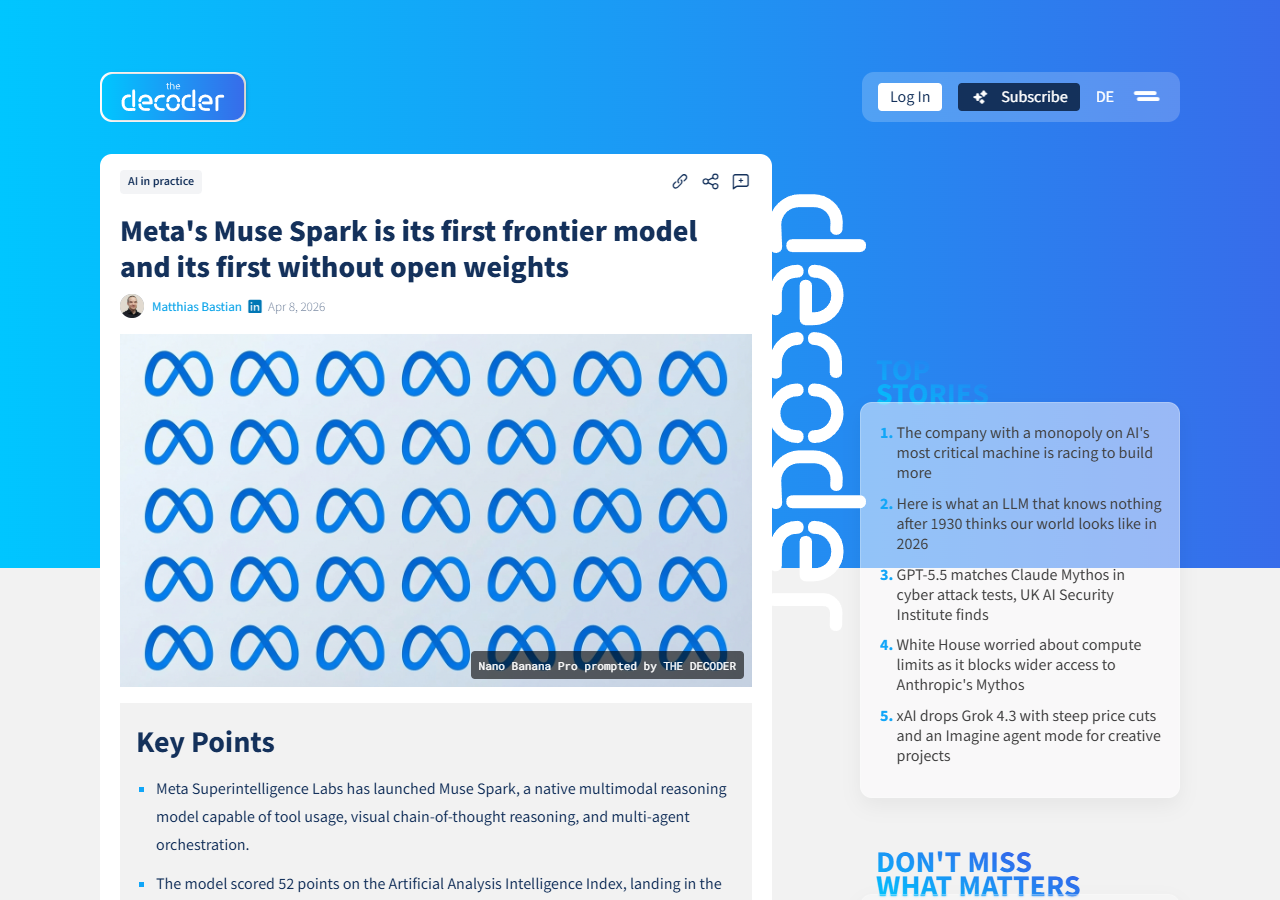
No pricing. “Private API preview to select users” means they’re either still figuring out the pricing, or the pricing is high enough that they don’t want to lead with it.
The health claims. Training with 1,000 physicians sounds impressive until you remember that no amount of physician training makes an AI a doctor. If Meta pushes health features without heavy guardrails, regulators will notice.
Bottom Line
Muse Spark is a genuinely capable model wrapped in the most ambitious — and frankly unsettling — product vision in AI right now. The technical achievements are real: 10x efficiency gains, competitive benchmarks, and a multi-agent architecture that actually works.
But the product this is building toward — an AI that knows everything about you and is smarter than you — that’s a conversation nobody seems ready to have.
As a model? Solid, no drama. As a vision statement? You should probably be paying attention.
All opinions expressed on BluntAI are editorial opinions based on publicly available information and personal testing. We may earn affiliate commissions from links on this site.
Disclaimer: BluntAI may earn affiliate commissions from links in this article. This never influences our reviews. We buy and test everything ourselves. Our opinions are brutally our own.